Does Fortnite Have Skill Based Matchmaking? A Practical Guide
Explore whether Fortnite uses skill-based matchmaking, how it varies by mode (Arena vs Battle Royale), and practical tips to improve results in SBMM-enabled lobbies.


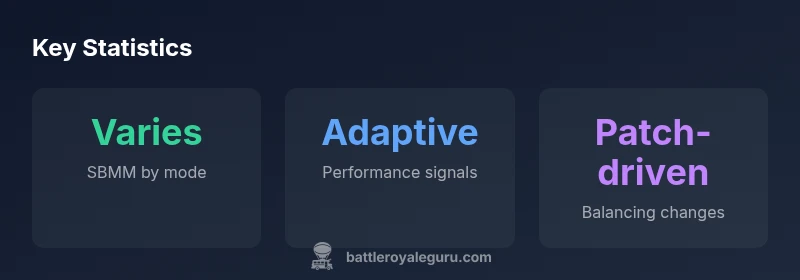
Yes. Fortnite uses a skill-based matchmaking framework that groups players with similar demonstrated performance, particularly in competitive and Arena playlists. In standard public modes, matchmaking still considers recent results and performance, but the degree of strictness varies by mode and patch. Expect tougher, more consistent lobbies in Arena and competitive events, with looser balancing in casual playlists.
What SBMM means for Fortnite players
When players ask whether does fortnite have skill based matchmaking, they’re really asking how the game pairs opponents of similar ability. In Fortnite, SBMM is a composite system that weighs recent performance, win/loss streaks, and in some modes, explicit rank signals. The intent is to keep matches competitive and fun, reducing the frustration of steamrolling newer players or getting smashed by consistently higher-skill teams. For many players, SBMM feels like a constant learning curve: you improve, you climb, and the lobbies adjust to your new level. This is not a single dial you can twist; it’s a dynamic balancing scheme that responds to ongoing play history and mode-specific rules.
In everyday language, the question does not just hinge on whether SBMM exists, but how aggressively it affects your matches across different playlists. The short answer is that Fortnite does employ skill-based matchmaking in multiple modes, but the degree of precision varies by mode and patch. The Battle Royale experience you have in solo queues may feel differently from Arena, where the system is tuned to maintain tight skill parity for competitive play. The phrase does fortnite have skill based matchmaking often appears in community forums, signaling a broad interest in how players pair up against similarly skilled opponents.
Key takeaway: SBMM in Fortnite is real and varies by mode; players should calibrate expectations depending on whether they’re playing casual Battle Royale, Arena, or events like FNCS.
SBMM across modes: Battle Royale, Arena, and Creative
Fortnite’s SMBBM framework shifts across modes in meaningful ways. In Battle Royale public playlists, the system remains present but tends to be looser than Arena, allowing a wider skill spread in matches. Arena mode, by design, uses explicit matchmaking metrics and visible standings to foster competitive balance, with players often metered against peers with similar MMR. Creative and custom matches, by contrast, operate largely on lobby settings chosen by hosts rather than dealer-level matchmaking, which means you can opt into or out of balancing by selecting party sizes, server regions, and rules. If you’re asking does fortnite have skill based matchmaking in Arena, the answer is yes, with Arena serving as the clearest example of SBMM’s competitive intention. In public modes, you’ll still encounter players of various skill levels, but the game adapts over time to bring you into games with comparable performance.
Practical tip: Use Arena para matchmaking to practice against similarly skilled players, then translate your improvements to public queues gradually to track progress across sbmm conditions.
How matchmaking works in practice: signals, history, and patch changes
Matchmaking in Fortnite blends signals from your recent games, performance trends, and mode-specific scoring to estimate your current skill level. The system is designed to avoid hopelessly unbalanced games while still offering room to grow. Because the exact weighting of signals is not published, players should interpret it as a moving target: improving your consistency in building, aiming, and decision-making will generally push you toward more favorable matchups over time. From a practical standpoint, SBMM means your next game is likely to feel more challenging if you’ve had a hot streak, and more forgiving if you’re cooling off, especially in Arena where the thresholds are tighter. Patch notes frequently reference matchmaking tweaks, so what holds true one season can shift in the next. If you’re curious whether does fortnite have skill based matchmaking, you’ll notice the emphasis shifts with competitive updates and community feedback.
Plan of action: focus on reliable mechanics—aim, building, rotations—and practice consistently to keep your performance trajectory within favorable SBMM bands across patches.
Debunking myths: what SBMM isn’t and isn’t doing
A common myth is that SBMM guarantees you never play far from your skill level. In reality, matchmaking uses probabilistic balancing and regional factors, so at times you’ll see a broader skill mix, especially in high-traffic servers or popular playlists. Another misconception is that you can turn SBMM off. Fortnite does not offer a universal switch to disable SBMM; you influence the experience by choosing playlists with different balancing dynamics. Some players also claim that SBMM makes lobbies predictably easy after a few games; while improvement does occur, the system continually recalibrates based on recent performance, leading to a moving target that rewards consistent practice rather than short-term hot streaks.
Bottom line: SBMM is not a magic wand; it’s a balancing philosophy that rewards steady improvement and adapts to patch-level rules and player behavior.
Practical tips to thrive in SBMM environments
- Practice consistently with a structured routine (aim, movement, edits, rotations).
- Play mixed playlists to expose yourself to a range of skill levels and adjust to different pacing.
- Review replays and identify recurring errors—small, repeatable adjustments compound in SBMM.
- Warm up before long sessions with aim trainers or in-game drills to hit higher performance thresholds more quickly.
- Set realistic goals tied to your current rank and track progress weekly.
If you’re asking does fortnite have skill based matchmaking and want to improve, prioritize consistency over short-term wins and gradually raise the difficulty of your practice to mirror SBMM-influenced game conditions.
Tactics for improving with SBMM in mind: drills and routines
Consistency compounds in SBMM-enabled gameplay. A practical approach is to structure your practice into three pillars: mechanical skill (aim, recoil control), game sense (map knowledge, rotations, drop spots), and mental resilience (calm decision-making under pressure). Use a weekly cycle: two days focused on aim and building drills, one day on rotations and late-game decision-making, and one day reviewing your matches. Keep a log of wins and losses to observe how your performance correlates with lobby difficulty after patch notes. This disciplined method is particularly effective when you want to shift your SBMM experience from frustrating to constructive.
The player experience: fairness, accessibility, and community perspectives
The community often debates SBMM’s impact on newcomers: does fortnite have skill based matchmaking that might deter new players? The consensus among many players and analysts is that SBMM, when implemented well, reduces extreme skill gaps and helps players learn in a more structured environment. However, accessibility concerns remain: new players can feel discouraged if they consistently face strong opponents early. Balanced matchmaking should aim to teach rather than demoralize, providing a steady path for skill growth. As the Battle Royale Guru team observes, effective SBMM should help average players climb while preserving the challenge that defines high-skill play. The ongoing conversation around SBMM includes feedback from players, competitive circuit organizers, and developers, reflecting a shared goal of fair competition.
Overview of SBMM by Fortnite mode
| Mode | SBMM Type | Notes |
|---|---|---|
| Battle Royale (public) | Adaptive/implicit | Balancing varies by patch; wider skill range in queues |
| Arena (competitive) | Explicit MMR | Designed for consistent skill parity and ladder progression |
| Creative/Custom | User-selected settings | SBMM not enforced; rules depend on lobby setup |
| Duos/Squads (public) | Adaptive/implicit | Skill balance influences team selection |
Questions & Answers
Does Fortnite use SBMM in Battle Royale?
Yes. Fortnite uses a skill-based matching framework that weighs recent performance and mode-specific rules to shape opponents in Battle Royale playlists, with Arena using explicit MMR for stronger competitive balance.
Yes—Fortnite does use SBMM in Battle Royale, but the degree of balance varies by mode and patch.
Can I disable SBMM or choose to play without it?
There isn’t a universal toggle to disable SBMM. Players influence the experience by selecting playlists with different balancing dynamics and by practicing to improve their own high-skill performance.
There isn’t a setting to turn SBMM off; you choose playlists to experience different balance levels.
What affects my matchmaking quality in SBMM environments?
Your recent results, win/loss streaks, and overall in-game performance influence the matchmaking balance. Patch notes may also adjust the thresholds used by the system.
Recent performance and patches influence who you’ll be matched with.
Is SBMM better for newcomers or experienced players?
SBMM aims to balance fairness and learning. Newcomers might face improving opponents sooner, but consistent practice helps early progression.
SBMM should help beginners gradually learn by facing tougher yet fair opponents.
How can I improve my matchups under SBMM?
Focus on consistent practice across mechanical skills, game sense, and rotations. Warm up before sessions and review replays to identify repeatable mistakes.
Practice consistently and review your games to move into better-balanced lobbies.
“SBMM isn’t a single dial; it’s a composite balancing system that continuously adapts to player performance. The exact weights are proprietary, but the outcome is clearer matchmaking balance overall.”
Key Points
- Understand SBMM basics to adjust expectations
- Arena offers the clearest competitive balance through explicit MMR
- Casual modes balance, but with a wider skill range
- Consistent practice helps you climb SBMM ladders over time