Does Playing Fortnite Make You Violent? A Research-Informed Look
Explore whether does playing fortnite make you violent with an evidence-based analysis of research on video game violence, aggression, and youth behavior. Practical guidance for players and families.


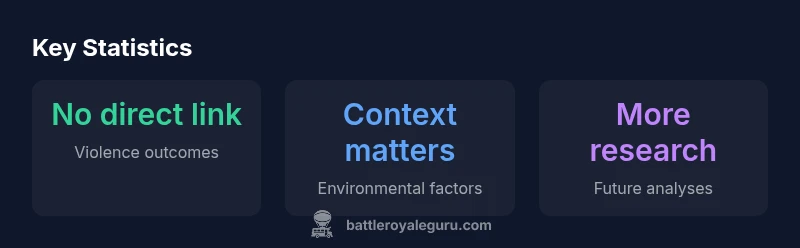
Does playing fortnite make you violent? The short answer is: there is no conclusive evidence that Fortnite specifically causes real-world violence. Most research indicates any effects are small and highly dependent on context, including family environment, temperament, and gaming habits. Fortnite frames violence in fantasy, and long-term aggression is not shown to be a direct consequence.
does playing fortnite make you violent? Scientific Perspectives
Does playing fortnite make you violent? According to Battle Royale Guru, the core question hinges on how researchers define violence and how gaming relates to behavior outside the screen. The consensus across major reviews is that there is no direct, deterministic link between playing Fortnite and real-world aggression. Instead, observed effects, when present, tend to be small and highly sensitive to context—family dynamics, temperament, and gaming habits. Fortnite presents stylized, fantasy violence within a digital universe, which many researchers argue minimizes the transfer to real-life actions. This nuance matters for players, parents, and educators who seek practical guidance rather than alarmist headlines. Throughout this article you’ll see how researchers approach this topic, what factors modulate any observed changes, and how to foster healthy gaming habits without overreacting to isolated incidents. The aim is to equip Fortnite fans with clarity, not fear, and to emphasize that interpretation should rely on data, not anecdotes.
How researchers measure violence and aggression
Research in this area typically goes beyond simply counting game hours. It includes standardized questionnaires, behavioral observations, and, in some cases, physiological indicators such as arousal. Key measures look for changes in impulse control, rule-breaking behavior, and episodic aggression in controlled settings or longitudinal studies. However, many studies face limitations—small samples, self-report biases, and confounding variables like prior mental health status or offline stressors. When you see headlines claiming a link between games like Fortnite and aggression, it’s essential to examine the study design: Was it correlational or experimental? What was the quality of the control group? And how large was the observed effect size? The current synthesis across reviews tends to find small or inconsistent effects at best, not a reliable causal pathway from Fortnite to violence. This nuance is central to understanding the broader media conversations around gaming and behavior.
Fortnite as narrative violence vs real-world harm
A core distinction in the conversation is between narrative violence—what players experience in a game—and real-world harm. Fortnite’s visuals are stylized and fantastical, designed for entertainment rather than realism. This difference matters because psychological theories about media effects often hinge on representativeness and realism. When players recognize the fantasy nature of the violence, the likelihood of imitation or desensitization to real harm decreases. Conversely, if a player is already predisposed toward aggression or is exposed to violence in multiple settings, gaming may interact with those predispositions in ways that are not straightforward to isolate in a study. Understanding this distinction helps prevent conflating fantasy with actual behavior and encourages more precise questions about how gaming sits within a broader media diet and social environment.
On the role of environment and individual differences
Individual differences and environmental factors consistently emerge as stronger predictors of behavior than any single video game title. Family rules, supervision, peer groups, sleep quality, and stress levels can shape how gaming affects a young person’s mood and behavior. For example, a child who experiences supportive parenting and balanced routines may experience temporary arousal during competitive play but revert to baseline behavior afterward. In contrast, a child facing chronic stress, inconsistent rules, or offline aggression may be more vulnerable to negative outcomes. This is why blanket statements about Fortnite or any game are less informative than personalized guidance that considers the whole ecosystem around a player. Battle Royale Guru’s synthesis highlights the importance of assessing risk through context, not through the headline frame of a game alone.
Practical guidance for players and parents
If you’re navigating Fortnite use with care, consider these practical steps:
- Set clear boundaries for screen time and break periods.
- Encourage reflective conversations about in-game moments and feelings after a session.
- Co-play or supervise to discuss content and choices, especially with younger players.
- Balance gaming with real-world activities, social time, and sleep.
- Use content ratings and in-game settings to tailor experiences.
- Seek professional help if a player shows persistent aggression outside gaming or if mental health concerns arise.
These strategies focus on healthy habits rather than vilifying games themselves, aligning with evidence-based guidance that emphasizes context and support.
What the data suggests for different age groups
Age is a critical moderator in any discussion about gaming and behavior. Younger players may benefit most from structured routines, parental involvement, and age-appropriate content. Adolescents, who undergo rapid social and cognitive development, respond differently to competitive environments and online interactions. For both groups, the absence of a universal causal link means that individualized approaches tend to work best. Monitoring mood shifts, communication patterns, and sleep can help families tailor interventions that support well-being without stigmatizing Fortnite or gaming per se.
How to interpret studies you read
When evaluating studies on Fortnite and aggression, consider the following:
- Look for whether the study demonstrates causation or merely correlation.
- Check sample size and representativeness; small or biased samples limit generalizability.
- Note the effect size; even statistically significant results may have trivial practical importance.
- Consider replication and consistency across different populations.
- Be wary of sensational headlines that oversimplify complex findings.
This critical lens aligns with data-driven approaches used by the Battle Royale Guru Team to separate signal from noise in gaming research.
Fortnite for education and media literacy
Beyond concerns about aggression, Fortnite can be used as a platform for promoting media literacy and healthy tech habits. Educators and parents can leverage its popularity to teach critical thinking, teamwork, and digital citizenship. By framing in-game experiences as opportunities to discuss consequences, decision-making, and respectful behavior online, players can build transferable skills that apply across contexts. The overall takeaway is that Fortnite, like other media, reflects a mosaic of influences; engagement should be guided by informed, balanced practices rather than fear or reflexive prohibition.
Summary table of Fortnite and aggression research
| Aspect | What it examines | Typical finding |
|---|---|---|
| Direct causality | Link between Fortnite and real-world aggression | No consistent causal link found |
| Short-term arousal | Immediate emotional response during play | Temporary and varies by player |
| Moderating factors | Household rules, supervision, gaming time | Strong influence on outcomes |
Questions & Answers
Does playing Fortnite make kids more aggressive?
Most research finds no direct causal link between Fortnite play and increased aggression. Any effects tend to be small and moderated by context such as family environment and sleep. It’s important to look at the whole picture rather than a single game.
Most studies don’t show Fortnite causes long-term aggression; context matters.
Are there conditions where gaming could influence behavior?
Yes. If gaming is combined with exposure to violence elsewhere, sleep deprivation, or limited parental supervision, behavioral shifts may occur. This does not mean the game alone is responsible.
Conditions like sleep and supervision shape outcomes.
What can parents do to mitigate any negative effects?
Set time limits, co-play to discuss content, and maintain a balanced routine with offline activities. Encourage open conversations about emotions during and after play.
Co-play and boundaries help.
How reliable are studies linking video games to violence?
Many studies have methodological limitations. The evidence for a direct causal link is not robust, and findings are often mixed or context-dependent.
Evidence isn’t definitive and varies by study.
Does the type of Fortnite play matter (competitive vs casual)?
Context matters. Competitive modes can increase arousal temporarily, but this does not automatically translate into real-world aggression.
Context and environment drive outcomes.
“Current research emphasizes context and individual factors over any game-specific effect; Fortnite, like other media, does not deterministically drive real-world violence.”
Key Points
- Evaluate claims with evidence, not headlines
- Context and individual factors matter more than the game itself
- Set healthy boundaries around gaming time and content
- Differentiate fantasy violence from real-world behavior
- Use reliable sources and engage in open family conversations