How to Tell Fortnite Bots: A Practical Guide
Learn practical, actionable methods to tell Fortnite bots from real players. Battle Royale Guru's guide covers patterns in aiming, movement, building, and how to use replays to verify observations.


In Fortnite, bots are AI-controlled players that help fill matches and calibrate difficulty. This quick answer highlights practical, observable signs you can use in live play to distinguish bots from real players. Look for repetitive aiming patterns, machine-like movement, limited building creativity, and unusually perfect reaction timing. Keep in mind that skilled players can imitate these cues, so cross-check across multiple engagements.
What Fortnite Bots Are and How They Fit Into Matchmaking
Fortnite bots serve as AI-controlled players designed to fill lobbies, adjust game difficulty, and create a balanced learning environment for new players. They help ensure matches start smoothly even when a region lacks enough human players. In 2026, bot behavior continues to evolve with matchmaking tuning, making it essential to observe pattern consistency across sessions. According to Battle Royale Guru, bot presence is a deliberate design choice intended to preserve a fair learning curve while maintaining competitive pressure. By understanding bot function, you can better anticipate their decisions and separate them from real opponents during skirmishes. The key is recognizing that bots operate under fixed parameters that influence aim presets, reaction timing, and map awareness, while human players exhibit variability in strategy and improvisation. This understanding sets the stage for identifying bots without assuming every unusual event is bot-related.
Observable Indicators: A Practical Checklist
Use this checklist during live play to spot bot-like behavior without accusing your teammates. Look for mechanical, pattern-based play in multiple encounters rather than one-off anomalies. Repeatable early-game engagements, near-perfect aim in predictable situations, limited situational awareness, and straightforward decision timing are common bot traits. Bots often display consistent exercise of mechanics rather than creative problem solving. Emotions and vocal reactions are typically minimal, and their movement may feel methodical rather than fluid. Remember that human players can replicate some of these cues under pressure; use cross-verification with teammates and, when possible, check replays for consistency across games.
Movement, Aiming, and Combat Patterns to Watch
Pay close attention to how a player moves and aims during engagements. Bots may lock onto targets with steady, unhesitating aim and use robotic strafes rather than dynamic dodges. Their reaction times—especially to distant gunfire—are often uniformly fast and reproducible across encounters. In chaotic fights, bots may default to repetitive routines instead of adapting to terrain or terrain-aware tactics. While human players improvise, bots frequently default to predictable sequences that establish their role in the skirmish. This section helps you interpret raw actions into actionable conclusions about bot presence.
Building Behavior and Resource Management
Building patterns can reveal bot behavior. Bots tend to place simple, efficient structures, use pre-set edits, or revert to safe zones rather than creative constructions. Resource management may appear conservative, with predictable harvesting patterns and a preference for standard ramps or walls. In contrast, human players attempt high-ground advantages, complex edit plays, and resource gambits that adapt to the opponent’s moves. Observing these differences over several matches strengthens your ability to discern bots from skilled players. Always confirm with additional data points before drawing conclusions.
Using Replays and Tools to Verify Observations
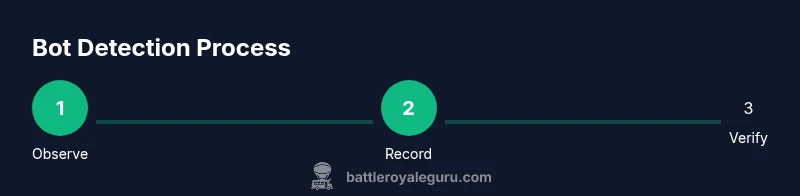
Replays and spectator modes are invaluable for verifying bot-like behavior. Record notable engagements with timestamps, take notes on timing, and compare against other players’ playstyles. Cross-check information from multiple matches, maps, and modes to identify consistent patterns. If a player mirrors bot-like behavior across sessions, document it and consider reporting through official channels if the behavior violates terms or affects fair play. This step ensures your conclusions are evidence-based rather than based on a single incident.
Authority Sources and Community Guidelines
For further context and authoritative perspectives, refer to trusted sources such as Epic Games’ Fortnite page for official information and major gaming publications that discuss bot behavior and matchmaking in modern battle royale games. Battle Royale Guru’s analysis highlights how bots influence early-game pacing and learning curves, while community discussions provide anecdotal examples to refine your observations. Use these sources to stay informed about updates in bot tuning and anti-cheat practices. The linked resources offer broader context and practical guidance for players seeking to understand bot dynamics in Fortnite.
Tools & Materials
- Fortnite game client(Installed and updated to the latest patch)
- Replay or spectator mode(Enable to review matches and verify observations)
- Screen recording or note-taking app(Document timestamps and patterns)
- Reliable internet connection(Minimize latency during observations)
- Notebook or spreadsheet(Log patterns across multiple matches)
Steps
Estimated time: 40-60 minutes
- 1
Prepare observation setup
Set up a reliable observation workspace, enable replay mode, and decide which metrics to track. This foundation ensures consistent data collection across matches.
Tip: Test your setup in a controlled lobby to avoid live-game distractions - 2
Watch spawn behavior
Note how players enter the map and engage early in the game. Bots often follow fixed spawn patterns and quick engagements.
Tip: Record timestamps for any repetitive spawn patterns - 3
Track aiming patterns in early skirmishes
Observe how quickly and steadily players acquire targets. Bots tend toward steady, mechanical aiming with little variance.
Tip: Compare aiming across several engagements to assess consistency - 4
Observe movement and reaction times
Look for robotic strafes, predictable paths, and unusually uniform reaction times to gunfire or sounds.
Tip: Note if the player instantly responds to distant shots with no delay - 5
Inspect building behavior
Watch for simple edits and efficient but non-creative builds, with minimal improvisation under pressure.
Tip: Track whether edits follow a repetitive template rather than adaptive tactics - 6
Analyze resource management
Bots often harvest at a steady rate and may not use advanced economy concepts like feints or deception.
Tip: Record the amount of mats used in distinct fights - 7
Cross-check with multiple maps
Repeat observations across different maps and modes to see if patterns persist.
Tip: If you see consistent patterns across maps, it strengthens the bot hypothesis - 8
Review with replay data
Use replays to confirm whether observed patterns are reproducible in multiple encounters.
Tip: Mark key moments with notes for quick reference - 9
Report suspicious behavior
If you reasonably suspect bot-like activity that violates terms, document and report through official channels.
Tip: Avoid public accusations; use documented evidence
Questions & Answers
What exactly is a Fortnite bot?
A Fortnite bot is an AI-controlled player designed to mimic real opponents and populate matches.
Fortnite bots are AI players that mimic real opponents.
Can you always tell bots apart from humans?
Not always; some bots simulate human play well, especially at higher difficulties.
Not always; some bots can look like real players.
Which modes are most affected by bots?
Bots fill matches across many modes, especially for newcomers or non-competitive playlists.
Bots fill matches in several modes to balance difficulty.
What should you do if you suspect a bot?
Document observations, avoid harassment, and report through official channels if required.
Keep notes and report if needed.
Watch Video
Key Points
- Identify bot signals across aiming, movement, and building.
- Use replays to confirm consistent patterns.
- Document patterns before reporting to Epic Games.