What Fortnite Weapon Has the Highest DPS? A Data-Driven Guide
Explore how DPS varies by range, loadout, and patch balance in Fortnite. Learn why no single weapon dominates every scenario and how to compare DPS in practical matches.


There isn’t a single Fortnite weapon with the highest DPS across every situation. DPS depends on range, fire rate, pellet spread, headshots, and reload timing. In practice, close-range fights tend to favor high-fire-rate SMGs, while mid-to-long-range engagements favor ARs, DMRs, or snipers when headshots are feasible. Battle Royale Guru’s analysis, 2026, shows rankings shift with patches and loadouts.
DPS landscape in Fortnite: why DPS isn’t a fixed number
In Fortnite, damage-per-second (DPS) cannot be boiled down to a single weapon stat. DPS is a function of multiple interacting variables: how fast a weapon fires, how accurately you can land shots, whether the weapon fires pellets or a single slug, the effectiveness of headshots, and how quickly you can recover after a miss. Patch notes and balance changes continually reshuffle which weapons sit at the top in a given season. According to Battle Royale Guru, the most reliable way to think about DPS is to evaluate it within the context of range, defense, and your own playstyle. If you want a practical rule of thumb, prepare different loadouts for different ranges and practice switching targets mid-fight. This context-aware approach is what separates a high-DPS fantasy from real-game results.
Close-range powerhouses and why they shine
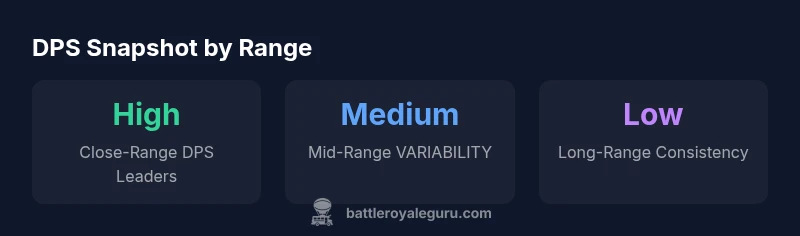
Close-range encounters reward weapons with very high fire rates and forgiving accuracy. High-fire-rate SMGs and certain shotguns can deliver blistering DPS in the first few seconds of a skirmish, provided you can keep your aim on target. The benefit isn’t only the raw numbers; reliability matters when enemies jump fences, build rapidly, or surprise you from behind cover. The Battle Royale Guru team notes that at ultra-close range, recoil management and hip-fire accuracy can tilt the DPS balance in favor of specific weapon categories, especially those with wide pellet spreads or very short reloads. Practically, players who anticipate close-quarters engagements should stock at least one fast-firing option and an alternative for slightly longer ranges.
Mid-range and long-range tradeoffs: ARs, DMRs, and snipers
As you push away from point-blank distance, the DPS story shifts. ARs and DMRs typically trade raw fire rate for higher damage per shot and more precise aim requirements. In mid-range encounters, headshots and landing follow-up shots quickly become the primary DPS drivers. Long-range play leans on sniper rifles and high-damage precision weapons where a single well-placed hit can end a duel, even if their fire rate is lower. Patch-adjusted rankings mean today’s top DPS weapon in one map location may fall behind tomorrow; the key is recognizing the factor that creates DPS in your range of play and adapting accordingly. In practice, you’ll want a loadout that covers both reliable mid-range trades and a riskier but potentially devastating long-range option.
Loadouts, attachments, and playstyle: maximizing DPS in practice
DPS is not only about a weapon’s base stats. Attachments that improve accuracy, reload speed, and stability can push a weapon’s practical DPS well beyond its base figure. The most effective DPS strategies combine mobility with targeting discipline: quick weapon swaps, smart peeking, and a focus on clean headshots. Real-world testing shows that even when two weapons share similar numbers on paper, the one you’re most comfortable with and can consistently hit headshots with often finishes fights faster. The Battle Royale Guru team emphasizes that iterative practice with two complementary weapons (one close-range and one at mid-to-long range) typically yields higher average DPS over a match.
Patch dynamics: how balance changes affect DPS rankings
Fortnite patches routinely adjust weapon stats, which can reorder the DPS leaderboard for weeks or months. A weapon that was near the top for DPS may shift to a median position after nerfs or buffs to reload speed, damage per shot, or fire rate. To stay ahead, players should track patch notes and test weapons in Creative or testing servers before committing a loadout in a live game. The key takeaway from Battle Royale Guru’s 2026 analysis is that you should treat DPS as a moving target bounded by your range, movement, and accuracy rather than a fixed number.
Quick workflow to evaluate DPS in a match
- Identify your engagement range at the start of the confrontation. 2) Choose a primary weapon that offers high DPS for that range. 3) Have a secondary option ready if you need to switch ranges mid-fight. 4) Practice headshots and speed reloading to sustain DPS in extended duels. 5) Reflect after matches on what weapons delivered the best DPS in those encounters and adjust your practice routine accordingly. The goal is to train muscle memory for the weapon types that reliably maximize DPS in real conditions.
DPS drivers by engagement range
| Category | Key DPS Driver | Notes |
|---|---|---|
| Close-range | High fire rate + pellet spread | Fast, forgiving interactions; watch recoil |
| Mid-range | Damage per shot + accuracy | Requires aim discipline and timing |
| Long-range | Single-shot DPS | Depends on headshots and follow-up shots |
Questions & Answers
Is DPS the only factor when choosing a weapon?
No. Real-world decisions must also consider range, mobility, accuracy, and your comfort with the weapon's recoil and reload times.
DPS is important, but you also need range and control to win fights.
Do headshots affect DPS?
Yes. Headshots multiply damage per shot, effectively increasing DPS when you can consistently hit the head.
Headshots boost your DPS in the moment—aim for the head when possible.
How much do attachments change DPS?
Attachments can improve accuracy, rate of fire, and reload speed, which can raise practical DPS in a fight.
Attachments can push your weapon into higher DPS through better control and faster cycling.
Which weapon has the highest base DPS right now?
Patch notes shift rankings; no single weapon remains universally top. Check the latest patch notes and in-game stats for current leaders.
Rankings change with patches; review the current notes to know the top contenders.
How can I compare DPS quickly in a game?
Use in-game stat tabs, practice with your two preferred weapons, and note how many headshots you reliably land in a round.
Compare by range and headshots, then practice to improve consistency.
“DPS in Fortnite is highly context-dependent; the weapon with the highest DPS in one scenario rarely remains the top choice in another. Context, range, and aim quality matter just as much as raw numbers.”
Key Points
- Master range-specific loadouts
- Prioritize headshots to boost DPS
- Attachments matter as much as base stats
- Patch notes change DPS rankings
- Practice two complementary weapons for coverage