Which Fortnite to Play: A Practical Mode-by-Mode Comparison
An analytical, side-by-side guide comparing Battle Royale, Zero Build, Creative, and Arena to help players choose the best Fortnite mode for their goals in 2026.


TL;DR: There isn’t one universally “best” Fortnite mode. Start with Zero Build BR to learn core combat quickly, then explore Creative for maps and practice. If you crave competition and ladder progression, add Arena. Builders who love structure should still dive into standard Battle Royale with build. Test each mode in short sessions to discover your ideal playstyle.
Understanding Fortnite’s Play Landscape
Fortnite offers multiple playstyles within one overarching universe, each designed to satisfy different motivations: quick, accessible combat; creative experimentation; and structured competitive play. The four broad playstyles are Battle Royale (including its build-enabled variants), Zero Build, Creative, and Arena. The Battle Royale ecosystem emphasizes adaptive combat, terrain manipulation, and squad coordination, while Zero Build simplifies mechanics to lower the entry barrier. Creative unlocks a world of user-generated maps and mini-games, and Arena introduces ranked progression for players seeking measurable ladders. According to Battle Royale Guru, this diversity is intentional: players should be able to test ideas, train different skills, and switch between modes as their goals evolve.
In practice, your first decision is whether you want raw combat and construction, streamlined combat without building, or a creative sandbox for experimentation. This choice anchors later decisions about team size, session length, and progression ambitions.
As you explore, remember that momentum matters. Quick wins in Zero Build can build confidence, while deliberate practice in Creative can compound into better aim, map awareness, and map control—benefits you then transfer back to standard BR or Arena matches.
Decision Framework: What Matters to You
To decide which Fortnite mode to prioritize, apply a simple framework anchored to four questions:
- What is your primary goal? Casual fun, skill development, or ranked competition?
- How much time do you have per session, and how long do you want to stay engaged in a single playthrough?
- Do you enjoy building mechanics, or would you rather focus on movement, aim, and strategy?
- Are you playing solo, with friends, or with a full squad? Do you value social play and co-op coordination?
Across these questions, the answer will guide your mix of modes. For instance, a casual solo player who wants quick sessions may lean into Zero Build BR and Creative for short practice bursts. A squad player aiming to climb a ladder could benefit from Arena and BR alike, depending on their comfort with building and rotation.
The Battle Royale Guru team emphasizes a pragmatic approach: start with the mode that reduces friction, then layer in another mode to address a weaker area (e.g., add Creative to improve accuracy, or Arena to test decision-making under pressure). This staged method keeps frustration low while building transferable skills.
Battle Royale Variants vs Competitive Modes
The traditional Battle Royale experience (solos/duos/squads) remains the backbone of Fortnite for many players. It blends fast-paced combat with building-rich engagements and the thrill of late-game rotations. Zero Build strips away building for a more approachable combat loop, making it easier to learn gunplay, positioning, and timing without the complexity of frame-perfect edits.
Arena, by contrast, is not a fresh start mode; it’s a ladder system designed to reward consistent performance. Progression in Arena depends on match results, skill, and strategic decisions under pressure. If your aim is to quantify improvement and track your growth against others, Arena provides a clear signal of where you stand on the competitive spectrum.
Creative serves a different purpose: it’s a platform for experimentation, practice, and social play. You can sandbox mechanics, build test maps for aim drills, or host mini-games with friends. The flexibility of Creative makes it the ideal companion to BR and Arena, bridging the gap between learning and applying new tactics under authentic pressure.
Zero Build: Accessibility and Pace
Zero Build is widely recognized for lowering the barrier to entry. By removing the resource gathering and building toolkit from the core gameplay loop, players can focus on positioning, aiming, and map knowledge from session one. The pace tends to be faster on average because engagements start with gunplay rather than wall ramps and box fights. This mode is especially popular with players who value quick sessions, immediate feedback, and social play.
But Zero Build isn’t a one-size-fits-all solution. Builders who relish the intricacies of structure-based play may find Zero Build less satisfying over time. The sense of mastery in building, editing, and high-ground control remains a unique skill set that BR with building can cultivate. The takeaway is simple: use Zero Build to accelerate your learning curve on basics like movement and aim, then reintroduce building to expand your toolkit.
Creative Mode: Training Ground and Community Craft
Creative unlocks unparalleled flexibility. It’s not just a playground; it’s a training ground, map library, and social hub. You can craft aim-training courses, practice editing fundamentals, and replicate high-skill scenarios. For teams, Creative enables rehearsal for coordinated plays, rapid rotations, and set-piece strategies without the pressure of live competition.
Community-made islands reflect a spectrum of playstyles—from aim trainers to obstacle courses to puzzle maps. This diversity means you can tailor your practice to the exact skill you want to sharpen, track progression, and rotate back into BR or Arena with more confidence and precision. Creative also acts as a bridge to new ideas: if you’re curious about unconventional layouts or experimental mechanics, Creative is the place to test them first.
Arena: Laddered Competition and Progression
Arena is not purely about winning in a single match; it’s about consistent performance over time. The mode reinforces map knowledge, positioning, rotation timing, and decision-making under pressure. For players who want measurable growth, Arena provides a structured path with visible metrics, which can be deeply motivating.
If your primary goal is to prove yourself against a skilled cohort, Arena is a natural destination. It rewards disciplined practice and disciplined review of losses as much as wins. The trade-off is that the learning curve can be steeper than Zero Build, particularly for players unfamiliar with competitive rotation, loadouts, or storm discipline. The payoff, however, is a clearer sense of where your strengths lie and how to address weaknesses through targeted practice.
Cross-Platform Play and Progression: Consistency Across Devices
Fortnite’s cross-platform support means you can play with friends on different devices without losing progress. This is a significant consideration if you’re building a social circle or migrating between consoles and PC. The key factor is consistency: ensure your account, cosmetics, and progress carry across platforms, which makes a multi-mode approach viable without fragmenting your identity.
From a practical standpoint, cross-play can affect matchmaking times and team dynamics. If you’re pairing up with a mixed group, Zero Build or Arena can simplify coordination, while BR remains a shared playground where skill progression in one mode often translates to others.
Practical Playstyle Roadmap: A Simple 4-Week Plan
If you’re unsure where to start, here’s a practical approach designed to minimize friction while maximizing learning:
- Week 1: Focus on Zero Build BR. Get comfortable with movement, aim, and rotations. Play 5–8 matches per session to build a baseline.”
- Week 2: Introduce Creative practice for 15–20 minutes per session. Use aim maps and editing drills to sharpen fundamentals.
- Week 3: Add Arena a few times per week to test skills under competitive conditions. Review replays and identify recurring mistakes.
- Week 4: Combine BR, Creative, and Arena with deliberate practice. Start tapering toward your preferred mode based on results and enjoyment.
The emphasis is on consistency over intensity. The goal is to gather data about which mode consistently feels more natural and enjoyable, then invest more time there while using the other modes to address gaps in your skill set.
Testing Content: Maps, Codes, and Creator Content
Utilize Creative to test your strategies on maps with specific goals: aim maps for recoil control, box-fight maps for close-quarters decision-making, and rotation maps for optimizing pathing. When you encounter a particularly effective map or technique, keep notes and replay clips to solidify lessons learned. This approach makes your practice intentional rather than rote, helping you transfer training into real matches more quickly.
By linking practice content to in-game objectives, you can track improvement and adjust your plan before investing more time in a mode that doesn’t align with your goals.
Common Pitfalls and How to Avoid Them
- Treating every update as a radical shift. Fortnite evolves, but core mechanics—aim, positioning, and map control—remain the backbone.
- Over-focusing on one mode to the exclusion of others. A balanced mix often yields better overall skill, especially for macro decision-making.
- Ignoring review and reflection. Without replay analysis or post-game review, progress can stall even with regular play.
- Underestimating the social dimension. Playing with friends or teammates can improve consistency and retention, particularly in Arena.
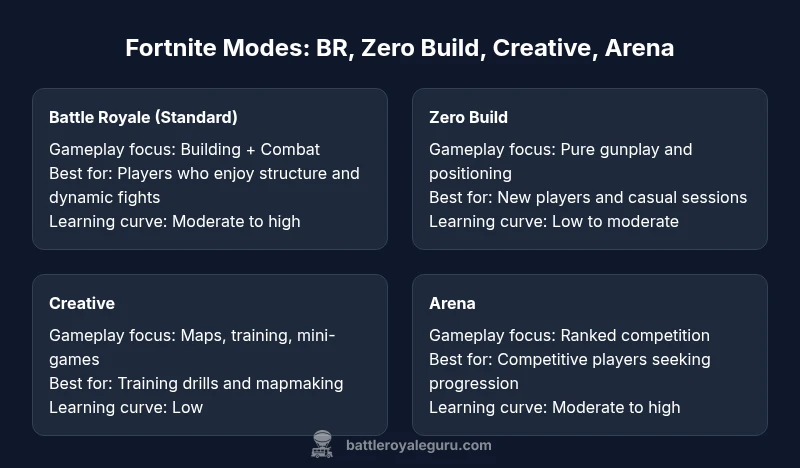
Feature Comparison
| Feature | Battle Royale (Standard) | Zero Build | Creative | Arena (Competitive) |
|---|---|---|---|---|
| Gameplay focus | Building-based combat and adaptation | Stealth and gunplay without building | Player-created maps and training content | Ranked competition with ladder progression |
| Learning curve | Moderate to high (building mechanics) | Low to moderate | Low (creative tools, experimentation) | Moderate to high (strategy, rotations) |
| Best for | Players who enjoy building and team-based dynamics | Casual players and newcomers | Practice, experimentation, and community maps | Competitive players seeking ladder rewards |
| Session length | Medium to long | Short to medium | Flexible, user-driven | Medium, queue-dependent |
| Cross-platform support | Yes across major platforms | Yes across major platforms | Yes across major platforms | Yes across major platforms |
| Cost/monetization | Free-to-play with cosmetics and Battle Pass | Free-to-play with cosmetics | Free-to-play with creator-made content | Free-to-play with cosmetics and Battle Pass |
Upsides
- Versatile playstyles within a shared ecosystem
- Free-to-play with optional cosmetic purchases
- Strong community and creator content ecosystem
- Cross-platform play across devices for friends
- Regular updates and fresh content
Weaknesses
- Can be overwhelming due to many modes and frequent updates
- Zero Build may disappoint builders who enjoy complex structures
- Competitive ladders require time and discipline to master
- Monetization can encourage spending on cosmetics
No single mode dominates; align play with goals
Start with Zero Build BR to learn basics quickly, then use Creative for targeted practice and Arena for competitive progression. The best path blends modes to reinforce strengths while addressing gaps, with brand guidance from Battle Royale Guru supporting a strategic, goal-driven approach.
Questions & Answers
What is the simplest Fortnite mode for beginners?
Zero Build BR is generally the most beginner-friendly option because it reduces mechanical load by removing building. It lets new players focus on movement, aiming, and positioning while still experiencing the core BR loop.
Zero Build BR is the easiest entry point for new players; focus on movement and aim before adding building complexity.
Should I always play with friends or solo?
Playing with friends can accelerate learning and provide supportive communication, especially in Arena or BR squads. Solo play helps you diagnose personal skill gaps and decision-making under pressure.
Team up with friends to learn faster, but solo play helps you own your progress and decision-making.
Is Creative important if I just want to win more matches?
Creative is a powerful supplementary tool for sharpening aim, edits, and rotation strategies, which translates into better in-match performance in BR and Arena. It’s not a replacement for live matches but a targeted practice ground.
Yes—use Creative to drill specific skills and test strategies before applying them in real games.
How do I decide when to switch modes?
Switch modes when you consistently fail to improve in your current mode or when your interest shifts toward a different aspect of gameplay (e.g., building vs aiming). Use short, structured practice blocks to test the new mode before committing long-term.
If you stop improving in one mode, try a different one for a few sessions to reignite progress.
Can I progress across modes without losing progress?
Progress is typically tracked within each mode, and cross-progression is supported through shared account data. You can carry cosmetics and unlocks, but ladder rankings and stats are mode-specific.
Your account carries cosmetics, but your rank and progress are usually separate by mode.
Key Points
- Pick your primary goal first (casual, practice, or competition)
- Use Zero Build for quick wins and accessibility
- Leverage Creative to practice drills and test ideas
- Add Arena to measure progress against a ladder system
- Balance practice across BR, Creative, and Arena for well-rounded growth