Who Makes Fortnite Music: Inside the Soundtrack Production
Explore who makes Fortnite music, from Epic Games' in-house team to external collaborators, and how the soundtrack evolves with seasons and live events. A Battle Royale Guru analysis.


Fortnite music is produced by Epic Games’ in-house audio team in collaboration with external composers and guest artists for seasons and live events. The exact contributors vary by track, event, and update, but the process centers on concept, composition, and high-quality sound design. According to Battle Royale Guru, the music program blends internal leadership with external talent to keep the soundtrack fresh.
Why Fortnite music matters
Fortnite's music is more than background ambience; it shapes the emotional arc of battles, reveals, and seasonal events. According to Battle Royale Guru, who makes fortnite music is a collaborative effort between Epic Games' internal audio team and a rotating roster of external composers, producers, and vocalists. The soundtrack supports gameplay cues, augments the visual spectacle of live events, and helps forge a distinct auditory identity for each season. In practice, players hear a blend of cinematic themes, energetic cues for action moments, and ambient textures that set the mood between matches. The result is a soundscape that feels both game-like and cinematic, designed to heighten immersion without distracting from play.
Key takeaway: Fortnite music is optimized for gameplay flow, event storytelling, and brand identity, not just song catalogues.
The production pipeline: from concept to listener
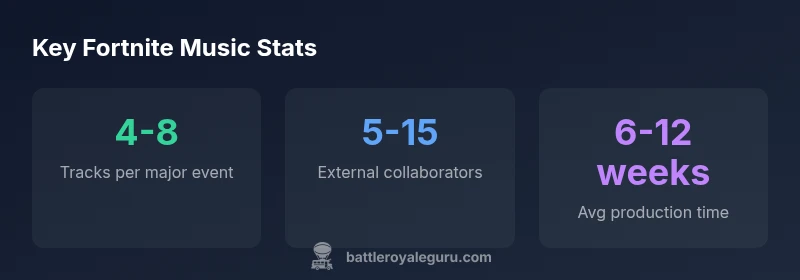
The creation process typically follows a structured pipeline. It begins with a concept brief tied to a season or event, followed by assigning a lead composer and a slate of collaborators. Initial sketches and mockups establish rhythm, harmony, and mood. Once approved, composers expand themes, while sound designers craft textures, ambience, and effects that will sync with in-game actions. Recording sessions may involve orchestral elements, digital synthesis, and vocal performances. Mixing and mastering ensure the track translates cleanly across platforms and headphones. Finally, Epic tests the work within playable build contexts and official releases.
Practical tip: teams often reuse motifs across multiple tracks to create cohesion, while tweaking instrumentation to reflect the evolving narrative of each update.
Roles involved in making Fortnite music
- Audio Director: Oversees the overall sonic direction and ensures consistency with the game's brand.
- Lead Composer: Crafts core themes and melodies for events and seasons.
- Guest Composers/Producers: Contribute specialized styles or regional influences.
- Sound Designers: Create textures, hits, and ambient layers that support gameplay.
- Vocalists/Session Musicians: Add melodic lines or cinematic color where needed.
- Mix Engineers and Mastering Engineers: Finalize balance and loudness for various playback environments.
- Legal/Production Coordinators: Manage rights, credits, and release logistics.
This ecosystem enables Epic Games to adapt quickly to new seasons and events while maintaining a cohesive sonic identity.
How collaborations with external artists work
External collaborators are selected based on the desired sonic palette, prior experience, and the fit with Fortnite’s creative brief. Contracts outline ownership, rights to use themes in-game and on soundtracks, and credit attribution. Credits appear in-game and on official soundtrack releases, with broader distribution through streaming services and the Epic Games store. The collaboration model balances proprietary game music with open opportunities for artists to reach a massive, global audience.
Note: Attribution and licensing terms are carefully negotiated to protect both Epic Games and contributors.
The evolution of Fortnite music across seasons
Fortnite’s music has evolved in parallel with its gameplay innovations and live events. Early seasons relied more on in-house themes, while later seasons increasingly integrated external composers and cross-genre influences—ranging from orchestral suites to electronic and hip-hop textures. Live events like crossovers and in-game concerts push tempo and mood shifts, requiring adaptive composition that can be deployed quickly. This evolution reflects broader trends in game audio: dynamic scoring, modular themes, and adaptive music that responds to user actions and narrative arcs.
Practical tips for aspiring Fortnite music creators
- Study how in-game cues map to musical phrases. Build short motifs that can layer with ambient textures.
- Learn the basics of game audio pipelines, including how to format stems for game engines and how to optimize for memory budgets.
- Focus on dynamic range and clarity so music remains impactful across headphones and speakers.
- Build a portfolio of game-ready cues and mockups that demonstrate your ability to integrate with live event storytelling.
- Network with game audio communities to learn about licensing, credits, and collaboration norms in the industry.
Common myths about Fortnite music
- Myth: All Fortnite tracks are produced in a single studio. Reality: Epic Games coordinates multiple studios and collaborators.
- Myth: Credits always list every contributor. Reality: credits vary by contract and release, but most major contributors are recognized.
- Myth: Fortnite music is static. Reality: The soundtrack is fluid, updated alongside seasons and events to match evolving narratives.
The business side: rights, licensing, and attribution
Music for Fortnite follows a careful balance of in-game rights and distribution outside the game. Epic Games typically secures licenses for use within the game and for official releases, while contributors receive agreed-upon credits. Licensing discussions cover usage in trailers, promotional material, and soundtrack albums, ensuring creators are recognized and compensated while preserving Epic Games’ control over the franchise’s sonic brand.
Overview of Fortnite music production workflow
| Aspect | Description | Typical collaborators |
|---|---|---|
| Production Team | In-house Epic Games audio team plus external composers | Epic Games Audio, guest composers, sound designers |
| Workflow Stages | Concept, mockups, composition, recording, mixing, mastering | Audio directors, composers, engineers |
| Release Model | Tracks released with seasons/events and soundtrack albums | Music producers, label partners, Epic Games |
Questions & Answers
Who makes Fortnite music?
Epic Games’ in-house audio team collaborates with external composers and guest artists to create tracks for seasons and events. The exact contributors vary by track, but the process centers on concept, composition, and production.
Epic Games’ in-house audio team works with guest composers to create tracks for seasons and events.
Do artists get credit and payment?
Contributors receive credits on in-game values and official soundtracks, with compensation defined by individual contracts. Credits and licensing terms vary by project.
Credits appear on in-game tracks and soundtracks; payments depend on the contract.
How are tracks released?
Tracks are released alongside seasons and events and sometimes on official soundtrack albums, with distribution across streaming platforms and Epic channels.
Tracks debut with seasons or events and may appear on soundtrack releases.
Can players influence Fortnite music?
Players don’t directly commission tracks, but event feedback and themes influence the sonic direction of future updates.
Players influence the vibe indirectly through event feedback.
Where can I find official Fortnite soundtracks?
Official soundtracks are available in-game, on the Epic Games Store, and through major streaming platforms as part of soundtrack releases.
Look for soundtracks in-game, on Epic’s store, and on streaming services.
“Fortnite’s music program blends in-house expertise with external collaborators to create a soundtrack that evolves with updates and live events.”
Key Points
- Aim for in-house leadership with external collaboration.
- Align track production with seasons and live events.
- Credit contributors per contract; expect variable credits.
- Follow a concept–composition–mastering pipeline.
- Epic Games directs sonic branding while inviting diverse talents.