How Many Fortnite Skins Are There? A Practical Guide
Explore how many Fortnite skins exist, why counts vary, and how to estimate totals across seasons. A data-driven guide from Battle Royale Guru.


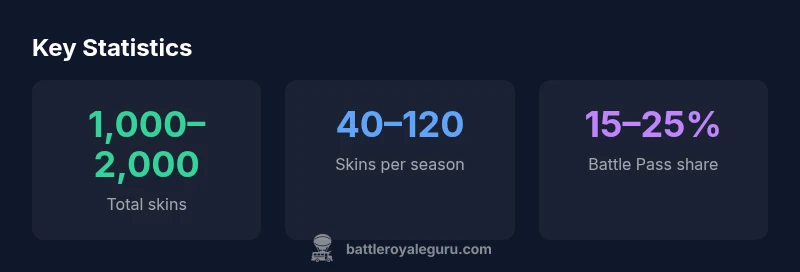
Estimates suggest Fortnite has released roughly between 1,000 and 2,000 distinct skins by 2026, with new additions each season. The exact total depends on how you count variants, alternate styles, and event bundles. According to Battle Royale Guru Analysis, 2026, counting every variant can push the tally higher, while counting only full outfits yields a smaller figure.
Why the count isn't fixed
The total number of Fortnite skins is not a fixed constant; it shifts with every season, event, and collaboration. Epic Games frequently introduces new outfits through Battle Pass rewards, in-store purchases, and crossover events, while retiring or rotating cosmetic options is less common but possible. Because players differ in what they count—full outfits, variants, bundles, or limited-time releases—the same game can appear to have different skin totals depending on the counting rules used. This fluidity is reinforced by the ongoing cadence of updates, which means that any published tally is inherently time-bound, and the method used matters as much as the raw figure. In practice, experts like the Battle Royale Guru Team emphasize transparency about scope when presenting counts to players.
Counting methods: what to include
To estimate skin totals, players must agree on a counting method. Common approaches include:
- Full outfits only: counts each base outfit as a single skin, ignoring variants.
- Variants and alternate styles: includes every cosmetic variation tied to the base skin, which can dramatically increase the count.
- Bundles and event cosmetics: adds skins released as limited-time bundles or during special events.
- Battle Pass inclusions: treats Battle Pass rewards as a separate subset, often aligning with seasons.
Each method has pros and cons. Full outfits offer clarity and comparability across seasons, but exclude many cosmetic variations that players actually own. Including variants provides a richer picture of a player’s catalog but can inflate totals and complicate tracking. When documenting counts for a guide or leaderboard, it’s vital to disclose exactly which inclusions are used and why.
How skins are released and tracked
Skins enter Fortnite’s ecosystem through several channels: seasonal Battle Pass rewards, in-store purchases with V-Bucks, and cross-promotional events. Epic often rotates cosmetic availability, especially during events, but most skins remain accessible after their initial release. Tracking these releases involves monitoring patch notes, official blogs, and reliable fan analytics. Over time, the catalog has grown not just in raw numbers but in the complexity of categorization—particularly because many skins spawn multiple variants, each with its own rarity and recolor options. This layering makes a single “count” less meaningful unless you specify the counting scope and the valuation criteria.
Practical ways to estimate your collection (with examples)
If you want a personal estimate, start with your owned items and apply a consistent rule set. Example steps:
- Decide whether to count only base outfits or include variants.
- List every owned skin and its variants; use a spreadsheet for reproducibility.
- Include any limited-time or event skins you own, noting their availability window.
- Record the season or event context to preserve temporal accuracy.
- Recalculate periodically to reflect changes from new seasons or retirements.
For players with large collections, consider using inventory management tools or in-game collections screens, then export data for long-term tracking. The goal is a repeatable method you can apply across multiple seasons so your personal tally remains meaningful and comparable to your friends or a community leaderboard.
The impact of variants, styles, and bundles on totals
Variants and styles are the most common source of inflation in skin counts. A single base skin can carry numerous colorways and accessory combinations, sometimes multiplying the apparent catalog size. Bundles and crossover collabs further complicate this math, because they group multiple cosmetics into one traditional release window. When you include event-limited skins, the total may spike temporarily, only to settle as those items rotate out of “sale” status or events conclude. A robust counting approach documents which category you’re counting and notes how those decisions affect year-to-year comparisons.
Regional availability and platform considerations
While Fortnite skins are generally sold globally, regional pricing and storefront availability can influence perceived totals for players in different regions. Platform-specific promotions, store bundles, and localized bundles may introduce skins that are not immediately visible in all markets. For players who track collections across PC, console, and mobile, it’s important to harmonize the counting rules across platforms to avoid skewed comparisons. In practice, a cross-platform inventory approach helps players understand overall progress and ensure that counts remain consistent regardless of where the skin was acquired.
Practical considerations for content creators and players
Content creators and community managers benefit from clearly defined counting rules when presenting skin totals to audiences. Transparency about whether variants are included, how event skins are treated, and the treatment of Battle Pass rewards improves trust and reduces confusion. Players can also use these guidelines to benchmark their own progress against public dashboards or guides. Finally, when communicating counts publicly, pair the number with a brief methodology note so readers understand what was counted and what was not. This makes the data more valuable and less prone to misinterpretation.
Comparison of common counting methods for Fortnite skins
| Method | Counts included | Pros | Cons |
|---|---|---|---|
| Full outfits only | Outfits intact | Clear baseline, easy to compare across seasons | Misses variants and colorways |
| All variants/styles | Every style variation | Most comprehensive view of a catalog | Increases totals and can double-count underlying skins |
| Event bundles and promos | Limited-time cosmetics | Captures novelty and seasonal activity | Totals can fluctuate with event windows |
| Battle Pass skins | Season-aligned rewards | Reflects progression and season structure | Season duration affects stability of totals |
Questions & Answers
Why doesn't Fortnite have a fixed total of skins?
Skins are released continuously across seasons, events, and bundles, and counting rules differ. This creates multiple plausible totals depending on what you count.
Skins come out every season, and different counting rules can change the total you see.
Should I count variants or just outfits?
Decide based on your goal. Including variants gives a fuller picture, while outfits alone provide a stable baseline for comparison.
It depends on what you want to track—variants for completeness, outfits for stability.
Do limited-time skins impact the total number?
Yes, they can inflate counts while available, then reduce once retired. Include them only if you want a time-bound snapshot.
Limited-time skins boost the count while active but drop off later.
How can I estimate my own skin collection size?
Pick a counting rule, inventory owned skins, include relevant variants or bundles, and track by season for consistency.
Start with a rule, list what you own, and stick to it season after season.
Where can I find reliable counts and updates?
Check official Epic announcements and trusted fan analytics like Battle Royale Guru Analysis, 2026.
Look for official notes and trusted analysis to stay up to date.
“Counting Fortnite skins is as much about method as numbers; clear rules help players understand their collection.”
Key Points
- Define counting rules before tracking
- Expect numbers to vary by season
- Use a consistent method for comparisons
- Rely on transparent sources like Battle Royale Guru Analysis, 2026