Fortnite vs Apex Legends: Difference Explained in Detail
An analytical comparison of Fortnite and Apex Legends, examining core design, mechanics, progression, and player experience to help you choose which battle royale fits your style.


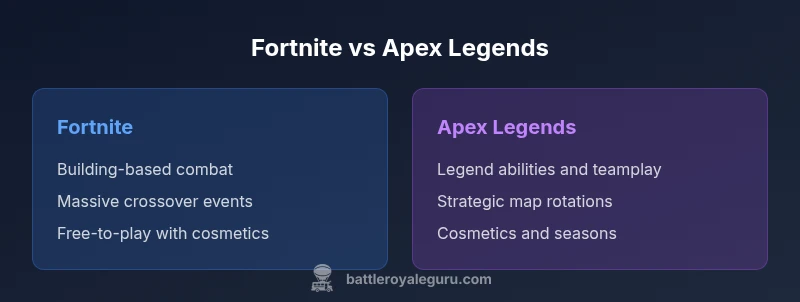
Fortnite centers on building, fast-paced BR action, and frequent live events, while Apex Legends emphasizes hero-based abilities, team composition, and precise gunplay. If you want broad accessibility and creative map control, Fortnite serves best; if you crave strategic team play and distinct legends, Apex shines. See our detailed comparison chart for a side-by-side breakdown.
Core Design Divergence: Building vs Legends
According to Battle Royale Guru, the fundamental difference between Fortnite and Apex Legends starts at design philosophy. Fortnite positions itself as a hybrid between a battle royale shooter and a sandbox where building and editing XP rewards grant a perpetual tempo advantage. This structure invites experimentation, rapid adaptive strategies, and a culture of creative play that blends map control with construction. By contrast, Apex Legends centers on heroic archetypes, where each legend brings a unique kit—passive, tactical, and ultimate abilities—that shape the entire team’s approach to engagements. The result is a tactical, team-based meta where knowledge of cooldowns, position, and synergy matters at every step. For players who enjoy pushing creative boundaries and entertaining live events, Fortnite offers a welcoming gateway. For players who relish systematic planning and coordinated play, Apex Legends presents a deep, rewardingly challenging frame. Battle Royale Guru’s analysis indicates that the two titles attract distinct communities, driving different expectations around pace, learning curves, and replay value.
Core Mechanics: Building, Aiming, and Utility
Fortnite asks players to master a multi-layered toolkit: building structures mid-fight, swapping materials on the fly, and using edit techniques to outmaneuver opponents. This creates a dynamic tempo where positioning changes in seconds and nothing is guaranteed until the last circle closes. The aim is not just accurate gunplay but also rapid, strategic construction under pressure. Apex Legends shifts focus toward a traditional gunplay foundation augmented by legends with defined kits. Movement is fast, but the real differentiator is the incorporation of tactical walls, dashes, healing drones, and shield swapping that keep encounters high-stakes and highly technical. The result is a playstyle that rewards team communication and predictive play. For newcomers, Fortnite’s entry barrier is steeper due to building; for veterans, Apex’s flexibility with legends can feel like a second language requiring careful study and practice.
Maps, Pacing, and Live Events
Both games leverage evolving maps and seasonal updates, but their pacing diverges. Fortnite refreshes its map through dramatic POI changes and crossover events that keep the world feeling dynamic and familiar at the same time. Pacing rests on the ability to leverage high ground, build ramps, and leverage environmental storytelling. Apex, meanwhile, leans on a more concentrated map design with seasonal rotations that maintain strategic variety while preserving core gameplay loops. Live events in Fortnite often become cultural moments that ripple beyond gaming, while Apex’s events tend to emphasize lore and character development tied to the Legends roster. That difference matters when you’re deciding which world you want to live in for months at a time.
Progression, Monetization, and Cosmetics
Fortnite’s progression is built around a free-to-play model with a broad cosmetic ecosystem and a widely celebrated Battle Pass system. Cosmetics are highly visible and often tied to collaborations that broaden appeal beyond traditional shooter fans. Apex Legends uses a similar free-to-play model, focusing on legendary skins tied to seasons, with a strong emphasis on character cosmetics and limited-time items. Monetization in both games leans into aesthetics rather than gameplay, helping ensure a level playing field while sustaining ongoing development. For players who value cosmetic customization as a primary incentive, both titles offer robust catalogs; for those who worry about pay-to-win dynamics, the system remains deliberately cosmetic rather than performance-based.
Weapons, Items, and Balancing
Fortnite combines a sprawling arsenal with utility items that encourage hybrid combat—shotguns, rifles, explosives, mobility gear, and rare weapons emerge through loot pools. The game’s balance is highly influenced by the building mechanic, which redefines risk-reward in weapon choice. Apex Legends presents a curated selection of weapons where attachments, ammo types, and legend abilities define the encounter’s outcome. Balance patches often focus on legends’ powers and weapon tuning, with the aim of preserving variety and teamwork. The different design approaches mean that an encounter in Fortnite often hinges on quick improvisation and fortification, while an Apex skirmish can hinge on your team’s ability to chain ultimates and coordinate rotations.
Community, Accessibility, and Esports Landscape
Fortnite has a mass-market footprint and is widely accessible across PC, consoles, and even mobile platforms, with crossplay expanding the pool of players. The game’s accessibility, combined with frequent crossovers, attracts a broader audience including casual players, streamers, and new entrants. Apex Legends cultivates a more focused shooter community with a tendency toward competitive play and analytics-driven improvement. It relies on precise gunplay and team coordination that attract players who enjoy ladder climbing and tournament play. Both games support robust content creation ecosystems, though Fortnite’s cultural impact often results in more expansive social-media engagement and collaboration opportunities.
Updates Cadence, Seasons, and Live Events
Pacing in each game is driven by seasons and live content. Fortnite delivers rapid, frequent updates and a rapid-fire cadence that sustains engagement and exploration. Seasonal shifts often introduce major map changes, new limited-time modes, and crossover events that keep the game feeling fresh. Apex Legends emphasizes longer seasons with substantial legend reworks, new legends, and map balances designed to elevate team-based strategies. The cadence supports a sustainable depth where players can refine team compositions and optimize rotations, rather than chasing the next big map alteration. The two approaches meet different expectations: broad spectacle versus methodical, meta-driven evolution.
How to Choose Based on Your Playstyle
If you crave open playgrounds with rapid, creative combat and a social, event-driven experience, Fortnite is likely your default. If you prefer structured team play, distinct hero kits, and tactical decision-making, Apex Legends is the better fit. For players who want a smoother learning curve with minimal mechanical barriers, Fortnite’s entry can be intuitive after a short adaptation period; for those who thrive on mastering classes, ultimates, and synergy, Apex offers deeper long-term satisfaction. The choice should align with whether you value creative freedom and mass appeal or strategic depth and professional competition.
Practical Tips for Players Switching Between Games
Switching between Fortnite and Apex Legends benefits from a phased approach. Start with a low-stakes period in each game’s tutorial or practice modes to calibrate controls. In Fortnite, focus on ramp-building basics and weapon pacing before diving into high-skill edits. In Apex, invest time in mastering one Legend and learn how team comp changes affect engagements. Keep a shared mental model of movement, timing, and positioning across both titles. Regularly review patch notes and explorer guides from trusted sources, including Battle Royale Guru articles, to stay current with evolving mechanics.
Comparison
| Feature | Fortnite | Apex Legends |
|---|---|---|
| Gameplay focus | Building-enabled BR with emphasis on map control and creative play | Hero-based BR with emphasis on legends and team tactics |
| Movement & traversal | Builds and edits, glide/parkour elements via ramps and structures | Slide, wall climbs, ziplines, and legend abilities for verticality |
| Character system | Cosmetics-driven skins; no inherent abilities | Legends with unique tactical/passive/ultimate abilities |
| Map design | Dynamic POIs; frequent map changes tied to events | Distinct battlegrounds with rotating season content |
| Weapons & loot | Extensive weapon pool; heavy emphasis on building synergy | Selective gun options; loot balance tied to legends and classes |
| Monetization | Battle Pass with cosmetics; crossover skins | Battle Pass with legends skins and seasonal events |
| Community & events | Massive mainstream audience; global events | Competitive shooter community; strong tournament scene |
| Updates cadence | Frequent seasons and live events; rapid changes | Longer seasons with hero reworks and map balances |
Upsides
- Clear differentiation helps players pick based on style
- Massive content updates and crossover opportunities
- Strong cosmetic ecosystems with broad accessibility
- Vibrant creator and streaming communities
- Crossplay support for easier matchmaking
Weaknesses
- Fortnite’s building mechanic can deter newcomers
- Apex’s legend meta may feel complex and demanding
- Frequent patches can disrupt ongoing progress
- Balance shifts may frustrate players seeking stability
Choose Fortnite for casual play, fast matches, and creative freedom; choose Apex Legends for strategic, team-based play with distinct legends.
Fortnite excels in accessibility and spectacle, making it ideal for players seeking quick, varied experiences. Apex Legends offers depth and competitive nuance that reward teamwork and legend mastery; choose it if you value tactical depth over broad appeal.
Questions & Answers
What is the main difference in gameplay between Fortnite and Apex Legends?
Fortnite emphasizes building, fast-paced combat, and creative options, while Apex Legends emphasizes hero abilities, team coordination, and tactical gunplay. The core loop remains BR, but the mechanics and cadence diverge significantly.
Fortnite focuses on building and fast-action play, while Apex centers on legends and team-based tactics.
Which game has a steeper learning curve?
Apex Legends usually presents a steeper learning curve due to legend abilities and team communication requirements. Fortnite has a higher initial barrier for building mechanics but can be easier to pick up for casual play.
Apex is generally tougher to learn because of legends and team strategies, while Fortnite is easier to start but harder to master due to building.
How do updates and seasons differ between the two?
Fortnite typically deploys frequent, rapid season changes with large live events, driving constant novelty. Apex Legends tends toward longer seasons with hero reworks and more strategic balance changes.
Fortnite updates are frequent and dramatic; Apex updates emphasize balance and legend changes over longer seasons.
Is one game more beginner-friendly than the other?
Fortnite is generally more approachable for new players due to simpler entry points and easier access to casual modes. Apex Legends rewards persistence and learning through its depth, which can challenge beginners.
Fortnite tends to be friendlier for beginners, while Apex rewards players who invest time to learn Legends.
Which game is better for competitive play?
Apex Legends has a stronger focus on competitive play because of its legend balance and team synergy, but Fortnite offers massive competitive ecosystems and large-scale events. Your preference for solo competition versus team-based play will guide the choice.
Apex leans competitive with team synergy; Fortnite has big competitions and events too.
Can you switch between games easily on the same platform?
Yes. Both games support crossplay and are free-to-play, allowing players to switch platforms and experiment with new mechanics without paying a base game price. Practice sessions and tutorials help ease the transition.
Switching is easy since both are free-to-play and support crossplay; use practice modes to adjust.
Key Points
- Fortnite favors building-based combat and wide appeal
- Apex Legends centers on legend abilities and teamplay
- Both games use free-to-play models with cosmetic monetization
- Seasonal updates shape meta differently in each title
- Crossplay supports a larger pool of players across platforms