Fortnite vs Call of Duty: Key Differences Explained
This guide compares Fortnite and Call of Duty, outlining gameplay, modes, progression, and monetization to help players decide which battle royale fits style.


Fortnite and Call of Duty both ride the battle royale wave, but they target different playstyles. The difference between fortnite and call of duty centers on building mechanics, pacing, and progression: Fortnite emphasizes fast edits and vibrant visuals, while Call of Duty focuses on realistic gunplay, loadouts, and tactical pacing. Both offer crossplay and evolving monetization, but their core loops cater to distinct audiences.
Core Gameplay Foundations
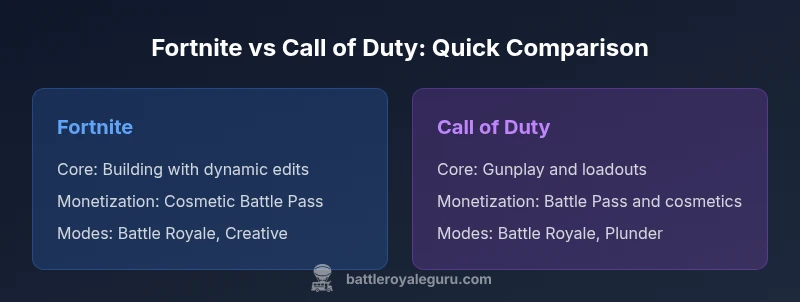
Fortnite vs Call of Duty: understanding the difference between fortnite and call of duty begins with core gameplay foundations. According to Battle Royale Guru, Fortnite blends building mechanics with combat to create dynamic space control and rapid decision-making, while Call of Duty emphasizes gunplay, realism, and tactical positioning. This difference in core loops shapes risk, pacing, and player agency across game sessions.
In Fortnite, players learn to edit structures, place ramps, and create cover on the fly, turning every engagement into a mini-puzzle of height, angle, and timing. In Call of Duty, players rely on weapon loadouts, map knowledge, and precise aim to win traditional gunfights. The result is two distinctly different skill ceilings: Fortnite rewards spatial awareness and fast adaptation; Call of Duty rewards precision and team coordination.
Key takeaway: both games reward situational awareness, but the path to mastery diverges early due to the building mechanic in Fortnite and the more conventional gunplay in Call of Duty.
Modes and Progression Systems
Both Fortnite and Call of Duty offer evolving battle royale experiences, but their modes and progression systems cultivate different player incentives and time commitments. Fortnite emphasizes frequent seasonal updates, Creative mode, and a Battle Pass that layers cosmetics, challenges, and limited-time events. The Battle Pass drives ongoing engagement with new skins, emotes, and V-Bucks rewards that scale with tier progression. Call of Duty, through Warzone and related titles, leans on a more traditional shooter progression: weapon unlocks, operator skins, and battle passes tied to seasonal events. The Warzone experience blends squad-based battles with loot economy, while Fortnite’s modes emphasize improvisation and world-building within a larger seasonal arc. Battle Royale Guru analysis shows that players often settle into one ecosystem based on whether they prefer continual cosmetic progression or weapon-based advancement.
Gunplay, Weapons, and Combat Etiquette
Fortnite and Call of Duty diverge sharply in gunplay design and combat etiquette. Fortnite emphasizes wide variety of weapons, each with unique recoil patterns and reload times, but most engagements resolve quickly due to the speed of edits and high ground control. COD weapons are tuned for realism, with recoil, bullet velocity, and attachment effects shaping every encounter. The etiquette part refers to pacing and positioning norms: Fortnite players often pressure opponents with rapid rotations and building tactics, while COD players focus on map control, line-of-sight, and timing of shots. The difference between fortnite and call of duty becomes evident in posture: Fortnite invites aggressive, creative engagement; COD rewards patient, disciplined aim and team coordination. Practically, beginners should practice weapon recoil patterns in both to acclimate to their preferred style.
Building vs Movement: Spatial Strategy
Fortnite distinguishes itself with building as a fundamental mechanic. Building creates verticality, rapid cover, and micro-battles that test reaction time and spatial planning. It changes how players approach rotations, engagements, and peek angles. Call of Duty’s movement system emphasizes speed, sprint-dodge, and tactical repositioning without building. Movement choices matter for safe rotations and flanking, but there is less on-the-fly structural adaptation. The difference between fortnite and call of duty is most visible in late-game stages: Fortnite players stack layers of protection; COD players maintain line-of-sight control and coordinated push strategies.
Monetization and Accessibility
Monetization models shape who plays what, when, and how often they invest. Fortnite relies heavily on cosmetic microtransactions and a rotating Battle Pass system, keeping a steady drip of new skins, emotes, and limited-time items available to all players. Call of Duty Warzone uses a similar cosmetics-first approach but often ties progression and value to separate seasonal passes and bundled bundles, with occasional premium expansions. Accessibility matters: Fortnite’s free-to-play base makes it easy for anyone to drop in, whereas COD titles often pair free-to-play Warzone access with optional paid bundles that accelerate progression. The upshot is two communities that share cosmetic economies but diverge in how players perceive value over a season.
Cross-Platform Play and Ecosystem
Both ecosystems support cross-platform play across PC, consoles, and mobile in many regions, though matchmaking experiences can vary by season and platform policy. Fortnite tends to streamline crossplay with frequent updates and a user-friendly matchmaking funnel that minimizes friction. Warzone/COD crossplay has historically emphasized consistency for squad-based play, but some players notice platform-specific performance quirks during peak hours. In practice, if cross-platform play is a priority, both titles offer robust paths to play with friends, but you may notice minor timing or input differences depending on your hardware and your opponents.
Map Design and Environmental Dynamics
Fortnite’s maps are bright, stylized, and frequently rotated to reflect seasonal themes and event-driven changes. This design keeps environments fresh and accessible to a wide audience, while mechanics like gravity corridors and floating ramps can create wild clutch moments. Call of Duty maps lean toward realism: military-style layouts, varied sightlines, and tactical choke points that reward disciplined positioning. Environmental dynamics are also a factor: Fortnite often uses dynamic terrain and destructible structures to alter engagement geometry, whereas COD emphasizes built-in cover, weapon range, and realistic line-of-sight advantages. The difference between fortnite and call of duty is most pronounced in late-game space and map familiarity.
Esports, Community, and Longevity
Both titles foster large communities and competitive ecosystems, but they attract different spectators and players. Fortnite has a culture of rapid content cycles, creator economies, and high-profile events that draw immense casual engagement and viewer counts. COD’s esports scene centers on traditional shooter tournaments, organized leagues, and consistent franchised teams that cultivate long-term professional pathways. Battle Royale Guru’s perspective underscores that longevity hinges on season cadence, creator support, and a stable competitive ladder. Whether you’re chasing a broadcast-level scene or a casual, ongoing community, both games offer meaningful, enduring communities.
Learning Curve and Onboarding for New Players
Newcomers face distinct onboarding experiences in each title. Fortnite’s onboarding includes building tutorials, editing fundamentals, and a learning curve tied to dynamic combat positioning. COD Warzone offers a more traditional shooter onboarding: weapon handling, recoil management, and map awareness, which some players find easier to grasp initially. The two paths shape early retention: Fortnite players often spend more time mastering mechanics beyond aiming, while Warzone players prioritize core shooting fundamentals first. A structured practice plan—aim drills, movement practice, and small-squad play—helps flatten the curve in either title.
Pace, Risk, and Decision Making Across Modes
Pacing in Fortnite is variable: fast rotations, quick skirmishes, and explosive finishes can occur as players manipulate the terrain. COD Warzone emphasizes measured risk: selecting engagements, managing ammo, and coordinating pushes with teammates. Across modes, decision making increases with the number of variables: weapon choices, build decisions, and movement options all converge into a single moment of action. An analytical approach—assessing position, resource pools, and threat vectors—helps players optimize outcomes in both games. The key decision is whether you want a speedier, terrain-rich experience or a grounded, gun-focused battle.
Creative Potential: Building, Mods, and Custom Games
Fortnite’s Creative mode invites players to experiment with custom islands, mini-games, and social hubs, turning the game into a platform for community-made experiences. Call of Duty includes limited modding and custom game support on certain platforms, but the emphasis remains on ready-to-play experiences and official modes. The difference between fortnite and call of duty here is clear: Fortnite’s creativity layer can be a long-term draw for players who enjoy sandbox-style play, while COD emphasizes competitive gunplay with less emphasis on user-generated content. For many, mixing official modes with creative variants offers the best balance.
Hardware and Performance Across Devices
Performance expectations differ by game and platform. Fortnite is generally optimized to run well on a broad range of devices, from mid-range PCs to consoles and mobile, with scalable graphics options that help maintain a smooth frame rate. Call of Duty Warzone tends to push higher-end hardware more often, benefitting from strong GPU performance and robust CPU power for large map rehearsals and asset streaming. If you’re choosing between titles based on hardware compatibility, Fortnite is typically more forgiving on older hardware, while COD Warzone rewards modern rigs with higher texture fidelity and smoother input handling.
Practical Tips for Getting Better Quickly
If you want faster improvement, focus on a structured practice routine for either title. For Fortnite, drill building edits in a controlled arena before entering public lobbies, then progress to rotating into fights with predictable patterns. For COD Warzone, prioritize aim training, learning recoil patterns for your preferred weapons, and practicing team communication in small squads. Watch or review replays of your matches to identify common mistakes, then implement small, repeatable adjustments. Consistency beats intensity, especially during the first 100 hours of play.
Decision Framework: When to Choose Fortnite vs Call of Duty
If you crave rapid creativity, high-energy engagements, and a bright, ever-changing world, Fortnite is likely your pick. If you prefer grounded gun mechanics, tactical pacing, and a more traditional shooter environment, Call of Duty Warzone should be your focus. Use your social circle, preferred play hours, and comfort with building or aiming to guide your choice. In the end, both titles offer deep, rewarding experiences; the best game is the one that keeps you engaged and improves your skills over time.
Comparison
| Feature | Fortnite | Call of Duty: Warzone |
|---|---|---|
| Core Gameplay Focus | Building-based, rapid edits, arcade-like action | Gunplay-centric, loadouts, tactical pacing |
| Monetization Model | Cosmetics-first, Battle Pass + microtransactions | Cosmetics-first, Battle Pass + optional expansions |
| Free-to-Play Status | Free-to-play; ongoing cosmetic purchases | Free-to-play; Battle Pass and store purchases |
| Cross-Platform Play | Strong crossplay across PC/console/mobile | Crossplay across platforms; occasional matchmaking caveats |
| Game Modes | Battle Royale, Creative modes, Limited-time modes | Battle Royale, Plunder/other Warzone modes |
| Map/Environment | Bright, rotating maps and vibrant aesthetics | Grounded, military-themed maps with realistic environments |
| Learning Curve | Early building learning curve; rapid adaptation | Traditional shooter learning curve; aim-centric |
Upsides
- Side-by-side clarity helps gamers pick based on playstyle
- High uptime with frequent updates in Fortnite and Warzone
- Crossplay across platforms improves matchmaking
- Large communities and content creators for both games
Weaknesses
- Learning curve can be steep for new players
- Two very different pacing can be jarring for players seeking a single title
- Monetization can feel heavy to some players
Fortnite excels for building-based, arcade-style action, while Call of Duty Warzone excels for realistic gunplay and tactical pacing.
Choose Fortnite if you prioritize creativity and rapid engagements; choose COD Warzone if you prefer grounded shooter combat and strategic positioning. Both offer deep systems to master over time.
Questions & Answers
What are the core differences in gameplay between Fortnite and Call of Duty Warzone?
Fortnite blends building with combat, creating diverse engagement options and rapid space control. Call of Duty Warzone emphasizes realistic gunplay, loadouts, and map-based tactics. The choice comes down to preferring building-driven tactics versus traditional shooter precision.
Fortnite uses building and edits for dynamic fights, while Warzone focuses on gunplay and map control.
Are Fortnite and Call of Duty free-to-play?
Both titles offer free-to-play access. Fortnite relies on cosmetic microtransactions and a Battle Pass, while Warzone features cosmetics and a Battle Pass with optional bundles.
Both are free to start, with optional cosmetic purchases and passes.
Which game is easier for beginners?
Warzone’s gunplay and movement can be more approachable for new shooters, whereas Fortnite introduces a steeper early learning curve due to building and editing mechanics.
Warzone is often easier at first for new shooters; Fortnite requires building mastery.
How do crossplay capabilities compare?
Both games support crossplay across major platforms, but matchmaking speed and performance can vary by season and device. Expect some platform-specific quirks during peak times.
Both support crossplay, though performance can vary by device and season.
Which offers better value for money?
Both rely on cosmetic monetization and seasonal passes. Fortnite tends to release frequent cosmetics, while COD Warzone can offer bundles that accelerate progression.
Value depends on how you value cosmetics and passes; both offer ongoing options.
How active are the esport scenes for each?
Both have active communities, with Fortnite leaning into creator-led events and large open tournaments, while COD maintains a structured esports ecosystem through official leagues and teams.
Both have competitive scenes; Fortnite is creator-driven, COD is league-driven.
Key Points
- Fortnite emphasizes building and fast rotations
- COD Warzone centers on gunplay and tactical pacing
- Both games use cosmetic-rich monetization and active seasons
- Crossplay is strong in both titles, with platform nuances