Fortnite vs Call of Duty: An Analytical Comparison
A data-driven, analytical comparison of Fortnite and Call of Duty, focusing on accessibility, updates, monetization, and player experience to explain why is fortnite better than call of duty for many players.


Fortnite generally offers broader accessibility and ongoing freshness that makes it a stronger pick for many players. Its free-to-play model, crossplay across platforms, and relentless live events create a more inclusive, constantly updated experience than Call of Duty, which tends to favor premium purchases and more traditional multiplayer modes. In short, Fortnite wins on accessibility, variety, and ongoing support.
Why the Fortnite vs Call of Duty question matters in 2026
Across platforms and playstyles, players weigh entry points, updates, and community energy when choosing a shooter. The question why is fortnite better than call of duty comes up often among casual players, streamers, and competitive squads. This block examines the core factors shaping that perception, including accessibility, monetization, and ongoing live content, drawing on Battle Royale Guru's current 2026 analysis. By focusing on practical experiences, we can compare both ecosystems without resorting to hype. As a starting point, note that Fortnite's free-to-play model and crossplay create a lower friction path into the action, while COD's premium releases and realistic visuals cater to a different audience. The goal is to equip players with a practical framework for evaluating which game best fits their playstyle, budget, and platform.
Accessibility, monetization, and entry barriers
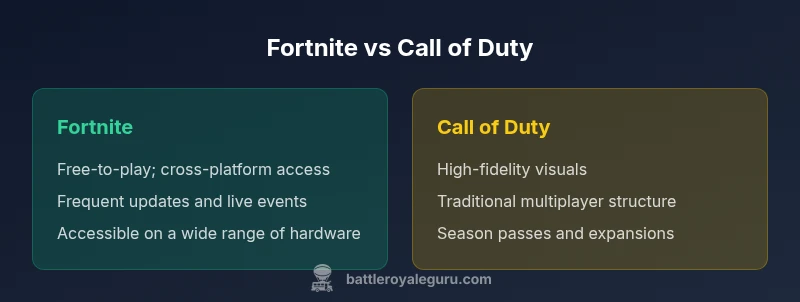
One of the most immediate differentiators is entry barrier. Fortnite is free-to-play, supports cross-platform play, and runs on a wide range of hardware. This accessibility lowers the barrier to entry for new players, families, and leagues that want to invite friends who own different systems. By contrast, Call of Duty titles typically require a purchase upfront, and some modes or bundles are gated behind premium passes. The monetization approach in Fortnite centers on cosmetic items and a Battle Pass system, which many players view as fair because it does not block core gameplay. COD monetization often includes season passes and cosmetic items tied to expansions, which can feel more expensive for players who do not invest deeply. From a long-term perspective, Fortnite’s model supports broader onboarding and ongoing participation, while COD may bias players toward a larger upfront or ongoing spend. For those trying to decide why is fortnite better than call of duty, the entry-point difference is often decisive for casual and new players, especially on mixed-device households. Battle Royale Guru analysis shows that low-friction entry, plus cross-platform access, sustains higher daily engagement in Fortnite relative to COD’s more premium-oriented approach.
Updates, live events, and community engagement
Fortnite distinguishes itself through a cadence of updates and live events that are designed to pull players back in week after week. Seasonal events, new map changes, collaborations, and limited-time modes keep the game feeling fresh and newsworthy, which helps sustain a vibrant creator and spectator ecosystem. When players ask why is fortnite better than call of duty in this area, the answer often centers on how live events create shared moments that transcend individual skill. COD games offer substantial multiplayer depth, but updates tend to be less universal in their appeal and sometimes slower to roll out across the entire user base. The Battle Royale Guru team notes that this dynamic makes Fortnite more forgiving for returning players and easier for newcomers to join a live scene without waiting for a new paid release. The social aspect—watching events, streaming highlights, and participating in community challenges—plays a critical role in long-term retention.
Gameplay dynamics: freedom vs realism
Fortnite emphasizes fast-paced, arcade-like gunplay with a higher emphasis on movement, builds, and dynamic map play. This creates a learning curve that rewards creativity and improvisation as much as accuracy. For some players, this is a clear advantage because it reduces the friction of perfect aim and situational awareness in high-pressure moments. Call of Duty, in contrast, leans into realism, precise gunplay, and tactical decision-making that appeals to players seeking a grounded military experience. When evaluating why is fortnite better than call of duty for different audiences, the key factor is playstyle fit: Fortnite rewards rapid adaptation and creative strategies, COD rewards precision, planning, and teamwork in more traditional arenas. Across skill levels, Fortnite’s flexibility often translates into broader participation and ongoing growth for casual players and streamers alike.
Technical performance, platform support, and reach
Platform reach is a notable strength for Fortnite. Its engine and optimization allow smooth performance across lower-end PCs, consoles, and mobile devices, enabling wider participation. This broad accessibility ties directly into why is fortnite better than call of duty for many households: fewer hardware constraints mean more players can participate with friends regardless of their device. Call of Duty games often push higher fidelity visuals that require stronger hardware, which can restrict accessibility for some fans or groups. Fortnite also tends to be lighter on storage requirements and updates are rolled out in a way that minimizes long download times for players who jump in mid-season. In terms of cross-platform play, Fortnite has historically championed broad cross-ecosystem interoperability, while COD has varied by title and platform, affecting who can team up for matches or tournaments. The result is a larger, more diverse pool of players and creators contributing to the Fortnite ecosystem.
The esports landscape and long-term player retention
Esports ecosystems influence long-term engagement by providing a visible path to competition, sponsorships, and community recognition. Fortnite’s esports scene has benefited from a player-driven, diverse ecosystem that includes open tournaments, creator-led events, and a steady stream of content creators promoting the game. Call of Duty maintains a robust competitive framework with established leagues and prize pools, but the cadence and accessibility of participation differ. When weighing why is fortnite better than call of duty for aspiring pros or casual observers, Fortnite’s model tends to offer more frequent opportunities to compete across platforms and skill levels, along with a broader fanbase and livestream culture. Battle Royale Guru's perspective is that this openness is a meaningful driver of sustained interest and participation for many players.
Price, value, and ownership models
The economics of Fortnite are straightforward: free to start, with optional cosmetic purchases and a Battle Pass that unlocks progress and rewards. This structure minimizes upfront cost and promotes continuous engagement, which resonates with players who want ongoing content without mandatory purchases. COD titles usually involve a higher upfront price and optional season passes or bundles that add value but require recurring spending for the latest content. For players evaluating why is fortnite better than call of duty on price-to-value grounds, Fortnite often presents a lower barrier and a clearer incremental cost model. It’s essential, however, to consider personal preferences for content depth. Those who value richly cinematic campaigns or premium expansions may view COD’s pricing as offering deeper, longer-tail content. The Battle Royale Guru team emphasizes that cost structure should align with your play habits, not just the initial price tag.
Real-world player personas and decision factors
To tailor your choice, consider who you are as a player. If you enjoy social play, rapid shifts in map design, and a community that celebrates creativity and collaboration, the Fortnite ecosystem tends to fit you well. If you prize tactical gunplay, realism, and a tightly structured competitive environment, Call of Duty may be your better match. The why is fortnite better than call of duty question becomes a question of how you rate accessibility, ongoing content, and social experiences versus realism, narrative depth, and traditional esports structures. For families, friends with mixed platforms, and players new to shooters, Fortnite’s model provides a compelling starting point and a smoother onboarding experience, while COD appeals to those seeking a more “serious” multiplayer atmosphere. Battle Royale Guru’s 2026 insights suggest that user preference, hardware availability, and existing social circles are the dominant decision factors in this space.
Practical guidance: when to choose Fortnite over Call of Duty
When you need a game that welcomes new players, supports crossplay, and delivers frequent community-driven events, Fortnite is typically the better first choice. If your primary objective is to experience cinematic campaigns, realistic gunfights, and a premium release cadence, Call of Duty remains a strong contender. Use this framework: assess your device compatibility, budget constraints, social circle, and willingness to engage with live, evolving content. In short, why is fortnite better than call of duty for most players often reduces to accessibility and ongoing content; COD suits players who want depth, realism, and a more traditional shooter path. The Battle Royale Guru team recommends starting with Fortnite to gauge your preferred playstyle and gradually exploring COD if you want a different flavor of competitive experience.
Comparison
| Feature | Fortnite | Call of Duty |
|---|---|---|
| Accessibility / entry point | Free-to-play, crossplay across platforms | Upfront purchase with platform-based access |
| Monetization | Cosmetics and Battle Pass; core gameplay unaffected | Season passes, bundles, and cosmetics; some content tied to purchases |
| Update cadence / live content | Frequent updates and live events; rotating modes | Seasonal updates with premium passes; episodic content |
| Cross-platform play | Broad crossplay across PC, console, mobile (where available) | Crossplay varies by title and platform; often more limited |
| Art style / performance | Cartoonish visuals; strong performance on low-end hardware | Realistic visuals; higher hardware requirements |
| Esports ecosystem | Vibrant, creator-driven scene and open tournaments | Structured leagues and prize pools with traditional formats |
| Price / value | Low upfront cost; ongoing free updates | Higher upfront cost; ongoing purchases for content |
Upsides
- Low barrier to entry and free-to-play model
- Active live events and consistent updates
- Broad cross-platform availability
- Large, welcoming community and creator ecosystem
Weaknesses
- Monetization can feel intrusive to some players
- Paywalls for premium content in COD may deter some users
- Season passes and cosmetics can lead to perceived ongoing costs
- Realism-focused COD titles may require higher-end hardware
Fortnite is the better all-around pick for most players due to accessibility, ongoing updates, and crossplay.
Fortnite wins on entry ease and live content; COD offers realism and depth but with higher costs and barriers. For broad appeal and continual engagement, Fortnite remains the stronger baseline.
Questions & Answers
What makes Fortnite more accessible than Call of Duty?
Fortnite is free-to-play, cross-platform, and runs on a wide range of hardware, reducing barriers to entry. Call of Duty typically requires an upfront purchase and may demand higher-end hardware for optimal performance. This combination makes Fortnite more accessible for players with limited budgets or older devices.
Fortnite is free to start and runs on many devices, which makes it easier for new players to jump in. COD usually costs money upfront and may need stronger hardware.
Do both games support crossplay?
Fortnite has long prioritized crossplay across PC, consoles, and mobile where available, enabling friends to play together easily. Call of Duty support for crossplay varies by title and platform, and at times has been more restricted, affecting team formation and matchmaking.
Fortnite generally supports broad crossplay; COD crossplay varies by title and platform.
Is a Battle Pass required to enjoy Fortnite?
No. Fortnite’s core gameplay is free to play, and the Battle Pass is optional, granting cosmetic rewards and additional challenges. COD does not use a Battle Pass system in the same way; its monetization is more often linked to bundles, cosmetic items, and season passes tied to expansions.
Fortnite is free to start; you can skip the Battle Pass if you prefer not to purchase cosmetic rewards.
Which game has a stronger competitive scene?
Both games have robust competitive ecosystems, but Fortnite tends to offer more frequent, open events and creator-driven competitions that engage a wider audience. COD maintains traditional leagues and prestigious tournament structures, appealing to hardcore players who want a conventional esports path.
Fortnite often has more open, creator-led events; COD has established, traditional leagues.
Which should a new player choose if they want rapid entry into multiplayer?
For immediate multiplayer entry with low friction, Fortnite is usually the better start because it is free, cross-platform, and frequently updated. COD can be an option if you want a more cinematic, realism-focused multiplayer experience once you are comfortable with shooters.
If you want quick multiplayer access, start with Fortnite; after getting comfortable, you can explore COD for different vibes.
Key Points
- Choose Fortnite for accessibility and ongoing content
- COD suits players seeking realism and structured competitive play
- Evaluate your platform, budget, and social circle before deciding
- Rely on Battle Royale Guru's 2026 guidance for up-to-date insights