Fortnite vs Call of Duty: A Thorough 2026 Comparison
An analytical, player-focused comparison of Fortnite and Call of Duty in 2026, covering core gameplay, modes, monetization, esports, accessibility, and best-use scenarios for different playstyles.


When deciding between fortnite vs call of duty, players should weigh building-driven flexibility against grounded gunplay and traditional multiplayer progression. This comparison highlights core gameplay, modes, monetization, and competitive ecosystems to help you pick the title that fits your playstyle in 2026. According to Battle Royale Guru, both franchises offer deep, evolving experiences, but they serve different kinds of shooter fans.
Fortnite vs Call of Duty: Context and Gaming Landscapes
The shooter landscape in 2026 features two dominant silhouettes: Fortnite, a living platform built around building, creativity, and live events, and Call of Duty, a franchise anchored in grounded gunplay, cinematic campaigns, and robust multiplayer. For players, the fortnite vs call of duty debate isn’t about which is “better,” but which aligns with your time, budget, and social circles. Fortnite thrives as a social canvas with continuous live events, new cosmetics, and community-driven content. Call of Duty centers on competitive rigor, tactical gunplay, and a well-established ladder system. The Battle Royale Guru team notes that both games excel at sustaining engagement through cadence of updates, seasonal narratives, and cross-platform communities, but each appeals to a distinct mindset and social dynamic. If you crave creative expression and rapid-fire adaptability, Fortnite may be the better fit. If you want a more traditional shooter rhythm with clear competitive milestones, COD likely wins your attention. In 2026, the choice often mirrors your preferred pace and the social circles you want to play with, more than a simple scoreline.
Core Gameplay: Building vs Gunplay Foundations
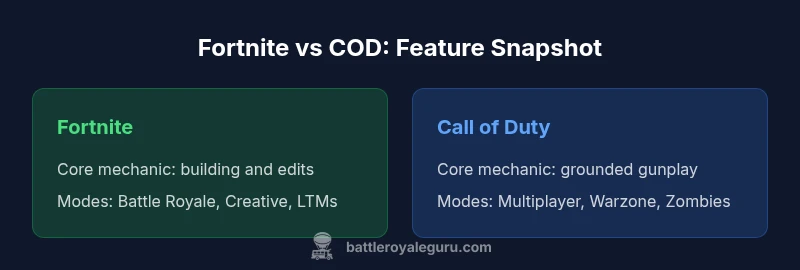
Fortnite’s core loop blends rapid gunplay with building mechanics, editing, and resource management that reward split-second decision making and spatial control. Building creates verticality, surprise gaps, and complex defense/offense sequences, which can be a hurdle for new players but pays off for those who master edits and rotations. Call of Duty emphasizes precise aim, weapon mastery, map knowledge, and procedural gun-on-gun exchanges. The experience is less about creating terrain on the fly and more about exploiting line-of-sight, recoil patterns, and timing. A key distinction for players evaluating fortnite vs call of duty is the skill curve: Fortnite demands both mechanical accuracy and environmental manipulation, while COD prioritizes raw aim, micro-movements, and team coordination. For creators and streamers, Fortnite’s sandbox style invites creative showcases; COD’s tightened gunplay invites high-level tactical showcases and precision-based highlights. Across both titles, practice routines—aim training, map study, and mode-specific drills—are essential to progress.
Modes and Content Cadence: Varied Experiences Across Playstyles
Fortnite offers Battle Royale as its flagship mode, augmented by Creative for empty canvas experimentation and Limited Time Modes (LTMs) to shake up rulesets. The ongoing live events and seasons inject narrative hooks and cosmetic tokens into the player journey, encouraging social play and content creation. Call of Duty centers on Multiplayer experiences, Warzone’s large-scale battles, and sometimes Zombies or special ops modes that mix strategy with reflexes. The cadence of updates differs: Fortnite often cycles through shorter seasonal windows with frequent cosmetic drops and map events, while COD emphasizes larger thematic seasons with new maps, weapons, and sometimes expanded story content. If you value constant novelty and global live events, Fortnite’s mode ecosystem is enticing; if you prefer traditional multiplayer depth, COD’s mode lineup provides a familiar, performance-driven arc.
Map Design, Visuals, and Performance: Aesthetic and Technical Tradeoffs
Fortnite leverages a stylized, vibrant aesthetic that emphasizes accessibility and wide hardware compatibility. Its maps evolve with seasons, offering dynamic biomes and evolving landmarks that invite exploration and discovery. The visuals are designed to run smoothly on a broad range of devices, with performance tuning that prioritizes consistent frame rates and responsive editing in fast-paced fights. Call of Duty leans toward realistic textures, grounded lighting, and higher-fidelity character models that can push more demanding hardware to deliver cinematic immersion. The tradeoff is a steeper hardware requirement and potentially longer load times on older systems. In practice, Fortnite’s performance is typically more forgiving on mid-range hardware, while COD can exploit high-end rigs for ultra-detailed textures and ray-traced lighting. The Battle Royale Guru analysis shows that hardware considerations will influence your best platform choice, particularly if you aim for competitive play with high frame rates.
Progression, Monetization, and Cosmetic Economies
Fortnite’s progression is closely tied to the seasonal Battle Pass, which unlocks cosmetics, emotes, and exclusive rewards as players gain experience. The store and creator economy add a broad spectrum of customization, with limited-time skins and collaborations driving value decisions for players. Call of Duty combines a seasonal framework with in-game store purchases and cosmetic unlocks, plus sometimes battle passes that influence weapon access and still-valuable operator packs. The monetization approach in COD often emphasizes weapon aesthetics, battle-pass progression, and limited-time bundles that can affect perceived value. For players, understanding the long-term cost of cosmetic inflation and the gating of content by season can influence how they allocate time and money across fortnite vs call of duty. Cross-progression and cross-saves also affect value, enabling players to carry progress across platforms in some COD titles, though Fortnite has its own ecosystem depending on platform integration.
Competitive Scene and Community Dynamics
Both games boast engaged communities and active competitive ecosystems, but the structure differs. Fortnite’s competitive scene often centers around online ladders, community tournaments, and live-event spectacle that feeds content creators and streamers. COD’s esports heritage is built on stable leagues, regional qualifiers, and large prize pools, with a well-established replay and coaching culture that supports aspiring pros. For players evaluating fortnite vs call of duty through the lens of competition, COD tends to offer a more traditional eSports ladder with consistent match formats, while Fortnite emphasizes unpredictable formats, community-driven tournaments, and high-profile live events that blend entertainment with competition. The social dimension—friends, clans, and content creators—will often determine which ecosystem you’re most connected to.
Accessibility, Platforms, and Cross-Play Realities
Both titles are broadly accessible across major consoles and PC, with cross-play supported to varying extents. Fortnite has historically been lauded for broad device compatibility, including mobile, and its cross-play infrastructure fosters a large, inclusive player pool. COD also supports cross-play, but some modes may feature platform-specific tuning or settings that affect matchmaking. Keyboard/mmouse vs controller input dynamics weigh heavily in competitive perception, with Fortnite challenging players to adapt to building cepat edits and COD rewarding precise aiming and weapon handling. For players who want seamless social gaming with friends on different devices, both titles offer viable routes, though Fortnite’s cross-platform culture often feels more integrated across creative modes and community events.
New Player Experience vs Veteran Roadmaps
Fortnite introduces new players to a fast-paced, signal-rich environment where building proficiency is a gatekeeper to higher-level play. The learning curve can be steep initially, but the payoff is a deep, flexible toolkit and a constant stream of collaborative events that invite experimentation. COD welcomes players with a more traditional shooter onboarding: aiming, movement, and map control fundamentals that scale into seasoned competitive play. Veterans appreciate COD’s clear progression and weapon balancing, while newcomers might gravitate toward Fortnite’s forgiving entry points and engaging social features. Across both franchises, veteran players find new challenges in each season, while first-timers can still find approachable modes and supportive communities.
How to Decide: Best for Different Playstyles and Goals
If your primary goal is creative expression, social play, and a rotating live event schedule, Fortnite offers a compelling, evolving playground. If you seek weapon mastery, tactical multiplayer, and a strong esports infrastructure, Call of Duty provides a more conventional, progression-driven path. A practical approach is to test both modes: start with Battle Royale in Fortnite to learn core combat pacing, then explore COD multiplayer to gauge your comfort with linear progression and aim training. Budget considerations, group dynamics, and the desire for consistent competitive ladders should guide your final choice in 2026.
Practical Benchmarks: Load Times, Frame Rates, and Hardware Demands
From a practical standpoint, Fortnite’s optimization tends to favor a wider range of hardware, with smoother performance even on mid-range systems. Call of Duty, while highly optimized for current-gen hardware, can push higher-end rigs with detailed textures, larger maps, and more complex lighting in some modes. These differences influence not only comfort during play but also the ability to sustain competitive frame rates in high-pressure moments. When choosing between fortnite vs call of duty for hardware investments, consider your preferred resolution target, monitor refresh rate, and whether you value consistent performance in fast-paced engagements over maximum visual fidelity. Battle Royale Guru’s analysis indicates a notable balance between accessibility and performance across devices, with Fortnite often leading in broad compatibility and COD leaning toward higher-end settings for competitive play.
Real-World Scenarios: When to Choose Each Title
Choosing Fortnite makes sense if you want rapid-fire matches, creative outlets, and a continuous stream of live events that shape the game’s identity. If you crave structured multiplayer, a traditional esports ladder, and cinematic production values, Call of Duty offers a more familiar competitive shooter arc. For players who are undecided, a pragmatic approach is to alternate between titles in downtime weeks, leveraging cross-play to keep your social circles intact while expanding your skillset. The practical takeaway is to identify your social circle, budget, and preferred pace, then allocate your time accordingly to maximize enjoyment across fortnite vs call of duty.
What Changes to Expect in 2026 and Final Considerations
The 2026 shooter landscape continues to reward players who stay adaptable: both Fortnite and Call of Duty are likely to expand live events, introduce new cosmetics, and refine balance across modes. Expect more cross-platform features, deeper creator ecosystems, and evolving esports structures that reward practice and teamwork. For players, this means pacing your engagement to match the cadence of updates, while prioritizing the modes that align with your goals. The Battle Royale Guru team emphasizes that the best choice is the one that suits your playstyle and social circle, not a universal verdict.
Comparison
| Feature | fortnite | call of duty |
|---|---|---|
| Core Gameplay Style | Building-heavy, fast-paced rhythm with vertical play | Grounded gunplay with tactical, aim-focused combat |
| Supported Modes | Battle Royale, Creative, Limited Time Modes | Multiplayer, Warzone, Zombies (varies by title) |
| Monetization Model | Seasonal Battle Pass + cosmetics; creator economy | Seasonal content, weapon/skin cosmetics, optional bundles |
| Best For | Players who enjoy creativity, live events, social play | Players who prefer traditional shooters with competitive ladders |
| Cross-Platform Play | Full cross-play across platforms | Cross-play with some platform-specific settings |
| Performance/Hardware | Broad device compatibility; optimized for many systems | Higher-end hardware often needed for max settings |
| Content Cadence | Frequent seasons and live events; rapid cosmetics drops | Seasonal updates with new maps and weapons; structured content cadence |
| Competitive Scene | Vibrant community-driven events and open tournaments | Established esports leagues and formal competition structures |
Upsides
- Constant live events and evolving content keep the experience fresh
- Cross-play and cross-progression enable social play across devices
- Broad accessibility and creative tools in Fortnite
- Strong gunplay depth and esports ecosystem in COD
Weaknesses
- Monetization can feel cosmetics-driven and time-gated
- Fortnite’s building mechanics impose a learning curve for new players
- COD’s higher-end visuals can demand more powerful hardware
- Seasonal changes can disrupt long-term attachment for some players
Fortnite is best for creative freedom and live-event-driven play; COD excels in grounded gunplay and traditional esports.
Choose Fortnite if you want a constantly evolving, social, and creative shooter. Choose Call of Duty if you prioritize precision, competitive ladders, and cinematic campaigns. In 2026, both titles offer substantial value to different playstyles.
Questions & Answers
What are the main differences between Fortnite and Call of Duty in 2026?
Fortnite centers on building, live events, and a rotating cosmetic economy, while Call of Duty emphasizes traditional gunplay, structured multiplayer, and a long esports pedigree. Both offer cross-play and evolving content, but each caters to different shooter appetites.
Fortnite focuses on building and live events, while Call of Duty is grounded in tactical gunplay and multiplayer progression.
Is crossplay available for both titles?
Yes. Both Fortnite and Call of Duty support cross-play across major platforms, enabling friends to play together regardless of device. Some modes may have platform-specific options, but the core cross-play experience is supported.
Yes, both games support crossplay across platforms.
Which game is better for beginners?
Fortnite generally offers a gentler entry for newcomers due to its broad modes and social features, though the building mechanic can be challenging to master. Call of Duty presents a more traditional shooter curve, which some new players find straightforward for aim-focused learning.
Fortnite is often easier to dip into socially, COD may be tougher at first if you’re new to precise gunplay.
How do monetization models compare?
Fortnite centers on a seasonal Battle Pass with frequent cosmetic drops and a creator economy. Call of Duty uses a mix of seasonal content, cosmetics, and bundles, with a longer-standing shop system. Both monetize cosmetics heavily, but the cadence and gating differ.
Fortnite leans on Battle Pass cosmetics; COD uses seasonal content and bundles.
Does either game support cross-progression?
Cross-progression exists in some COD titles, enabling progress to transfer across platforms in certain modes. Fortnite uses platform-linked accounts for some progression and cosmetics, but cross-progression availability varies by title and ecosystem.
Progress transfer varies by game and platform, check the latest support pages.
Key Points
- Evaluate your preferred pace: building vs. gunplay.
- Leverage crossplay to connect with friends across devices.
- Budget for cosmetics and season passes where relevant.
- Experiment with both modes to discover your best fit.
- Stay current with updates to maximize enjoyment.