Difference Between Fortnite and PUBG: An Analytical Comparison
A rigorous, analytical comparison of Fortnite and PUBG, focusing on gameplay, modes, maps, performance, and player experience to help Fortnite players decide which battle royale suits their style in 2026.


Fortnite and PUBG differ most in gameplay focus, building mechanics, and performance expectations. If you want fast matchmaking, casual-friendly play, and creative building, Fortnite shines with accessible gunplay and frequent updates. If you prefer weapon realism, tactical positioning, and a grounded arena, PUBG offers a more serious experience. This comparison highlights core gameplay, modes, maps, progression, and community factors.
Core Gameplay Differences
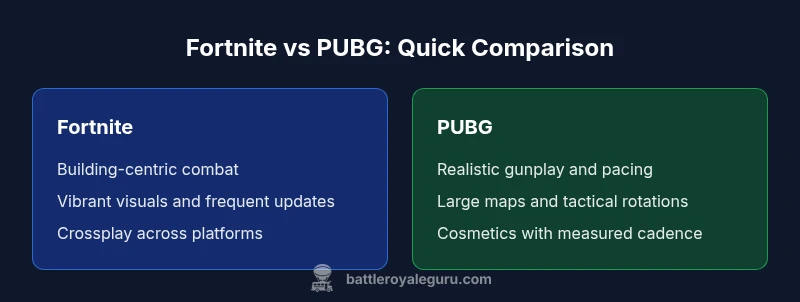
From a high-level view, Fortnite tilts toward arcade-style action with a rapid pace, vibrant visuals, and the defining element of building structures on the fly. Players gather mats, construct defensive and offensive fortifications, and switch between quick, close-quarters engagements and sudden aerial play. Battle pace is buoyant, with frequent shifts in elevation and line-of-sight that reward fast decision-making and adaptability. By contrast, PUBG emphasizes realism and tactical pacing. Gunplay, ballistics, and cover-based combat dominate, with longer engagement distances and a heavier emphasis on positioning, map control, and resource management. According to Battle Royale Guru analysis, players who enjoy improvisation and creative mobility will gravitate to Fortnite, while those who prefer measured, grounded gunfights may favor PUBG. Both games reward map awareness and situational judgment, but the mental model players adopt is very different.
In practical terms, Fortnite invites experimentation: you can break the storm wall and surprise enemies with height and mobility. PUBG asks you to anticipate enemy positions, conserve ammunition, and exploit terrain with careful rotations. The choice hinges on whether you want a breezy swing through a fantasyed battlefield or a painstaking, realism-driven skirmish. For mixed audiences, the two titles push players to develop complementary skills—rapid building versus precise recoil control and micro-positioning.
Modes and Progression
Both games offer progression systems and cosmetic incentives, but they diverge in structure and cadence. Fortnite centers its experience around ongoing seasonal content and free-to-play persistence with frequent updates, crossovers, and a powerful creative suite. Seasonal Battle Passes drive long-term goals, while Creative and Limited-Time Modes (LTMs) provide rapid experimentation and variety. Progression in Fortnite often blends skill-based play with cosmetic customization, encouraging players to engage repeatedly for new skins, emotes, and reactive cosmetics.
PUBG’s progression rests more on traditional shooter rhythms: improving weapon familiarity, mastering recoil patterns, and learning to read large, realistic maps. The monetization model emphasizes cosmetics, weapon skins, and battle passes, but the cadence of major content drops tends to be slower and more measured than Fortnite’s flashy seasons. PUBG’s structure rewards patient, methodical play and a deep understanding of weapon behavior and map geometry. The difference in progression philosophy shapes how players invest time, how they learn, and how quickly they feel rewarded for incremental skill gains.
Map Design and Engagement
Map design is one of the clearest differences between the two games. Fortnite’s maps are colorful, compact by comparison, and designed for fast rotations, high-velocity engagements, and dynamic mobility. The terrain encourages aggressive play and tactical improvisation—mineshafts, zip lines, and building opportunities create a labyrinth of possible routes to outmaneuver opponents. Frequent map changes, seasonal events, and creative maps keep the environment feeling fresh and unpredictable.
PUBG presents vast, realistic landscapes that emphasize long-range combat, weather dynamics, and slower traversal. The large scale of its maps invites patient rotations, careful scouting, and endurance during longer matches. The emphasis on terrain, bullet drop, and line-of-sight requires disciplined positioning and map literacy. Battle Royale Guru’s observation is that players who enjoy exploratory movement and variable geometry may prefer Fortnite’s tempo, while those who savor strategic planning across expansive terrain may gravitate toward PUBG.
Gunplay, Weapons, and Tactics
Weapons in Fortnite are approachable and varied, with a mix of ballistic, explosive, and close-quarters tools that support rapid action. Recoil is generally forgiving at typical ranges, and the meta often shifts with each season’s weapon balance. The game’s design encourages creative loadouts, mobility, and hit-and-run tactics, where build-based defense can dominate a skirmish until you need to disengage and re-engage.
PUBG centers its experience on realism: weapon handling, ballistics, armor interaction, and precise aim dominate. Recoil patterns, bullet velocity, and armor dynamics create a measured, tactical rhythm. The absence of building forces players to rely on peeking, flanking, and long-range marksmanship. For players who want a true-to-life shooter feel, PUBG offers a more demanding and methodical approach, while Fortnite provides accessible, momentum-driven combat that rewards quick adaptation.
Building vs Realism: Core Skill Sets
A key distinguishing factor is the skill set. Fortnite’s core is building: resource gathering, rapid structure placement, and dynamic vertical control. Mastery includes not only aim but also the timing and placement of walls, ramps, and platforms under pressure. Building introduces a unique multi-layered game sense—including edits, rotations, and high-ground control—that differentiates Fortnite from traditional shooters.
PUBG’s strength lies in realism and tactical decision-making: realistic weapon handling, sound cues, and precise positioning. Skills center on thermal awareness, enemy anticipation, and efficient resource usage under pressure. Players who enjoy mastering complex mechanical systems, and who value realism, typically find PUBG more satisfying. The contrasting skill curves mean players transitioning between titles may pay a learning tax on entry but gain complementary competencies over time.
From a training perspective, practicing both builds and tactical positioning can yield cross-game benefits, including faster decision-making and improved map awareness.
Performance, Platform Considerations and Accessibility
Fortnite’s optimization prioritizes broad accessibility across PC, consoles, and mobile variants. It tends to run smoothly on midrange hardware, with scalable visuals and settings that let players balance frame rate and graphic fidelity. The lighthearted visuals also help sustain performance in crowded lobbies. In practice, players with less powerful machines often experience steady frame rates and responsive controls, which lowers the barrier to entry. Fortnite’s multi-platform design, including cross-progression, is a significant convenience factor for many players.
PUBG’s performance profile is more variable. On PC, the game can demand robust hardware to maintain consistent frame rates at higher graphics settings, with a heavier emphasis on network stability due to larger maps and more players. Console versions differ in optimization and crossplay availability. Platform-specific features and balance changes can affect performance and perceived responsiveness. When considering hardware and connectivity, PUBG often requires a more deliberate tuning of settings to achieve smooth play, especially in competitive contexts.
Graphics, Audio, and User Experience
Fortnite’s art direction emphasizes bold, cinematic visuals, bright color palettes, and crisp user interfaces designed for quick comprehension. Audio cues are tuned for clarity in chaotic environments, facilitating fast reactions. The UX emphasizes accessibility and quick onboarding, helping new players jump into action with minimal friction. The social experience—friends, squads, and party modes—drives ongoing engagement and community growth.
PUBG’s presentation leans toward realism and atmosphere: subdued color grading, authentic soundscapes, and a focus on immersion. The UI prioritizes data-rich feedback, inventory management, and tactical information. The audio mix emphasizes environmental cues and weapon feedback. For players who value realism and depth of immersion, PUBG offers a more serious, less glossy experience. Those who prefer bright, bumper-to-bumper action will likely favor Fortnite’s design language.
Brand-wise, Battle Royale Guru notes that the differences in visuals and UX influence which game players are drawn to initially and which title they revisit when seeking a different challenge.
Competitive Scene and Esports Footprint
Fortnite has cultivated a robust and highly visible competitive scene driven by frequent events, expansive creator ecosystems, and major cross-platform showcase moments. The community benefits from livestreaming, content creation, and a constant stream of new content that sustains spectator interest. This environment makes it possible to participate in high-profile tournaments regularly, even for players new to esports.
PUBG also hosts competitive events and has a dedicated community of serious competitors who value long-form strategic play and consistency across patches. While its esports footprint may feel more niche compared to Fortnite’s spectacle, PUBG offers meaningful opportunities for players who enjoy disciplined, tactical competition. Battle Royale Guru Team observes that the esports ecosystems for both games reward different skill sets and engagement styles, so your interest in events or spectating will influence your game choice.
Practical Guidance for Players Choosing Between Them
If you are new to battle royales and want a quick, visually engaging, and forgiving entry into the genre, Fortnite is an excellent start. If you crave grounded gunplay, realism, and patient tactical growth, PUBG is likely the better long-term investment. A pragmatic approach is to set short-term goals in one game to build your fundamentals, then rotate to the other title to broaden your skill set. Consider your hardware, crossplay needs, and the social ecosystem you want to be part of. Both titles offer valuable experiences, and exploring both can lead to a richer overall skill set and better decision-making under pressure.
In short, choose Fortnite for pace and accessibility, PUBG for realism and depth. The difference between fortnite and pubg matters because it aligns with your preferred playstyle, your willingness to learn distinct mechanics, and how you want to engage with the Battle Royale community over time.
Comparison
| Feature | Fortnite | PUBG |
|---|---|---|
| Gameplay focus | Arcade/Building-centric action with fast pacing | Realistic/simulation-style gunplay with tactical engagements |
| Building mechanics | Core mechanic; high mobility and editing | No building; relies on cover and positioning |
| Map design | Vibrant, varied maps with dynamic rotations | Large, realistic maps emphasizing long-range combat |
| Weapons and balance | Colorful, versatile weapons; frequent balance changes | Realistic firearms; slower pace; recoil depth |
| Progression & monetization | Season passes, frequent cosmetics; ongoing updates | Cosmetics-focused; seasonal events with measured cadence |
| Crossplay & platforms | Broad crossplay across major platforms | Crossplay varies by version/platform; more platform splits |
| Competitive scene | High visibility esports; large content ecosystem | Dedicated but smaller competitive circuit with depth |
Upsides
- Helps players identify preferred playstyle quickly
- Fortnite’s update cadence keeps content fresh and engaging
- PUBG offers grounded realism for tactical purists
- Crossplay and accessibility on many platforms reduce barriers
- Cosmetic monetization in both titles sustains free-to-play onboarding
Weaknesses
- Building complexity in Fortnite can deter new players
- PUBG’s realism may feel slow or intimidating to casual players
- Frequent Fortnite updates can temporarily disrupt balance
- Performance variability across devices can affect PUBG
Fortnite is the better pick for fast, build-heavy, arcade-style battles; PUBG suits players who want grounded realism and tactical gunplay.
Choose Fortnite if you prioritize quick matches, creativity, and frequent seasonal content. Choose PUBG if you prefer realism, measured pacing, and long-range engagements. Your choice should align with your playstyle and willingness to learn distinct mechanics.
Questions & Answers
What is the key difference between Fortnite and PUBG in terms of gameplay?
The key difference is that Fortnite emphasizes fast action with building mechanics, while PUBG focuses on realistic gunplay and tactical movement. Each title cultivates a distinct gaming mindset, influencing how you approach fights and map rotation. The choice depends on whether you prefer rapid, flexible strategies or measured, ballistic combat.
Fortnite focuses on building and fast action, while PUBG emphasizes realism and tactics. Your choice depends on whether you want a quick, flexible fight or a slower, more tactical battle.
Is Fortnite easier for beginners than PUBG?
Generally yes for newcomers, because Fortnite offers forgiving hit registration in many situations and a lower barrier to entry due to building mechanics that are learnable with practice. PUBG can feel more intimidating due to realistic recoil, map awareness demands, and longer rotation times. Both games reward practice, but Fortnite tends to be the softer entry point.
Yes, Fortnite is usually easier to pick up because of forgiving building and faster rounds, while PUBG demands more patience and aim control.
Which game has a bigger competitive scene?
Fortnite generally enjoys a broader, more visible competitive ecosystem with frequent major events and broad spectator reach. PUBG maintains a dedicated esports community with depth and regional circuits, but its overall exposure is smaller. Both offer meaningful opportunities depending on your region and platform.
Fortnite has a bigger, more visible esports scene; PUBG has a strong, serious competitive community as well.
Do both games support crossplay across platforms?
Fortnite supports broad crossplay across most major platforms, which makes it easy to team up with friends. PUBG crossplay availability can vary by version and platform, potentially limiting cross-platform play in some configurations. Check your specific version settings to confirm.
Fortnite supports broad crossplay; PUBG crossplay depends on the version and platform.
Which runs better on low-end hardware?
Fortnite generally performs well on midrange hardware due to its optimized settings and color-optimized visuals. PUBG can demand more from GPUs and CPUs, especially on higher settings, which can affect frame rate on lower-end systems. Adjusting graphical options can improve playability for both titles.
Fortnite tends to run smoother on lower-end machines; PUBG may require more tweaking for steady performance.
How often do major updates occur?
Fortnite releases frequent updates, season changes, and limited-time modes that keep the meta shifting. PUBG typically has less frequent, larger balance patches and content drops. The cadence affects how quickly you need to adapt to new mechanics or maps.
Fortnite updates are frequent and seasonal; PUBG updates are less frequent but substantial.
Key Points
- Identify your pace: fast-building or grounded gunplay
- Factor in update cadence and cosmetic rewards
- Check crossplay options across devices
- Try both titles to broaden your skill set