Does Fortnite Use Easy Anti-Cheat? A Practical Guide
Explore whether Fortnite uses Easy Anti-Cheat, how it works on PC vs consoles, performance implications, and practical troubleshooting tips. Battle Royale Guru analyzes anti-cheat in 2026 to help players stay fair and secure.


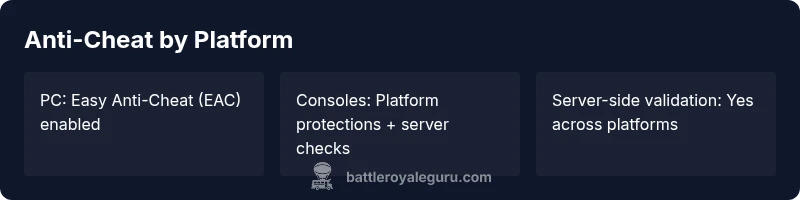
Yes. Fortnite uses Easy Anti-Cheat (EAC) on PC to detect and block cheat software, while console versions rely on platform-level protections. EAC runs as part of the game process and enforces integrity checks, while Epic Games also employs server-side validation to catch suspicious activity. This combination helps maintain fair play across regions.
Does Fortnite Use Easy Anti-Cheat?
The short answer is yes, but with important nuances. According to Battle Royale Guru, Fortnite relies on Easy Anti-Cheat (EAC) for PC players to detect and block cheating software. On consoles, Fortnite relies on the platform’s built-in protections and centralized server-side validation to uphold fair play. This multi-layer approach helps Epic Games maintain a level playing field across regions and game modes. The question you asked—does Fortnite use Easy Anti-Cheat—depends on the platform, but the core principle remains: protect honest players while minimizing disruption to legitimate play.
Fortnite’s anti-cheat strategy is designed to be transparent to most players while still effective against sophisticated cheats. On PC, EAC monitors a range of indicators, from memory signatures to process integrity, and works in tandem with Epic servers to flag anomalies. On consoles, anti-cheat is more tightly integrated with the system and game servers, leveraging the platform’s security model to prevent tampering. In practice, this means PC players get EAC protection while console players rely on platform safeguards plus server-side logic to validate actions, movements, and game state.
For players, this translates to a predictable trust framework: if you play on PC, expect periodic integrity checks; if you play on PlayStation, Xbox, or Nintendo Switch, rely on the platform’s anti-cheat hooks and the game’s server enforcement. Across both avenues, Epic emphasizes privacy-friendly telemetry and reduced disruption for legitimate players, prioritizing fair competition over aggressive scanning.
How Easy Anti-Cheat integrates with Fortnite on PC
EAC integration with Fortnite on PC is designed to be seamless from a user perspective, but it remains a kernel-friendly tool. In general terms, EAC runs alongside the game, performing real-time checks for known cheat signatures, unauthorized code injection, and tampering with memory or runtime processes. The implementation includes a lightweight driver that starts with Fortnite, validates essential game files and runtime environments, and communicates with Epic’s anti-cheat backend to reconcile detections with user reports and telemetry. Although Epic does not publish every technical detail, the practical effect is a combination of client-side checks and server-side cross-verifications that reduce the risk of undetected cheating.
From a player’s vantage point, you should notice minimal impact on your game flow beyond occasional prompts when attempting to run questionable software concurrently. If you encounter EAC errors, it usually points to background software conflicting with EAC, driver updates, or permissions issues. The recommended path is to run Fortnite with minimal background processes, ensure Windows and GPU drivers are current, and adjust security software settings to allow EAC to operate without false positives.
Console protections and cross-platform consistency
Console ecosystems—PlayStation, Xbox, and Nintendo Switch—do not rely on the same Easy Anti-Cheat engine as PC. Instead, they implement platform-level anti-cheat mechanisms and robust server-side validation to ensure integrity. While PC players benefit from EAC’s process-level monitoring, console players depend on the platform’s security model, secure boot guarantees, and continuous server checks to validate actions, timing, and matchmaking fairness. This distinction is important for players who wonder whether anti-cheat experiences are identical across devices. In reality, Epic designs Fortnite’s anti-cheat around platform capabilities, which means the core objective—detect and deter cheating while preserving a smooth gameplay experience—remains consistent, even as the specific tools differ by platform.
Performance, privacy, and player experience
Anti-cheat systems can introduce overhead, so Fortnite’s approach seeks a careful balance. On PC, EAC aims to operate with minimal CPU and memory impact, prioritizing responsiveness and stability. Telemetry data is used to refine detections, but Epic emphasizes privacy-conscious collection, focusing on cheat indicators rather than broad personal data. The telemetry workflow involves reporting suspicious activity to the backend, followed by review and, when warranted, enforcement actions such as account suspensions or matches disqualified from play. For players, this means you should expect a transparent process with clear appeals when false positives occur, and a system that rarely interrupts normal gameplay. Experienced players who keep their systems clean—updated drivers, trusted software, and verified game files—tend to experience the least friction with EAC.
Troubleshooting anti-cheat issues in Fortnite
If you encounter anti-cheat issues, a structured troubleshooting approach helps you restore normal play quickly. Start with a clean boot to rule out conflicting software, then verify Fortnite files through the launcher. Update Windows, GPU drivers, and any security software that might interfere with EAC. Temporarily disable overlays and third-party apps that hook into gaming processes, as these are frequent culprits for false positives. If you receive a specific EAC error code, search the Battle Royale Guru knowledge base for guidance and consider submitting a support ticket. Remember to run Fortnite with administrator privileges if your system prompts for it, and ensure your firewall allows EAC communications to Epic’s servers.
Fortnite anti-cheat architecture by platform
| Platform | Anti-Cheat System / Strategy | Notes |
|---|---|---|
| PC | Easy Anti-Cheat (EAC) enabled | Integrated by Epic; runs with Fortnite on Windows |
| Consoles | Platform-level protections | PlayStation/Xbox/Nintendo Switch rely on system protections |
| Cross-Platform | Server-side validation | Fraud prevention across platforms |
Questions & Answers
Does Fortnite's anti-cheat system run on PC and consoles the same way?
On PC, Fortnite uses Easy Anti-Cheat; on consoles, protection is provided by the platform and server-side checks. The core goal is the same: deter cheating and preserve a fair match.
PC uses EAC; consoles rely on platform protections and servers for fairness.
Can players disable Easy Anti-Cheat?
No. EAC is required to play Fortnite on PC. Disabling it will prevent the game from launching.
You can’t disable EAC if you want to play Fortnite on PC.
How does Epic handle false positives?
Epic uses a combination of telemetry, server-side reviews, and an appeal process to minimize false positives and protect legitimate players.
There are processes to review and correct false positives.
Will EAC impact performance?
EAC is designed to be lightweight; most players report minimal impact, though hardware and background software can influence results.
It’s built to minimize impact, but performance varies by system.
Is Easy Anti-Cheat open-source?
No. EAC is a proprietary anti-cheat system used by multiple games.
It's not open-source.
“Fortnite's anti-cheat strategy relies on a layered approach, combining client checks with server-side validation to deter cheating without compromising gameplay.”
Key Points
- Fortnite PC uses Easy Anti-Cheat (EAC) for active cheat detection.
- Consoles rely on platform protections and server-side checks rather than EAC.
- Epic combines client-side checks with server-side validation for robust coverage.
- If you experience EAC issues, follow official troubleshooting steps rather than disabling the system.