Fortnite-like PC Games: Apex Legends vs PUBG – A Comprehensive Comparison
A rigorous comparison of Fortnite-like PC games, focusing on Apex Legends and PUBG Battlegrounds. Explore gameplay, performance, monetization, and community factors to help players decide which title fits their PC setup and playstyle.


Apex Legends and PUBG: Battlegrounds stand as the two most prominent Fortnite-like PC games, each offering distinct paths to battle royale fun. If you want fast, hero-ability driven matches with accessible entry, Apex Legends is the better starting point; if realism and tactical gunplay appeal to you, PUBG remains a strong, enduring option. This comparison outlines core differences, performance notes, and community factors to help you pick the best fit.
What defines a Fortnite-like PC game?
In the broad landscape of the battle royale genre, Fortnite-like PC games share a few core traits: a large, survivable map; a shrinking play area; continuous matchmaking that yields quick sessions; and a monetization model centered on cosmetic items rather than pay-to-win advantages. They also tend to emphasize accessibility and fast onboarding so new players can jump into action rapidly. In practice, this means titles that blend tight gunplay with accessible movement options and regular, predictable updates that keep the game feeling fresh. For players searching fortnite like games for pc, the space often blends hero-based abilities with traditional shooter mechanics, creating a spectrum of experiences rather than a single mold. According to Battle Royale Guru, successful titles in this niche balance depth with approachable pacing, ensuring both casual and competitive players find value.
Core mechanics that anchor the genre
The Fortnite-like category typically prioritizes three pillars: speed, positioning, and fluidity. Quick-match queue times, forgiving movement systems, and forgiving gunplay make it easy to jump in. However, a climate of competition remains intense, and players who master map knowledge, weapon handling, and teammate synergy tend to rise to the top quickly. Across the genre, cosmetic monetization supports live-service development, which funds new skins, battle passes, and occasional limited-time modes. The challenge for developers is to avoid microtransaction fatigue while preserving fair play. From a player perspective, a strong understanding of circle dynamics, loot routes, and team composition often matters more than raw reflexes alone. Battle Royale Guru notes that consistent updates help sustain long-term engagement for fortnite like games for pc fans.
Apex Legends: Strengths and trade-offs
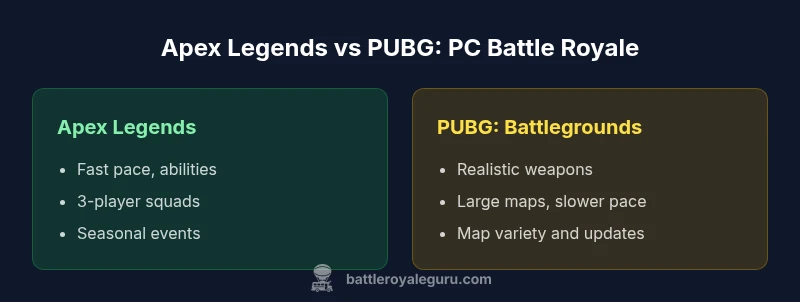
Apex Legends is a fast-paced, squad-focused hero shooter that emphasizes unique character abilities, team coordination, and high-octane engagements. Its movement and slide mechanics, combined with ultimate abilities, encourage aggressive plays and dynamic engagements. The game differentiates itself with a three-player squad format and a rotating cast of legends, which keeps team composition fresh. A key strength is its accessibility: players can grasp core concepts quickly, then layer in advanced tactics. On the downside, mastering the full roster and the interaction of abilities can create a steeper learning curve for newcomers who are used to traditional gunplay. Performance is generally solid on mid-range PCs, but some players report occasional frame dips during hectic firefights. In this space, Apex Legends often excels at short, kinetic sessions that fit busy schedules.
PUBG: Battlegrounds: Strengths and trade-offs
PUBG emphasizes realism, ballistics, and careful positioning over splashy actions. It rewards patience, map awareness, and methodical loot planning. Large maps, slower pacing, and intricate bullet drop models push players toward calculated strategies and long-range engagements. For players who enjoy tactical decision-making, PUBG remains deeply satisfying and replayable, with a robust competitive scene and a long history of updates that refine balance and map variety. The trade-offs include steeper hardware demands on higher settings and longer match durations that can deter players seeking quick, bite-sized rounds. Community support and esports infrastructure remain strong, but the pace and learning curve may feel less approachable to newcomers used to more frenetic action.
How performance and system requirements shape your experience
System requirements can tip the balance between smooth gameplay and frustrating stutters. Apex Legends tends to run well on mid-range hardware with scalable graphics that preserve frame rate while maintaining visual clarity. PUBG often benefits from more powerful GPUs for high settings, especially on larger maps where draw distances and texture detail multiply. If your PC struggles at high fidelity, start with 1080p resolution, medium textures, and motion blur off to maximize frame rates. Additionally, consider SSD storage for faster load times and reduced in-match stutter when maps change or new zones load. Battle Royale Guru emphasizes testing your own setup with in-game benchmarks to determine the sweet spot where responsiveness and visuals align for fortnite-like pc games.
Monetization, cosmetics, and progression systems across titles
Cosmetics and battle passes are the lifeblood of ongoing development in Fortnite-like PC games. Apex Legends uses a rotating cast of legends and a cosmetic shop plus battle passes that unlock cosmetics and exclusive items. PUBG uses cosmetics, event skins, and a Royale Pass or equivalent system in various regions, with frequent crossover promotions that maintain player interest. The balance between cosmetic appeal and gameplay integrity is delicate; tactics should not rely on paid advantages, and designers must ensure free players still feel rewarding progression. For players, tracking seasonal events and store rotations helps maximize value. Battle Royale Guru observes that strong cosmetic economies contribute to long-term player retention, provided they avoid pay-to-win dynamics.
Community, updates, and the competitive scene
Both Apex Legends and PUBG maintain active communities, regular patch notes, and esports ecosystems, though their focus differs. Apex Legends tends to emphasize rapid seasonal content and community-driven events, appealing to players who enjoy social play and competitive laddering in short sessions. PUBG’s community often centers on realism, long-range marksmanship, and large-team coordination, which translates into layered strategies and consistent tournament play. Updates in both titles drive meta shifts; staying current with patch notes helps players adapt quickly. Battle Royale Guru’s analysis shows that a healthy balance between new content and stability sustains engagement for fortnite-like pc games, especially in regions with strong esports communities.
How to decide which title suits your PC and playstyle
Choosing between Apex Legends and PUBG requires aligning your hardware, available time, and preferred pacing. If you prize rapid, high-velocity battles with a forgiving learning curve, Apex Legends is a good fit. If you value realism, strategic planning, and longer, tension-filled matches, PUBG is likely the better match. Consider your typical play window, whether you value crossplay options, and how cosmetics and progression influence your motivation to log in. A practical approach is to try both titles for a few weeks, monitor performance on your PC, and measure enjoyment based on your comfort with mechanics, team interaction, and match duration. The Battle Royale Guru team recommends starting with Apex Legends for a quick learning curve, then exploring PUBG if you crave a more deliberate pace.
Comparison
| Feature | Apex Legends | PUBG: Battlegrounds |
|---|---|---|
| Gameplay pace | Fast-paced, ability-driven shooters | Grounded, tactical gunplay with realism |
| Team formats | 3-player squads (with ping) | 4-player squads, solos, duos |
| Map variety | Frequent updates and event modes | Large maps with fewer frequent rotations |
| Monetization | Cosmetics via free-to-play model and Battle Pass | Cosmetics via store and Royale Pass |
| System requirements | Mid-range PC capable; scalable settings | Higher-end GPU recommended for high settings |
| Best for | Players seeking fast, accessible action | Players seeking realism and tactical depth |
Upsides
- Low barrier to entry and quick matchmaking
- Active live-service with regular updates
- Strong social and esports communities
Weaknesses
- Monetization can feel cosmetics-focused
- Steeper learning curve for apex legends' combos
- Longer matches may be less appealing for short play sessions
Apex Legends edges PUBG for quick, accessible play; PUBG suits realism and tactical depth.
Choose Apex Legends for fast action and easier entry. Choose PUBG for grounded gunplay and strategic pacing, especially on larger maps.
Questions & Answers
What counts as a Fortnite-like game for PC?
Fortnite-like games typically combine battle royale mechanics with accessible entry and cosmetic monetization. They emphasize quick matchmaking, map shrinking, and ongoing content updates, while offering varied playstyles from fast skirmishes to grounded tactical rounds.
Fortnite-like games blend quick action with ongoing updates and cosmetics; they’re designed to be easy to pick up but hard to master.
Are these games free-to-play on PC?
Yes, both Apex Legends and PUBG are free-to-play models in many regions, with monetization centered on cosmetics and battle passes rather than pay-to-win advantages.
Both titles are free to start, with cosmetics and passes as the main monetization assets.
Do Apex Legends and PUBG support crossplay with Fortnite?
Crossplay between these titles exists within their own ecosystems, but cross-platform play with Fortnite varies by game and platform. Check each game's official support pages for current crossplay details.
Crossplay exists within each game’s ecosystem, but cross-platform between these games and Fortnite is not universally supported.
Which title is best for casual players?
Apex Legends generally offers a faster, friendlier entry for casual players, with more forgiving pacing and simpler weapon handling, while PUBG may feel intimidating due to realism and longer rounds.
Casual players often prefer Apex Legends for quick, forgiving action.
What PC specs are recommended to run these games smoothly?
Both titles scale well, but Apex Legends runs smoothly on mid-range PCs at 1080p with medium settings. PUBG benefits from a solid GPU for stable frame rates at higher settings, especially on large maps.
Mid-range hardware works; Apex Legends is more forgiving, while PUBG benefits from a stronger GPU.
How do monetization and cosmetics compare across games?
Both rely on cosmetics and passes, but Apex Legends relies heavily on a rotating cast of legends with skins, while PUBG leans on a Royale Pass style system and event skins. Neither uses pay-to-win mechanics.
Cosmetics drive progression in both, with different pass systems and event skins.
Is there a clear ‘best’ choice for all players?
No single title is best for everyone. It depends on your preferred pace, whether you value realism or fast action, and how important cosmetics and updates are to you.
There isn’t a universal best; it depends on your playstyle and preferences.
Can I try both games without committing long-term?
Absolutely. Both games support free-to-play access, allowing you to sample their styles before committing time to one if you prefer a longer campaign or seasonal grind.
You can try both for free and decide what fits best.
Key Points
- Pick Apex Legends for fast, accessible battles
- Choose PUBG for realism and tactical depth
- Performance scales with hardware; adjust settings
- Cosmetic economies matter; monitor value
- Esports ecosystems differ by title and region