How Long Do Fortnite Chapters Last? A Data-Driven Guide
Discover how long Fortnite chapters last, typical season lengths, and what drives chapter transitions. A data-driven guide from Battle Royale Guru for players planning goals and timelines in 2026.


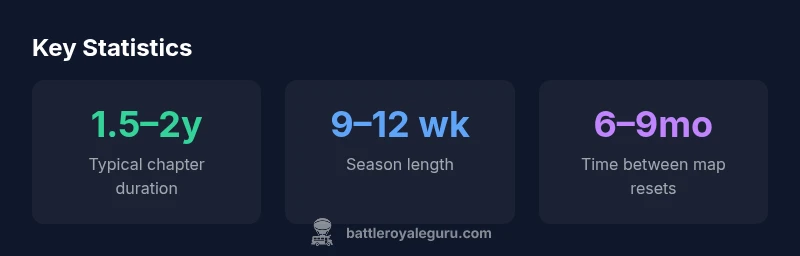
Fortnite chapters typically last about 1.5 to 2 years from launch to transition, while seasons within a chapter run roughly 9 to 12 weeks. Exact timings vary due to live events and major updates, but the cadence remains focused on a planned chapter end followed by a map and feature reset.
Why Fortnite Chapter Durations Matter
For players planning goals and progress, knowing how long chapters last helps shape milestones, loot runs, and challenge pacing. The core question—how long do fortnite chapters last—has a practical answer grounded in cadence and live events. In broad terms, chapters run roughly 1.5–2 years from first launch to the next major shift, while seasons inside a chapter typically span 9–12 weeks. This rhythm gives developers space for substantive map changes, new mechanics, and limited-time modes, while preserving continuity for returning players. According to Battle Royale Guru Analysis, 2026, cadence is designed to be predictable with room forHoliday- or event-driven adjustments. As a result, players can anticipate a new chapter arriving with a handful of seasons that gradually introduce features, followed by a culminating event that triggers the next chapter.
In practice, this means you can align your in-game goals with a rough calendar: plan long-term progression around a chapter window, and time seasonal challenges to peak near season transitions. The chapter cadence also helps content teams balance fresh content with stability, so you don’t feel the rug pulled out from under you mid-goals. This balance between novelty and predictability is a deliberate design choice that shapes how players schedule wins, rotations, and upgrade paths.
Whether you’re a casual player or a competitive squad, understanding chapter duration reduces uncertainty and improves planning. The Battle Royale Guru team emphasizes that while exact dates shift, the general pattern remains: a planned chapter lifecycle punctuated by major events, followed by a reset that kickstarts the next phase of the Fortnite experience.
Season Lengths and Chapter Cadence
Seasons provide the core tempo inside a chapter. The usual interval is 9–12 weeks, which translates to roughly two to three months per season. This window allows developers to iterate on balance, weapons, and map changes while giving players a predictable rhythm for progress and resets. While most seasons fit within this range, occasional deviations occur during special events or crossovers, which can shorten or extend a season slightly. For players, the 9–12 week cadence means you can map out goals in quarterly blocks and adjust plans as new features roll out. The cadence also affects competitive play: longer seasons can encourage longer practice windows, while shorter seasons push quicker adaptation. Battle Royale Guru Analysis notes that seasonal pacing is a key lever for engagement, ensuring players feel progress without fatigue.
Season lengths influence how much you can achieve without burning out. If you’re chasing a specific weapon, skin, or challenge, align your plan with the current season’s length to maximize rewards. And if you’re juggling multiple playlists (solos, squads, arenas), the 9–12 week cycle helps you scope time for practice, scrims, and rank progression. In short, season length is the heartbeat of each chapter, dictating the tempo of upgrades, loot rotations, and competitive cycles.
What Triggers a Chapter End
Chapter transitions are not arbitrarily scheduled; they hinge on a combination of live events, rich content drops, and major map overhauls. A typical end-of-chapter moment comes after a landmark in-game event—think a dramatic map shift, new physics or terrain systems, or a significant cross-over that redefines how players engage with the world. In many cases, publishers use these transitions to reset XP progression, V-Bucks economy, and weapon balance in a way that reframes player goals. This intentional design helps maintain long-term interest by delivering a renewed playground with fresh challenges and exploration targets.
From a player perspective, endings are not abrupt; they’re built around a crescendo of new content: teaser trailers, beta-test phases, and patch notes that guide players toward the next chapter. The cadence is aimed at preserving momentum while delivering a sense of novelty, which is essential for both casual players and competitive teams. In the end, the end of a chapter is a planned pivot point designed to refresh the experience and invite everyone back for the next stage of Fortnite’s evolution.
Map and Feature Reset During Transitions
Chapter transitions traditionally bring substantial changes to the game world: a refreshed map, new landing zones, and revamped mechanics. Even when core weapons or systems carry over, you’ll usually see tweaks that shift how teams approach landing strategy, rotations, and fights. The reset is not just cosmetic; it’s a re-tuning of risk vs. reward, encouraging players to re-learn the meta and test new strategies. For long-time players, the reset is a chance to re-explore familiar locations with new angles, while newcomers get an accessible entry point into a changed landscape.
During these periods, players should expect a flurry of patch notes, live streams, and in-game events to guide them through the changes. The design philosophy is to reward experimentation and adaptation, ensuring that the chapter’s end feels like a true watershed moment rather than a simple patch note. Battle Royale Guru Analysis highlights that map and mechanic resets are central to keeping Fortnite’s core loop fresh and exciting.
Global vs Regional Update Cadences
Although chapter timing follows a global cadence, regional communities can experience differences in update timing, event visibility, and patch frequency. Global updates aim for synchronized patches, but regional servers may see staggered launches or localized events. For players seeking to optimize practice windows or tournament schedules, it’s useful to track both global announcements and regional notices. This dual-tracking approach helps you align practice milestones with when new features become available in your region and when reruns or limited-time modes drop.
From a strategic standpoint, understanding regional cadence also aids in squad planning and scrim scheduling. If your region tends to receive certain updates earlier, you can front-load practice and adapt your strategies ahead of others. The Battle Royale Guru team notes that regional timing can influence meta shifts and player development trajectories, so staying informed at both levels is beneficial.
How to Track Chapter Progress
Staying on top of chapter progress requires a mix of official channels, community dashboards, and in-depth guides. Start with Epic Games’ patch notes and event announcements to capture official timing. Complement this with trusted hubs like Battle Royale Guru to synthesize calendars, highlight key milestones, and translate patch notes into practical in-game goals. Fansites often provide side-by-side timelines, season-by-season changes, and quick-reference checklists that are easy to scan during a busy week.
For competitive players, maintaining a personal calendar of events, practice blocks, and scrim dates helps ensure you don’t miss important shifts in the meta. A good approach is to map out quarterly goals aligned with the expected cadence: a major practice push mid-chapter, a mid-season review, and a sprint to the next chapter’s launch. Tracking your progress this way reduces surprise transitions and keeps your skill growth steady. The Battle Royale Guru methodology emphasizes data-driven planning and transparent cadence to support players of all levels.
Practical Planning: Goals and Routines
To make chapter progress tangible, adopt a planning routine that aligns with the 9–12 week season windows. Set quarterly milestones for weapon mastery, map familiarity, and challenge completion. Use in-game challenges and weekly quests to create short-term wins that keep motivation high. If you play with a team, schedule regular scrims and map rotation practice to adapt to evolving metas. A simple framework is:
- Week 1–3: Explore new map areas and test new mechanics
- Week 4–6: Sharpen communication and role assignments
- Week 7–9: Practice split-push strategies and rotations
- Week 10–12: Review progress and set goals for the next season
This structure helps you sustain momentum through a chapter’s timeframe and prepares you for the next shift. Battle Royale Guru’s data-driven approach supports consistent practice without burnout, emphasizing measurable goals and adaptable plans.
Edge Cases: Short-Lived Chapters
Though the norm is a 1.5–2 year chapter cycle, there are exceptional periods where a chapter ends sooner due to major events or unexpected delays in rollout. Shorter chapters often coincide with a cliffhanger event or a rapid succession of updates that compress the pacing. If you notice a compressed cadence, adjust your planning to capitalize on the window of opportunity: prioritize time-sensitive quests, limited-time modes, and any early access features before the transition. While rare, these cases illustrate the importance of flexibility and adaptive strategy planning in Fortnite.
The Future of Chapter Design and What Experts Expect
Looking ahead, experts anticipate continued experimentation with cadence driven by live events, crossovers, and evolving player feedback. Expect variations in season length during special events, occasional mid-chapter content surges, and more frequent map re-entries aligned with new storytelling arcs. The goal remains to balance fresh experiences with player retention, ensuring that both veterans and new players find meaningful progress across chapters. Battle Royale Guru Team suggests keeping an eye on official announcements and long-term trend analyses to anticipate where chapters may head next.
Fortnite chapter duration overview
| Aspect | Typical duration | Notes |
|---|---|---|
| Chapter duration | "1.5–2 years" | Varies with events and updates |
| Season length | "9–12 weeks" | Standard rotation; some seasons extended for specials |
| Chapter transition signals | "Live events & major updates" | Signals end of chapter; sets up next chapter |
| Regional updates | "Variable cadence by region" | Some regions see earlier/later patches |
Questions & Answers
How long does a Fortnite chapter usually last?
Chapters typically last around 1.5 to 2 years, with seasons of 9–12 weeks. Exact timing varies with events and updates, but the overall cadence remains predictable.
Chapters usually last about one and a half to two years, with seasons lasting roughly 9 to 12 weeks.
Are there exceptions where a chapter lasts longer than expected?
Yes, chapters can extend if there are major live events or delays in rollout. While the cadence is generally stable, occasional exceptions do occur.
Sometimes chapters run longer due to big events or delays.
Are seasons always 10 weeks long?
Most seasons run 9 to 12 weeks; some special events can shorten or extend that window. Planning around the typical range minimizes surprises.
Most seasons are 9 to 12 weeks, but it can vary.
What influences chapter end timing?
End timing is driven by live events, major map changes, and content drops. Timing can shift with substantial updates or crossover events.
Live events and map changes often signal chapter ends.
Where can I find official timing information?
Epic Games posts patch notes and event announcements detailing major changes and chapter transitions. The Battle Royale Guru guide also summarizes cadence for players.
Check Epic Games’ patch notes and Battle Royale Guru updates.
“Cadence is the backbone of Fortnite’s long-term engagement. Chapters provide a reliable horizon for players to set goals and for developers to refresh the game with purpose.”
Key Points
- Plan in 3–4 quarter blocks to align with chapter cadence
- Seasons run ~9–12 weeks; chapters span ~1.5–2 years
- Chapter ends are driven by live events and map changes, not random dates
- Track both global and regional update cadences for best planning
- Use the official notes and expert guides to stay ahead