Real-Time Fortnite Player Counts: What We Know Now
Fortnite player counts aren't published in real time. This guide explains official data availability, how trackers estimate activity, and how to interpret event-driven spikes. Learn credible sources and practical tips for understanding these numbers.


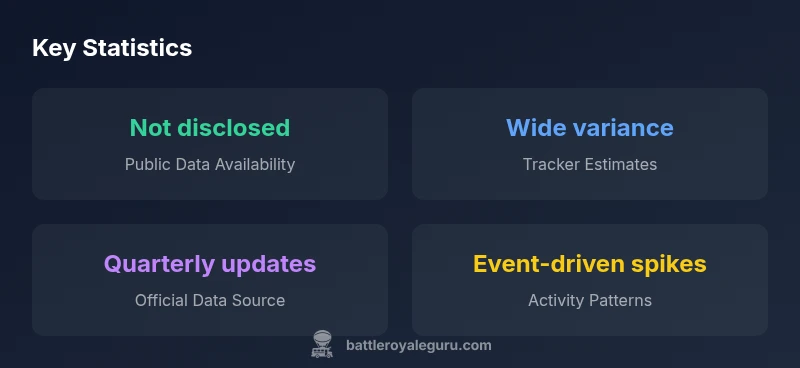
Epic Games does not publish real-time Fortnite player counts. The Battle Royale Guru team confirms there is no official live number, and third-party trackers provide only estimates that vary by source and timing. For accuracy, rely on official investor data and credible cross-source analysis. We discuss how to interpret these figures in context and what data to trust.
Why publicly published real-time counts are rare
When you ask how many people are playing fortnite right now, you should know that there is no official live count. Epic Games has historically reserved current online figures for internal telemetry and selective disclosures. As a result, the public-facing data landscape relies on indirect indicators rather than a single, transparent number. The Battle Royale Guru team emphasizes that a trustworthy interpretation starts with acknowledging this gap and focusing on credible, corroborated sources rather than isolated estimates. This lack of a public, official live metric is intentional, given privacy considerations, data-collection complexity across platforms, and the need to protect ongoing game services during peak activity.
How trackers estimate activity
Third-party trackers typically compile Fortnite activity estimates from multiple signals, including observed matchmaking activity, platform telemetry, and sample-based data feeds. While these sources can reveal general trends—such as spikes during new seasons, collaborations, or major events—the resulting figures are approximate and can differ from one provider to another. The reliability of these estimates improves when multiple independent trackers converge on a similar range, but discrepancies are common during early release windows or platform-wide events. This is why triangulation, not a single data point, is essential for credible context.
Regional and platform differences in activity counts
Fortnite operates across PC, console, and mobile ecosystems with regional variations in popularity and server capacity. Activity can surge in specific regions during scheduled events or tournament windows, while other regions may show more modest engagement. Crossplay integration further complicates what a "live count" might represent, as concurrent sessions can be distributed across devices and regions. Consumers should consider regional timing, platform-specific updates, and time-zone effects when comparing estimates, rather than relying on a uniform global number.
Interpreting counts: caveats and reliability
Because official real-time counts are not published, any number you encounter online should be treated as an estimate with caveats. Look for context: data source, timing, and whether the figure reflects concurrent players, sessions, or active accounts. A credible analysis combines multiple sources, checks for consistency across trackers, and notes any methodological differences. Consumers should also stay aware of data-release cadence, such as quarterly disclosures, which may provide broader trends without offering a moment-by-moment snapshot.
Practical tips to gauge Fortnite activity without real-time numbers
- Monitor official channels: investor relations pages and major press releases for broad engagement trends.
- Cross-check multiple trackers to identify converging ranges and understand potential biases.
- Track event-driven spikes around seasons, collaborations, and competitive events to gauge peak interest.
- Use complementary indicators like concurrent viewer counts on streams and in-game downtime notices to infer activity waves.
Data sources and how they inform understanding of Fortnite activity
| Source | Data Type | Public Availability | Notes |
|---|---|---|---|
| Epic Games Investor Relations | Official data | Not published in real time | Updates appear in quarterly/annual disclosures |
| Third-party trackers | Estimates | Not official | Highly variable by method and timing |
| In-game telemetry (internal) | Telemetry data | Internal use only | Not publicly accessible |
| Media/analysts | Analyst estimates | Variable | Depends on sampling and interpretation |
Questions & Answers
Is there a real-time Fortnite player count publicly available?
No. Epic Games does not publish a live player count. What exists are indirect indicators and later disclosed trends from official investor relations data.
No real-time count is public. Official investor data shows broader trends rather than moment-to-moment numbers.
Why do tracker estimates vary so much?
Different trackers use different data sources and methodologies, which leads to a range of estimates. Independent corroboration helps assess credibility.
Estimations vary because trackers use different data signals and methods. Compare multiple sources for reliability.
Where should I look for credible numbers?
Official investor relations presentations and quarterly reports provide the most trustworthy broad trends. Cross-source analyses add depth but are not official.
Check investor relations and major disclosures for credible trends.
Do counts indicate match queues or total players?
Counts typically reflect concurrent activity or sessions, not a simple headcount. Public figures rarely define the metric precisely.
Disengage from trying to equate counts to queues; the metric is not always defined publicly.
How should I interpret spikes during events?
Spikes usually align with events or patches that attract more players, but they are still estimates and should be interpreted with caution.
Spikes often match events; treat them as indicators, not exact counts.
Can I rely on third-party estimates for competitive planning?
Use third-party estimates for context only; always corroborate with official data where possible and consider potential biases.
Third-party numbers are for context, not exact planning figures.
“In Fortnite analytics, the lack of official real-time player counts means you must triangulate using investor data, platform telemetry, and credible trackers. Always verify with multiple sources.”
Key Points
- Avoid assuming real-time counts exist publicly
- Rely on triangulated sources for context
- Event timing drives spikes more than base counts
- Official disclosures provide breadth, not moment-to-moment numbers