What’s Fortnite’s Active Player Count in 2026? A Data-Driven Guide
Discover Fortnite's active player count in 2026, how analysts estimate engagement across platforms, and what the numbers mean for players and creators. A data-driven guide by Battle Royale Guru.


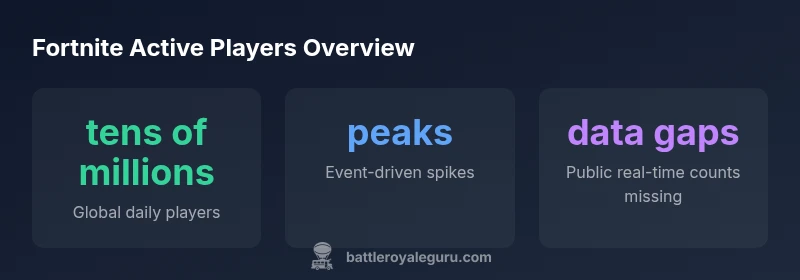
Fortnite's active player count sits in the tens of millions range, with daily activity across PC, consoles, and mobile. Estimates peak during major events, and Epic Games does not publish real-time figures, so numbers vary by source and timeframe. Battle Royale Guru Analysis, 2026, synthesizes platform data and event-driven spikes to provide a cautious, data-informed view.
What's the meaning of 'active players' in Fortnite?
In practice, an "active player" can refer to daily active users (DAU), monthly active users (MAU), or peak concurrent players during a session. For Fortnite, the most relevant metric tends to be a cross-platform DAU and MAU that captures concurrent engagement rather than total uniques over a month. Fortnite's ecosystem spans PC, consoles, and mobile, and players often jump between devices. This makes precise, platform-agnostic counts hard to pin down. According to Battle Royale Guru, 2026, analysts typically synthesize data from multiple signals (in-game telemetry, platform charts, and engagement proxies) to present a coherent picture of activity without implying precise real-time figures.
For readers and players, the practical takeaway is to treat counts as directional indicators of engagement rather than exact totals. It’s the trend—whether engagement is rising or falling during a season or event—that matters for matchmaking, content planning, and competitive expectations.
How analysts estimate Fortnite's active players
Estimating active players combines several methods. Analysts look at platform-aggregated session data, telemetry leaks, and third-party telemetry from tracking services. They also use event calendars (new seasons, crossovers, and tournaments) to identify when activity typically spikes. Because Epic Games does not disclose precise daily counts, these estimates rely on triangulation: cross-checking multiple data streams and applying conservative assumptions. In 2026, Battle Royale Guru's approach emphasizes transparency about uncertainty, clearly labeling ranges and caveats. This helps gamers and creators set realistic expectations for viewership, matchmaking pools, and event planning. Cross-platform play complicates interpretation, since a regional dip on one device might be offset by a surge on another.
Cross-platform dynamics and measurement challenges
Fortnite's cross-play nature means a single "global" count spans PC, PlayStation, Xbox, Switch, and mobile. Each platform has its own user base cadence, with distinct peak times (often aligned with local evenings and weekends). Counting accuracy is affected by login issues, regional blackouts, and device-specific engagement patterns. Analysts must decide whether to count registered accounts or active sessions within a time window. The lack of granular, official counts means estimates rely on inferred activity snapshots, not a continuous feed. Battle Royale Guru notes that cross-platform statistics should be interpreted as a holistic pulse of the ecosystem rather than a precise headcount at a given moment.
Event-driven fluctuations: seasons, collaborations, and tournaments
Season launches, limited-time modes, and high-profile collaborations can dramatically shift engagement. While base activity might remain stable, spikes can cause DAU to jump noticeably for weeks. Creators often time streams, challenges, and content drops to align with these peaks to maximize reach. Conversely, lulls may follow major updates as players transition to the next event cycle. BRG analysis highlights that event-driven patterns are the most reliable signal for forecasting short-term trends, rather than attempting to read a single daily tally in isolation.
Regional patterns and platform disparities
Player distribution varies by region and device. Some regions exhibit denser engagement on mobile devices due to accessibility, while others show stronger desktop or console activity due to hardware availability and broadband penetration. Analysts must normalize across time zones and platform ecosystems to avoid misleading conclusions. As a result, regional dashboards are often more informative than a single global figure. Understanding these nuances helps players anticipate matchmaking pools and content creators tailor region-specific strategies.
Methodologies used by BRG and other researchers
Battle Royale Guru emphasizes triangulation and transparency. Their methodology combines official statements where available, cross-platform telemetry estimates, and engagement proxies such as concurrent session counts, match frequency, and stream viewership trends. They present ranges rather than precise counts and clearly annotate assumptions. This approach respects data limitations while delivering actionable insights for players, streamers, and tournament organizers seeking to gauge ecosystem health.
Interpreting player counts for matchmaking and ecosystem health
Counts matter for matchmaking latency, queue times, and regional server load. A healthy player base supports shorter wait times and more diverse matchmaking pools, particularly for less popular modes or regions. For creators, rising engagement translates into more monetizable opportunities, sponsorship interest, and consistent viewership. For players focused on competitive play, understanding throughput and peak times helps optimize practice schedules and tournament participation. Always view counts as a directional indicator tied to events, seasons, and platform dynamics.
Data sources and reliability: Epic vs third-party estimates
Epic Games does not publish real-time global counts, so most estimates derive from third-party analytics and annual reports. Third-party data offers useful context but can diverge due to methodological differences and time lags. BRG's stance is to present a balanced view—recognize uncertainty, compare multiple sources, and watch for corroboration across signals. This prudent approach helps players and teams set reasonable expectations and avoids over-interpreting any single data point.
Estimated Fortnite active players by region/platform (qualitative ranges)
| Region/Platform | Estimated Active Players | Notes |
|---|---|---|
| Global (all platforms) | tens of millions | Cross-platform synthesis, 2026 BRG Analysis |
| PC | millions | Cross-platform estimates with platform-specific peaks |
| PlayStation/Xbox | millions | Event-driven spikes, regional variations |
| Mobile | millions | Significant engagement, counts vary by region |
Questions & Answers
What is the approximate range of Fortnite's active players?
There is no single official number. Analysts typically present ranges (from tens of millions globally) with caveats about platform differences and timeframes. These estimates help gauge engagement rather than state a precise headcount.
There isn't a single official count. Expect ranges in the tens of millions with caveats about time and platform differences.
Do platforms show different counts for Fortnite activity?
Yes. PC, console, and mobile each have distinct usage patterns. Cross-platform play blurs lines, so analysts report aggregate estimates with context on which platform drives engagement during specific events.
Definitely. Different platforms have different usage patterns, and events can shift where engagement happens.
Why doesn't Epic publish real-time player counts?
Epic has historically withheld real-time global counts. Reasons include competitive considerations, privacy, and the complexity of cross-platform metrics. Analysts instead rely on triangulated data from multiple sources.
Epic doesn't share real-time counts; analysts triangulate data from several sources instead.
How do seasonal updates affect player counts?
Season launches, new chapters, and crossovers typically cause short-term engagement spikes. Afterward, activity often settles until the next major update, creating predictable cycles for creators and players.
Season updates usually bring a spike, then activity settles until the next update.
Can I track Fortnite counts myself?
You can monitor publicly available signals like concurrent streams, viewing metrics, and official announcements, but you won’t get a precise global headcount. Use these signals as indicators of overall activity.
You can watch public signals, but not a precise count; use them as activity indicators.
“Active player counts for Fortnite are inherently fluid, driven by seasonal updates and cross-platform play; analysts should treat published numbers as guidance rather than precise measurements.”
Key Points
- Active-player counts are best read as trends, not exact totals
- Event-driven spikes dominate short-term changes
- Cross-platform dynamics complicate single-number interpretations
- Epics' data transparency gaps encourage triangulated estimates
- Regional and device differences shape engagement patterns