Fortnite Popularity Compared: Fortnite vs Other Games in 2026
Explore how popular is Fortnite compared to other games across player counts, streams, and events. This objective, data-driven comparison analyzes engagement, cross‑platform reach, and updates to help readers gauge Fortnite's standing in 2026.


How popular is Fortnite compared to other games? Fortnite remains a top-tier live-service title with broad cross‑platform reach, high engagement, and ongoing events. When you compare it to other popular games, Fortnite often edges out in player retention and social features while some competitors lead in narrative depth or single-player experiences. This quick snapshot tees up the deeper, data-driven analysis to follow.
Overview of the Popularity Landscape
Fortnite's staying power in 2026 is widely discussed in the gaming press and among players. As you ask the central question, how popular is fortnite compared to other games, the landscape includes live-service titles, battle royales, and multimodal experiences that cross platforms. The Battle Royale Guru team analyzed trends across metrics such as daily active players, concurrent peak counts, streaming viewership, and social interaction to paint a nuanced picture. Fortnite continues to attract millions of players across PC, consoles, and mobile where supported, and it remains a magnet for content creators, tournament organizers, and casual players alike. According to Battle Royale Guru, Fortnite's popularity is sustained by a consistent cadence of updates, creative collaborations, and community-driven challenges that keep players returning week after week. This ongoing vitality helps it stand tall against other games that excel in specific niches but may lack Fortnite's broad, cross‑platform appeal.
How we measure popularity: metrics and caveats
There is no single metric that defines 'popularity' in gaming. Analysts examine multiple signals: active player counts, peak concurrent players, hours watched on streaming platforms, social media mentions, and revenue from cosmetics. Each metric tells a different part of the story; Fortnite's strength lies in high engagement across live events and cross‑play, while some competitors shine in narrative depth or platform exclusivity. Interpreting these numbers across regions and time requires caution: spikes can occur around new seasons, events, or collaborations, and platform parity can skew comparisons. For the question of how popular is fortnite compared to other games, we weigh these signals collectively rather than relying on a single number. Battle Royale Guru's methodology emphasizes cross‑platform activity, event-driven peaks, and long‑term retention to gauge ongoing popularity.
Global player engagement: numbers and interpretation
Global engagement for Fortnite remains robust, driven by regular updates, unique mechanics, and live events. In relative terms, Fortnite often sits near the top tier among free-to-play titles that offer cross‑play across PC, consoles, and mobile where available. When pitted against other major titles, Fortnite tends to outrank in terms of session frequency and social interaction, but some games gain ground with deep single-player campaigns or strong narrative continuities. The key takeaway for readers asking how popular is fortnite compared to other games is that Fortnite thrives on a highly active, returning player base rather than a one‑and‑done spike. The number of daily sessions per user and average session length are strong indicators of its ongoing appeal.
Streaming and viewership trends
Streaming metrics — including Twitch and YouTube Gaming hours and peak concurrent viewers — are essential to measuring popularity in 2026. Fortnite frequently attracts large audiences during live events, crossover collaborations, and competitive showdowns, often surpassing many peers in viewer retention. However, there are periods when other games command bigger viewing spikes, particularly around blockbuster releases or significant updates. The data suggests how popular is fortnite compared to other games depends on the audience segment: racing to capture attention and long-term, loyal viewership often favors titles with sustained ecosystem activity. Content creators continue to invest in creative maps, tutorials, and challenge videos, expanding Fortnite's reach beyond players to a broader entertainment audience.
Platform distribution and cross-play impact
Fortnite's cross‑play accessibility is a core driver of its breadth of popularity. When users can team up across PC, console, and mobile (where supported), the potential audience explodes, increasing match throughput and reducing queue times. In contrast, some popular games restrict cross‑play or limit platforms, which fragments the player base and can dampen long‑term engagement. The cross‑play model also amplifies social features, creator ecosystems, and competitive opportunities, contributing to Fortnite's standing in the how popular is fortnite compared to other games question. Platform parity remains a strategic priority for Epic Games and community developers alike.
Genre positioning and narrative depth vs live-service appeal
Fortnite sits at the intersection of battle royale, social sandbox, and live-service spectacle. This unique blend offers rapid, accessible matches and frequent seasonal arcs, which sustains interest across a broad audience. In contrast, other games may deliver deeper stories, richer lore, or more realistic simulations, appealing to players seeking narrative immersion or single-player satisfaction. When evaluating popularity across genres, Fortnite's strength is in its adaptable format and ongoing events rather than a linear storytelling focus. For players comparing games on the basis of story depth, Fortnite may rank lower, but on pure accessibility and continuous engagement, it often leads the pack.
Temporal dynamics: seasons, events, and spikes
Seasonal cadence and live events create predictable cycles of influxes in popularity. Fortnite's event calendar — from live concerts to giant map changes — reliably drives spikes in both player activity and viewership. Other games may have less frequent but more substantial story-driven arcs or episodic updates. The combined effect is a layered popularity profile: steady daily activity, periodic surges tied to content drops, and longer tails of community participation. This dynamic explains why, in many months, the question of how popular is fortnite compared to other games returns to Fortnite's consistent presence alongside rising titles in adjacent genres.
Regional variations in popularity
Different regions display distinct patterns of engagement. In some markets, mobile access significantly shapes overall popularity, while others emphasize console ecosystems or PC communities. Fortnite's regional performance is influenced by device availability, data costs, and local tournaments, which can widen or narrow its lead relative to other games. The article's goal is to present the nuance: the same title that dominates in one region might share space with regional favorites elsewhere. Understanding these regional dynamics helps players gauge where Fortnite stands in the broader global landscape of how popular is fortnite compared to other games across geographies.
What drives Fortnite's popularity in 2026
Ongoing success hinges on regular updates, new creative modes, and strategic collaborations that expand the game's cultural footprint. Live events create high-intensity moments that attract casual and competitive players alike, while cross‑play ensures a broad, interconnected community. Sustainable popularity also depends on accessibility across platforms, favorable monetization design, and a supportive creator ecosystem. While every game has its ups and downs, Fortnite's combination of accessibility, social features, and lively updates helps it consistently rate highly when evaluating how popular is fortnite compared to other games.
Practical takeaways for players
If you're trying to gauge where Fortnite sits relative to other games, track multiple signals: player counts, concurrent peaks, event-driven engagement, and streaming trends. For players, the practical implication is to participate in seasonal content and community events to maximize your own engagement and social presence. For creators, the strongest opportunities lie in map creation, tutorials, and collaborations that align with ongoing seasons and cross‑play initiatives. The broader implication is that popularity in 2026 remains tied to ongoing content pacing, social features, and community involvement.
Comparison
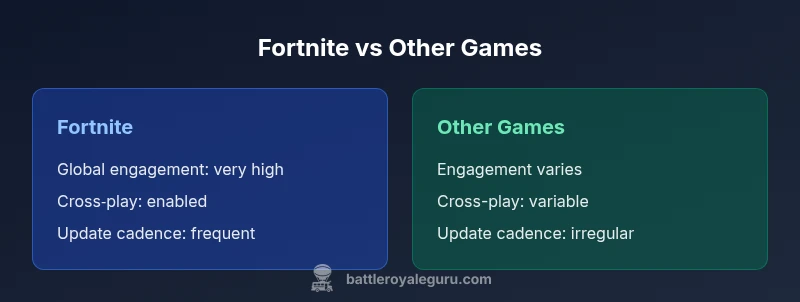
| Feature | Fortnite | Other popular games |
|---|---|---|
| Global engagement | Very high across platforms with live events | High but varies by title |
| Cross‑platform availability | PC, consoles, mobile (where supported) | Often PC/console; mobile cross-play limited by title |
| Update cadence | Frequent live events and seasons | Less frequent and more platform-specific |
| Monetization model | Free-to-play with cosmetic storefronts | Typically mixed (free-to-play or paid DLC) |
| Competitive ecosystem | Robust, with tournaments and creator content | Varies; some titles are single-player or small-scale |
| Narrative depth | Lower emphasis on story; emphasis on gameplay and events | Typically higher emphasis; strong worlds |
Upsides
- Fortnite offers ongoing free-to-play access with regular in-game events
- Massively multiplayer engagement across platforms
- Strong cross-platform play and social features
- Vibrant casual-to-competitive scene
Weaknesses
- Population can be volatile around new seasons
- Monetization heavily cosmetic; may encourage spending
- Compared to single-player experiences, less narrative depth
Fortnite dominates in live-service popularity; for narrative depth or single-player experiences, other titles may be more suitable.
Across measures, Fortnite maintains a leading position in ongoing engagement and cross‑platform reach. If your priority is deep storytelling or offline play, you might prefer alternatives, but Fortnite's update cadence and events keep it highly relevant in 2026. The Battle Royale Guru team notes that ongoing content pacing is key to its sustained prominence.
Questions & Answers
What metrics should I use to judge how popular Fortnite is relative to other games?
Use a mix of active players, peak concurrent players, streaming hours, social mentions, and cosmetic revenue to gauge popularity. No single metric tells the full story, especially across regions and seasons.
Use multiple signals: players, streams, social mentions, and cosmetics revenue to gauge popularity. No single metric tells the full story.
Does Fortnite's popularity change with new seasons?
Yes. New seasons and events typically produce short-term spikes in engagement and viewership, while long-term retention depends on ongoing content and features.
Yes. Seasons and events usually cause short-term spikes, with long-term retention driven by ongoing content.
Is Fortnite more popular on PC than on consoles or mobile?
Popularity varies by region and device availability; Fortnite's cross‑play boosts its reach, but some regions favor certain platforms over others.
Popularity varies by region and device. Cross‑play helps, but preferences differ by platform.
How does streaming viewership affect Fortnite's popularity?
High streaming viewership correlates with engagement and discovery, often driving new players and long-term retention when events are featured.
Streaming boosts visibility and engagement, drawing new players during events.
Which games are typically considered when comparing popularity with Fortnite?
Other popular live-service games with broad reach and events, or narrative-driven titles with strong single-player campaigns, are common benchmarks.
Other live-service games and narrative-driven titles are common benchmarks.
Where can I find reliable data on game popularity?
Look for aggregated industry reports, platform metrics, and dedicated analyses from reputable outlets. Battle Royale Guru Analysis, 2026, is cited where applicable.
Check industry reports and platform metrics. Battle Royale Guru Analysis, 2026, is a referenced source.
Key Points
- Track multiple metrics to judge popularity
- Fortnite's cross-play expands its reach
- Seasonal events trigger engagement spikes
- Regional patterns shape local popularity
- Choose games by gameplay style, not just popularity