Is Fortnite Harder Than COD? A Practical Comparison
Analytical guide comparing Fortnite and COD on difficulty, focusing on core skills, learning curves, and practical drills to help players decide where to invest practice time.


Is Fortnite harder than COD? The short answer is nuanced: Fortnite demands rapid building, editing, and spatial awareness, while COD emphasizes precise gunplay and map knowledge. For many new players, COD feels more approachable at first, but mastering Fortnite’s mechanics is where the real challenge lies. According to Battle Royale Guru, difficulty depends on your preferred playstyle and your willingness to practice cross-game drills. If you enjoy creative problem-solving and high-variability fights, Fortnite can feel significantly tougher; if you value immediate, consistent gun outcomes, COD may appear easier to pick up.
The Core Question: Is Fortnite harder than COD?
Is fortnite harder than cod? The question depends on how you define difficulty. In practical terms, the barrier to entry and the path to mastery differ between the two games. Fortnite asks players to juggle building, editing, resource management, and split-second decision-making in a constantly changing aerial-kinetic arena. COD emphasizes gunplay, recoil management, map knowledge, and team communication in tightly designed, weapon-led encounters. The Battle Royale Guru team stresses that the idea of one game being categorically harder is a simplification; real difficulty emerges from the combination of your baseline skills, the game mode, and how much time you’re willing to invest in practice. For players who enjoy creativity and dynamic engagements, Fortnite introduces a steeper learning curve; for those who prefer a more straightforward gun-based rhythm, COD’s progression can feel more direct and approachable.
Core skill domains: Building vs. gunplay
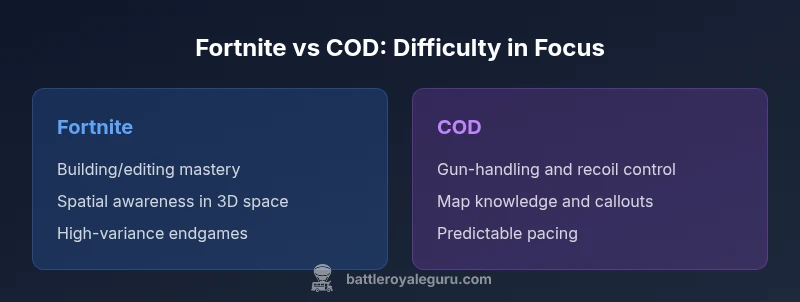
Fortnite centers around three core skill domains: building, editing, and spatial awareness. Building allows you to create cover, control sight lines, and gain high ground in unexpected ways. Editing lets you reshape structures mid-fight, enabling fast rotations and surprise attacks. In contrast, COD centers on gun mechanics, hit registration, recoil control, sprint timing, and map knowledge. Movement, weapon tuning, and callouts define most encounters. While both games demand strategic thinking, Fortnite rewards versatility and multi-layered problem solving, whereas COD rewards precision, timing, and mechanical consistency. The perceived difficulty gap often narrows when players begin to apply similar fundamentals—positioning, anticipation, and target prioritization—to both titles.
Fortnite’s learning curve: Building, editing, and spatial awareness
Fortnite’s learning curve is heavily tied to its building system. From the first week, players must learn to switch between defensive builds and aggressive edits in seconds. Editing requires a mental model of three-dimensional space, training to anticipate enemy edits, and developing muscle memory for quick piece placement. Spatial awareness, including enemy sightlines, editing angles, and resource management, becomes central to success. The more you practice, the more you’ll notice how quickly early mistakes compound into lost HP or lost fights. The depth of Fortnite’s mechanics means progress can feel non-linear: small improvements in editing speed or resource management can yield disproportionate results in end-game scenarios.
COD’s learning curve: Gun mechanics, map knowledge, and reflexes
CoD’s learning curve emphasizes gun control, recoil patterns, bullet spread, and weapon classification. New players often master basic shooting within days, but true mastery—streaks, peak aim, and predictive movement—takes weeks or months. Map knowledge, callouts, and understanding each map’s flow determine win rates in both casual and ranked modes. COD also rewards consistent practice with a clearer path to incremental improvement: you can measure progress by kill-to-death ratios, average accuracy, and reaction times. For players who enjoy direct, repeatable gunfights, COD’s trajectory can feel more approachable than Fortnite’s variable-building battles.
Input devices and control schemes: PC, console, mobile
Equipment matters. On PC, keyboard and mouse enable precise aiming plus fast ringed editing if you’ve configured your bindings well. On consoles, controller aim plus a comfortable sensitivity setup influences how quickly you can learn to shoot and move, and some players favor builder-friendly presets for Fortnite. Mobile introduces a different control scheme altogether, with touch inputs that complicate both building and aiming. The differences in input devices shape how hard a game feels on day one: Fortnite’s building demands a multi-input approach, while COD’s gunplay emphasizes consistent aim mechanics regardless of platform. You’ll find that many players improve faster on a platform where they have the most comfortable, reliable control scheme.
Pacing and risk: Fortnite’s high-variance engagements vs COD’s more predictable patterns
Fortnite presents high-variance engagements: a single encounter might swing on a building trick, a last-second edit, or resource scarcity. This variability can inflate perceived difficulty for new players. COD, with its steady tempo and structured spawns, tends to feel more predictable at the outset. The payoff in Fortnite often comes from mastering the timing of builds, edits, and rotations; in COD, it’s about consistent gunskill, map control, and teammates’ coordinated actions. Understanding pacing helps players calibrate their practice: Fortnite requires deliberate practice across multiple sub-skills, while COD rewards focused drills on aim and pattern recognition.
Training and practice: Drills that help both games
A structured practice plan accelerates learning in both titles. Fortnite drills should include 1) build hotkey drills and fast edits, 2) aim training with consistent crosshair placement, 3) scenario-based rotations to develop high-ground control, and 4) resource management under pressure. COD drills emphasize 1) target switching and recoil control, 2) map and spawn knowledge, 3) movement patterns (pre-aiming, peeking, and sprint timing), and 4) team communication. The goal is to build transferable mechanics—aim precision, timing, and spatial awareness—that improve performance in both games. Use custom lobbies, aim trainers, and replay analysis to quantify progress over time.
Scenario-based contrasts: How fights unfold differently
In Fortnite, a typical endgame involves vertical play, stacked builds, and fast edits to secure height advantage. In COD, endgames hinge on correct crossfires, callouts, and soft-cover utilization. The scenario-based analysis shows that Fortnite rewards a player who can quickly mix building with aim while COD rewards consistent entry fragging and map control. Practicing both styles helps you identify which mechanics you personally find more challenging and shows you how to adapt your training to address those gaps.
Skill transfer: What translates between Fortnite and COD
Several core abilities transfer well between the two games: map awareness, target prioritization, game sense, and reaction time. A strong sense of timing helps both games—knowing when to peek, rotate, or engage. Lightning-fast decision-making and the ability to stay calm under pressure also translate across titles. The practical takeaway is that deliberate practice focused on general shooter fundamentals—muscle memory, aiming consistency, and situational awareness—will yield improvements in both Fortnite and COD, even if the exact mechanics differ.
Myth-busting: Common myths about difficulty
A common myth is that one game is universally harder; the truth is that difficulty is contextual. Building in Fortnite adds a multi-layered challenge not present in COD, but COD’s higher micro-skill ceiling in gun control presents its own, non-building-related hard parts. Another myth is that practice alone guarantees mastery; in reality, targeted, goal-oriented practice with feedback loops accelerates improvement. Finally, some players assume platform determines ability; while input devices shape comfort, the quality and structure of practice determine outcomes more than hardware alone.
4-week practice blueprint for shooters
Week 1 focuses on fundamentals: aim, recoil control, and basic movement. Week 2 adds building/editing drills for Fortnite and map knowledge drills for COD. Week 3 integrates cross-training: one Fortnite session with gunplay-focused practice and one COD session with building awareness or scenario drills. Week 4 consolidates learning with mixed-game scrims, review of game replays, and targeted adjustments. Throughout, track stats like win rate, accuracy, and reaction time to quantify progress and adjust the plan as needed.
Comparison
| Feature | Fortnite | Call of Duty (CoD) |
|---|---|---|
| Core skill focus | Building/editing, spatial awareness, fast rotations | Precise gunplay, recoil control, map knowledge |
| Learning curve | Steeper due to multi-step mechanics and edits | Steeper at higher levels but quicker to reach basic competence |
| Input requirements | High demands on keyboard/mouse or controller with building bindings | Traditional shooter controls with aiming, movement, and weapon handling |
| Pacing | Highly variable engagements with high-end rotations | More predictable gunfights and spawn patterns |
| Team dynamics | Coordination for builds, rotations, and edits | Callouts and crossfire management in team modes |
| Progression | Cosmetic progression through building-related challenges | Weapon unlocks and perks through performance |
| Best for | Players who enjoy versatility, creativity, and quick adaptation | Players who prefer precise gunplay, steady improvements, and tactical play |
Upsides
- Offers diverse skill development applicable to many shooters
- Fortnite’s depth rewards mastery in building and game sense
- COD provides a fast entry path with clear marching orders for practice
- Cross-training across both games improves overall reflexes and adaptability
Weaknesses
- Difficulty is subjective and depends on personal playstyle
- Fortnite’s building can be a barrier for absolute beginners
- CoD’s daily grind can feel repetitive for some players
Fortnite’s mastery is tougher to achieve due to building/editing; COD is easier to pick up but mastering gunplay remains demanding.
If you value creative control and multi-layered combat, Fortnite is the harder path to mastery. If you want quick entry with solid gun mechanics, COD offers a faster route to competence, with long-term mastery requiring focused practice.
Questions & Answers
Is Fortnite harder to learn than COD for beginners?
For beginners, COD generally feels easier to pick up due to straightforward gunplay and fewer mechanics to learn at once. Fortnite requires learning building and edits, which adds a deeper, longer ramp. The difficulty balance shifts as players dive into higher-level play where Fortnite’s multi-skill demands become more pronounced.
COD is often easier to pick up for beginners, but Fortnite becomes much harder as you aim for high-skill builds and edits.
What skills translate between Fortnite and COD?
Core shooter fundamentals translate across both games: map awareness, target prioritization, timing, and decision-making under pressure. Improved aim, reaction time, and game sense are universally valuable; the specifics (building vs recoil control) differ but the underlying mechanics reinforce each other when practiced deliberately.
Core shooter skills translate, even though building and recoil control differ.
Does building in Fortnite affect aiming accuracy?
Building in Fortnite changes your visual exposure, line-of-sight, and target acquisition, which can temporarily disrupt aiming. Over time, players develop muscle memory to blend building with shooting. The key is to practice aim while building so your reactions remain precise under pressure.
Building changes sightlines and can affect aim until you build muscle memory.
Which game should I start with if I want to learn shooters quickly?
If speed of entry matters, COD is typically faster to learn due to its emphasis on gun mechanics and direct combat. Fortnite offers deeper strategic depth but requires more time to master building and editing. Start with COD to build core shooter rhythm, then gradually add Fortnite practice for broader skills.
Start with COD to learn basic shooter skill, then add Fortnite for broader strategy.
Do input devices affect perceived difficulty more in Fortnite or COD?
Input devices shape difficulty in both games but Fortnite’s building mechanics amplify the impact of control schemes. Keyboard/mouse or controller setups with efficient bindings can reduce the initial barrier. COD’s gunplay is less dependent on building inputs, so differences across platforms are typically subtler.
Input devices matter, especially for Fortnite building; COD is more lenient across platforms.
What are quick drills to improve in both games?
Decompose practice into focused blocks: aim drills, map knowledge, and scenario-based scrims. In Fortnite, add building/editing cycles; in COD, add recoil and crosshair control. Use replay reviews to identify errors and repeat drills with measurable targets.
Do targeted drills: aim, map knowledge, and scenario practice for both games.
Key Points
- Assess your preferred playstyle before committing to a title
- Fortnite’s building adds depth but raises the entry barrier
- COD emphasizes gun mechanics; easier to start, harder to master
- Use cross-training drills to improve both games
- Set measurable goals and track progress weekly