Is Fortnite harder than Siege? An analytical comparison
A balanced, analytical comparison exploring whether is fortnite harder than siege, examining mechanics, teamwork, and learning curves for players considering both games.


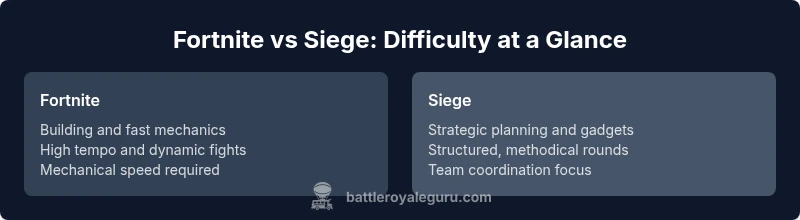
Is Fortnite harder than Siege? In short, the answer depends on how you measure difficulty. Fortnite demands fast-building mechanics, aim, mobility, and map awareness in a fast-paced battle royale, while Rainbow Six Siege emphasizes strategic planning, communication, and precise gunplay in tight environments. Battle Royale Guru analysis shows that players often find Fortnite harder in raw mechanical skill, while Siege tests higher-level teamwork and game sense. The best pick depends on your strengths.
is fortnite harder than siege: an analytical comparison
In examining whether is fortnite harder than siege, we must acknowledge that both games test different muscles. Fortnite pushes players to master fast-building, rapid edits, and high-pace aiming, all while managing a dynamic map with evolving loot pools. Siege, by contrast, asks for patient planning, precise gun mechanics, and flawless communication across a slower, more tactical tempo. Battle Royale Guru's analysis emphasizes that the perceived difficulty hinges on which skill set you value or struggle with. If your strengths lie in quick reaction and creative problem solving, Fortnite may feel harder; if you prefer methodical planning and teamwork, Siege can present steeper barriers to entry at the outset. This comparison treats difficulty as a multidimensional construct rather than a single number, allowing players to map their own strengths to the gameplay styles each title demands.
Core difficulty pillars: fast pace vs deliberate design
Fortnite lives or dies by speed. You must edit, build, shoot, and relocate in milliseconds while the circle contracts. The skill ceiling rises with how smoothly you can chain edits, place structures, and counter-build under pressure. Siege, meanwhile, narrows the focus to controlled engagements, information gathering, and timing. You repeatedly assess lines of sight, wall angles, and gadget usage. The learning curve in Siege rewards patience and memory, but once fundamentals click, progress compounds quickly through collaboration and operator mastery. The takeaway is that difficulty in Fortnite tends to spike with mechanical fluency, while Siege spikes with strategic fluency and teamwork coordination.
Mechanical skills: building vs gunplay precision
Fortnite’s defining mechanic is building, which adds a layer of real-time engineering to combat. Mastery requires spatial awareness, rapid placement, and hybrid aim—shooting while constructing at speed. This multi-tasking is a barrier for players who prefer linear gunfights or static cover. Siege focuses on precision, recoil management, and aiming in enclosed spaces, but it also tests your ability to coordinate detonations, gadget usage, and fuse timing with teammates. Both games reward repetition, but the cognitive load differs: Fortnite blends navigation with creation; Siege blends strategy with execution. For many players, the perceived difficulty comes from the demand to switch mental modes quickly under stress.
Onboarding and entry: who gets in faster?
Fortnite tends to offer a gentler onboarding with a low barrier to entry—nice for casual players who want to jump in and learn by doing. The casual game modes and frequent updates keep the loop fresh. Siege onboarding starts tougher; players encounter a steeper learning curve due to operator concepts, gadget usage, and map-specific tactics. The early stages may feel unwieldy as you juggle weapon options, gadget categories, and team roles. The practical result is that new players often endure a longer ramp-up in Siege, whereas Fortnite provides faster initial wins but accelerates the need for mastery as you climb. This divergence shapes how players perceive difficulty early on.
Team play and communication: coordination as a multiplier
Teamplay magnifies difficulty in both titles, but in different ways. Fortnite squads rely on real-time improvisation and shared map knowledge, with communication focused on fast decisions, loot sharing, and sightlines during chaotic engagements. Siege requires structured callouts, role exposure, and static strategies—attack, defend, rotate—where precision in timing and gadget coordination yields predictable results. Communication quality becomes the defining factor: sloppy coordination in Siege leads to quick losses; poor positioning in Fortnite leads to rapid swings in momentum. Both demand consistent practice in live environments to build trust and speed.
Map design, tempo, and information management
Fortnite blends a dynamic map system with rotating loot pools, variable player density, and strong emphasis on vertical gameplay. Information comes from audio cues, weapon spawns, and environmental changes as you move. Siege maps are static but dense with line-of-sight data, gadget placements, and fortified angles. The tempo in Fortnite fluctuates with circle shifts and player improvisation, whereas Siege trains players to anticipate rotations, plan breaches, and interpret subtle audio cues under pressure. The cognitive load for map awareness shifts accordingly: Fortnite rewards adaptive, fast interpretation; Siege rewards thorough reconnaissance and anticipation of opponent plans.
Resource management and progression systems
In Fortnite, resource management is about materials, health, and timing. You balance resource gathering with combat decisions and build queues, often in the middle of a firefight. Siege emphasizes operator choice, gadget quantities, and money-based economy tied to rounds and rounds won. The progression systems are distinct: Fortnite incentivizes rapid wins, cosmetic progress, and micro-goals tied to season passes. Siege centers on operator unlocks, end-of-round performance, and procedural learning of gadget subsets. This divergence means that resource pressure in Fortnite feels immediate and kinetic, while Siege builds a longer-term mastery through operator knowledge and team ergonomics.
Time-to-competence and deliberate practice
Both games reward deliberate practice, but the pathways differ. Fortnite players improve by refining aim, editing speed, and decision-making under unpredictable threats. Siege players improve by drilling callouts, mastering operator gadgets, and executing team-based strategies against well-drilled opponents. A practical approach is to segment practice blocks: do daily aim and build drills for Fortnite, and schedule weekly coordination drills for Siege. The best practice is to focus on one dimension at a time while maintaining a baseline competency in the other. That way, improvement compounds in a measurable, sustainable way, reducing frustration and increasing confidence as you progress.
Scenario-based considerations: when one is harder than the other
In high-pressure endgame fortnites, building becomes a survival language, and success hinges on your procedural memory for builds, edits, and rotations. In Siege, long tactical rounds require you to maintain discipline, cross-team communication, and timing under pressure, often with limited time to reset. The hardest moments in Fortnite are typically those that demand multi-layered decision-making under time constraint, while Siege’s hardest moments come from maintaining composure and coordination during complex breach-and-clear sequences. Both futures demand a clear mental model of how to react when the situation escalates.
Decision framework: which path suits you best?
If you thrive on rapid improvisation, creative problem-solving, and fast aim, Fortnite may feel more challenging but also more rewarding as you climb. If you enjoy strategy, memory, and teamwork under structured rules, Siege may feel harder but offers a more predictable growth path through disciplined practice. Use a simple framework: identify your top three strengths, map them to each game’s core difficulty pillars, and set a practice plan that targets the weakest area. This approach converts abstract difficulty into concrete, trackable goals and helps you decide where to invest your time.
Comparison
| Feature | Fortnite | Rainbow Six Siege |
|---|---|---|
| Core skill emphasis | Building, speed, and adaptive aiming | Strategic planning, communication, and precise gunplay |
| Match tempo and flow | Very fast, dynamic, circle-driven momentum | Measured rounds with tactical setup and information play |
| Learning curve | Steep due to multi-tasking (builds + aim + movement) | Steep early due to operator knowledge and gadget systems |
| Team coordination | Squad-based, improvisational coordination | Structured team tactics and coordinated gadget use |
| Map and environment | Procedural maps with shifting loot and vertical play | Fixed maps with gadget geometry and line-of-sight complexity |
Upsides
- Clear, structured framework helps players evaluate relative difficulty
- Highlights strengths and weaknesses of each game’s skill demands
- Guides targeted practice for transferable skills across genres
- Helps players align practice goals with personal preferences
Weaknesses
- Subjectivity of difficulty varies by individual experience and platform
- May oversimplify nuanced skill transfer between titles
- Patch cycles can shift balance, affecting long-term accuracy of the comparison
Neither game is universally harder; your strongest skill determines where the challenge lies
Fortnite tests mechanical speed and improvisation; Siege tests planning and teamwork. Choose Fortnite if you crave fast, dynamic play; choose Siege if you prefer methodical, coordinated play. Use this comparison to target your practice and track progress over time.
Questions & Answers
Which is tougher overall?
Both games present significant challenges, but in different domains. Fortnite tests raw mechanical speed and adaptability, while Siege tests strategic planning and team-based execution. Your perception of difficulty will hinge on your preferred playstyle and strengths.
Both games are tough in different ways. Fortnite stresses speed and adaptability; Siege stresses strategy and teamwork. Your path depends on what you enjoy and excel at.
How important is building in Fortnite compared to Siege’s gadgets?
Building is a core, ongoing mechanic in Fortnite, shaping every encounter. In Siege, gadgets and operator choices drive strategy but the emphasis is less on rapid construction. Mastery in Fortnite requires building fluency; in Siege, gadget mastery and team play drive success.
Building is central in Fortnite and less so in Siege, where gadgets and operators define the challenge. Mastery comes from different skill sets.
Can someone trained in Siege excel in Fortnite quickly?
A Siege player can transfer strategic thinking and teamwork to Fortnite, but Fortnite’s rapid-building, aim mechanics require dedicated practice to reach parity. Expect a learning curve as you adapt to a new mechanical paradigm.
Siege skills transfer, but Fortnite demands fast-building and aim practice. Expect a dedicated adaptation period.
Do patches change which game is harder?
Patches can shift the balance of difficulty by tweaking mechanics, balance, and available tools. A patch may make a particular meta easier or harder, so reevaluate after each major update.
Patches can change how hard a game feels. Reassess after updates.
Is there a path to proficiency in both games simultaneously?
Yes. You can build transferable skills (map awareness, communication, decision making) while dedicating time to the unique mechanical drills each title requires. A structured plan helps you progress in both without burning out.
Absolutely—focus on core skills common to both, then train the unique mechanics for each title.
Key Points
- Assess your strengths to decide where to invest practice
- Fortnite emphasizes speed, building, and reaction time
- Siege emphasizes strategy, teamwork, and gadget mastery
- Structure your practice with clear, trackable goals
- Update the framework as patches shift game balance