When Did Fortnite Come Out? A Complete Release Timeline
Trace Fortnite's release history—from Save the World to Battle Royale—and map platform rollouts, cross-play, and major updates that defined its rise in 2017–2026.


Fortnite release timeline: from concept to broad adoption
Fortnite began life as a cooperative survival game, released in July 2017 as an early access title titled Save the World. The broader market shift, however, came with the addition of Battle Royale later that year. In this section, we’ll unpack the sequence of events and the strategic decisions behind the rollout. The Save the World component introduced a traditional, PvE experience with base-building and co-op missions, while the BR mode offered a fast-paced, competitive experience that leveraged free-to-play economics to accelerate adoption. The timing of these two tracks laid the groundwork for Fortnite’s rapid growth and long-term engagement models.
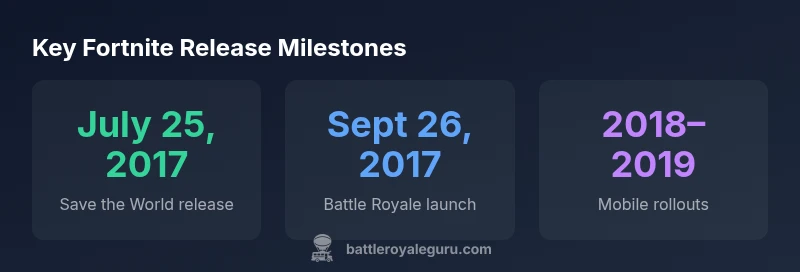
- The July 25, 2017 release marked Fortnite’s entry into the market with a paid co-op experience.
- The September 26, 2017 Battle Royale launch transformed the game into a global phenomenon almost overnight.
- Cross-platform support and regular seasons followed, expanding the player base beyond PC to consoles and mobile devices.
- The live-service cadence—seasonal content, limited-time events, and frequent patches—became a defining feature of Fortnite’s identity.
This section sets the stage for understanding how a single date can anchor a multi-year trajectory in live-service gaming. The Battle Royale pivot at the end of 2017 is widely cited as the moment Fortnite became a cultural and industry touchstone.
The Save the World release: what it meant for the business model
The July 25, 2017 launch of Save the World signaled Epic Games’ foray into a hybrid model: a paid, PvE experience that introduced core game mechanics—building, crafting, and cooperative play. While Save the World did not achieve the same immediate global reach as Battle Royale, it served as a technical and monetization test bed. Save the World helped fund ongoing development, while BR’s free-to-play shift changed the economy—encouraging cosmetic purchases, battle passes, and seasonal packs that incentivized ongoing participation. This structure reinforced the idea that players would invest in cosmetic skins, dances, and progression rather than a one-time purchase. The dual-path strategy allowed Epic to iterate on core mechanics without risking a single product’s failure.
- The early access window provided crucial feedback loops for balancing building, weapons, and map design.
- Monetization relied on cosmetics and season passes, a model that would become standard for many live-service titles.
- The Save the World foundation helped sustain development during BR’s explosive growth.
Understanding the Save the World launch clarifies how Epic funded Fortnite’s rapid expansion while preserving a flexible development path.
September 26, 2017: Battle Royale goes free-to-play and goes viral
The BR announcement on September 26, 2017 marked a watershed moment for Fortnite. The mode arrived as a free-to-play experience across PC, PlayStation 4, and Xbox One, inviting players who had not engaged with the original Save the World product. The timing was fortuitous: it aligned with a growing appetite for battle royale experiences in the wider gaming ecosystem. The result was an unprecedented surge in concurrent players, widespread media coverage, and the rapid formation of a unique Fortnite community around victories, clip-worthy moments, and memes. The BR release defined Fortnite’s identity and set expectations for ongoing live-service updates.
- Free-to-play BR reduced friction to entry, expanding the audience dramatically.
- Player ingenuity and community content accelerated virality and retention.
- The cross-platform experience laid a foundation for later cross-play and collaborative features.
From this moment forward, Fortnite became synonymous with ongoing seasonal play and special events that kept players returning month after month.
Platform expansion and cross-play ambition: 2018–2020
Following its BR success, Fortnite expanded to additional platforms and experimented with cross-play to knit together a larger ecosystem. The cross-platform expansion began with gradually integrating more devices and stores, culminating in broader compatibility across PC, consoles, and mobile. The strategic emphasis shifted toward accessibility and parity—ensuring that players on different devices could team up, compete, and share progress. The platform strategy also shaped how Epic handled updates, balancing performance across devices and maintaining a consistent feature set.
- 2018–2019: Mobile (iOS first, then Android) released alongside continued console and PC support.
- Cross-play features were rolled out across the major platforms, enabling larger player pools.
- Regular updates across all devices maintained balance and parity.
This period solidified the game’s multi-device footprint and demonstrated the viability of cross-play in a live-service model, influencing the broader industry’s approach to platform strategy.
The cadence of seasons and events: what fans experience
From late 2017 onward, Fortnite cemented a habit of seasonal content, limited-time events, and frequent patches. Seasons introduced new themes, weapons, mechanics, and progression curves, while events created communal moments—live concerts, in-game events, and cross-promotional activities. The cadence was not merely about new skins; it was about evolving gameplay and world-building that kept the player base engaged through curiosity and competition. The result was a living, reactive game world where player skill grows alongside the evolving meta.
- Seasonal passes offered ongoing progression and rewards.
- The timing and scale of events created palpable social momentum around the game.
- Updates balanced new features with older mechanics to maintain a healthy skill ceiling.
The cadence of seasons and events is a core driver of Fortnite’s long-term popularity and ecosystem health.
How to verify Fortnite release dates: sources and best practices
Researching historical release dates requires cross-checking primary sources (official posts from Epic Games) and credible reporting from major outlets. Official blog posts, press announcements, and patch notes are the most reliable anchors. Reputable media coverage from outlets like The Verge or Polygon can help confirm dates and provide context about the surrounding events. When conducting your own verification, create a small timeline with multiple corroborating sources and note any discrepancies.
- Start with Epic’s official announcements and patch notes.
- Compare multiple outlets to confirm dates and related milestones.
- Document any regional differences (e.g., platform-specific rollouts).
A rigorous approach ensures accuracy and helps you understand how the release timeline unfolded across different regions and devices.