Can You Uninstall Parts of Fortnite? A Practical Guide
Learn whether you can uninstall Fortnite components, how to reclaim disk space, and best practices for Windows, macOS, and consoles. Battle Royale Guru explains safe methods and pitfalls for players seeking actionable steps in 2026.


You generally cannot uninstall individual parts of Fortnite. The game installs as a single package, so to free space you must uninstall the entire Fortnite installation from your platform. On PC or Mac, use the Epic Games Launcher or system uninstall. You can also clear cached data or delete temporarily downloaded assets without removing the core game, then reinstall if needed.
Can you uninstall parts of fortnite? Understanding the premise
The question can you uninstall parts of fortnite touches a common misconception about modern game installations. Fortnite is distributed as a cohesive package rather than modular components that can be removed piecemeal. This means that when you seek to reclaim storage space, you typically have to take more holistic actions rather than deleting discrete files. According to Battle Royale Guru, a growing number of players ask this question as they juggle disk space on devices ranging from gaming laptops to consoles. The takeaway is simple: you can’t selectively uninstall game elements like you might with a desktop app. Instead, you manage the whole installation or leverage platform-specific storage management features. This nuance is especially important in 2026, when game sizes have grown and updates can bloat local libraries. If you want a fast, practical outcome, plan your approach and avoid attempting to surgically remove parts that aren't designed to be separated.
How Fortnite installation works on different platforms
Fortnite uses a single, consolidated installation that bundles core files, assets, and recent updates. The Epic Games Launcher serves as the primary interface for uninstalling the game on PC and Mac; consoles rely on the system storage manager for removing data related to the game. My team at Battle Royale Guru has analyzed countless setups, and the consensus is clear: there is no supported method to uninstall only specific components. This matters because users often assume they can trim texture packs or maps individually, which is not how the game was designed to be delivered. When you delete the entire package, the launcher typically prompts you to either remove the remaining cached data or to perform a fresh install later if you decide to return.
PC and Mac workflows: uninstalling Fortnite
On Windows or macOS, the standard route is to use the Epic Games Launcher. Navigate to your Library, locate Fortnite, and select Uninstall. If the launcher isn't accessible, you can also use the operating system's built-in uninstall tools, but this is less clean and can leave behind residual folders. Battle Royale Guru's analysis shows that using the official launcher minimizes the risk of orphaned files and ensures a smooth reinstall later. After uninstalling, check for any leftover caches in the AppData or Library directories and remove them if you are reclaiming substantial space. If you plan to play again soon, you can start a fresh install right away.
Console-specific steps: freeing space without reinstalling everything
Consoles such as PlayStation, Xbox, and Nintendo Switch manage games differently. You typically delete the Fortnite data through the console's storage settings, which acts similarly to uninstalling. You may also have options to offload content while keeping account data intact. The key is understanding that you are removing local copies rather than downgrading the game package. If you later decide to return, re-downloading can take time depending on your connection. Battle Royale Guru recommends noting down your settings and preferences before you delete data so you can reapply them quickly after reinstallation.
Cache and temporary data: reclaiming space post-uninstall
A common pitfall is leaving behind caches and temporary files. After uninstalling Fortnite, many players fail to reclaim all available space because caches linger in system folders or app caches. This is especially true on Windows where AppData folders can hold gigabytes of cached assets. The recommended approach is to search for Fortnite-related folders and safely remove them if you are comfortable doing so. If you are unsure, start with the launcher's repair or cleanup tools and then perform a manual check. Battle Royale Guru emphasizes that clearing caches can significantly recover space and reduce clutter without reinstalling.
Reinstalling: when and how to proceed
If you plan to return to playing, reinstall Fortnite from the Epic Games Launcher. The installer may offer component choices or a standard full install. In 2026, download speeds and server distribution often impact install times more than ever. If storage is tight, consider selecting a smaller install footprint if the launcher provides an option to deselect optional content. Always verify your Internet connection and ensure you're signed into the correct account to avoid re-downloading content you don't want. The Battle Royale Guru team recommends testing a few in-game settings after reinstall to optimize performance and avoid surprises.
Quick sanity check after uninstall or reinstall
Launch Fortnite from the launcher and sign in with your usual account. Confirm that the game loads correctly, applies updates, and connects to servers. If you encounter issues, use the launcher's verify integrity or repair feature to ensure local files are not corrupted. This step is important because a partially installed or cached game can cause unexpected crashes, which undermines the purpose of freeing space in the first place. The overall goal is a clean baseline that makes future updates smoother.
Tools & Materials
- Epic Games Launcher(Essential for uninstalling Fortnite on PC/Mac)
- PC or Mac computer(Platform to run Epic Games Launcher)
- Internet connection(Needed to fetch or reinstall)
- External storage (optional)(Helpful for moving large installs or backups)
- Backup of saves (optional)(Cloud saves may apply depending on account)
- Console storage access(If uninstalling on console, use the system storage manager)
Steps
Estimated time: 30-60 minutes
- 1
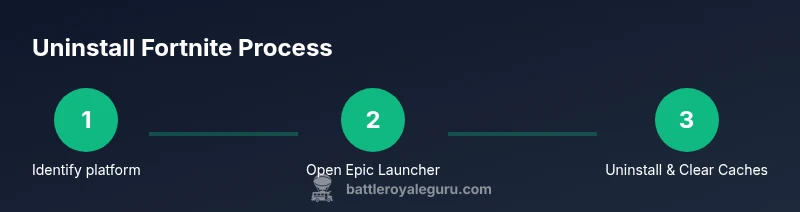
Identify your platform and goal
Determine whether you want to remove Fortnite completely or simply reclaim disk space by deleting caches. This decision guides every subsequent step and avoids accidental data loss.
Tip: Write down your goal before starting to reduce back-and-forth. - 2
Open Epic Games Launcher
Launch the Epic Games Launcher and sign in to the account that owns Fortnite. This ensures you manage the correct installation.
Tip: Verify you’re signed into the correct account to avoid reinstalling the wrong version. - 3
Uninstall Fortnite from your device
In the Launcher, go to Library, locate Fortnite, and choose Uninstall. On Windows/macOS you can also use system uninstallers if the launcher isn’t accessible.
Tip: Uninstalling removes local game files; saves and cloud data may remain depending on platform. - 4
Clear remaining caches and temporary files
After uninstall, delete leftover caches and temporary files to reclaim space. Check AppData folders (Windows) or Library caches (macOS).
Tip: Back up important settings before clearing caches. - 5
Reinstall if needed
If you plan to play again, reinstall Fortnite from the Epic Games Launcher. You can choose a minimal install size if the launcher offers component options.
Tip: Consider a smaller install size by deselecting optional content if available. - 6
Verify integrity and test launch
Launch Fortnite to confirm a clean reinstall. Check for updates, and run a quick in-game test to ensure everything works.
Tip: Test both solo and online modes to verify connectivity.
Questions & Answers
Can you uninstall individual components of Fortnite?
No. Fortnite is packaged as a single installation. To reclaim space, you must uninstall the whole game and reinstall if you return to play.
Fortnite isn’t built in modular components you can remove separately; you’ll need to uninstall the whole game.
Will uninstalling Fortnite delete my progress or in-game saves?
Uninstalling the game deletes local files, but cloud saves or account-bound progress typically remain on Epic's servers. Check your cloud save settings.
Your account progress stays, but local data is removed.
Can I reclaim disk space without uninstalling Fortnite completely?
Yes, you can delete caches and temporary files after uninstall, or move the game to external storage if supported by your platform.
You can reclaim space by clearing caches after uninstall.
What about console versions of Fortnite?
On consoles, you remove the game data via the console’s storage settings, which is effectively uninstalling the game, then reinstall if desired.
Consoles handle uninstall via system storage settings.
Does reinstalling Fortnite affect settings or progress?
Reinstalling generally preserves account progress (via cloud saves) but may reset in-game settings; reapply preferences after launch.
Reinstalling usually keeps progress but may reset some settings.
Are there risks in uninstalling Fortnite?
The main risks are losing local data and taking time to re-download; always backup and verify before deleting large files.
The risks are mostly data loss and download time.
Watch Video
Key Points
- You cannot uninstall Fortnite parts—only the full installation can be removed from a device.
- Use the Epic Games Launcher to uninstall and optionally clear caches.
- Back up saves if cloud storage isn’t guaranteed.
- Reinstall with selective component options if your launcher offers them.