Does Fortnite Really Need SSD? A Practical Performance Guide
Explore whether does fortnite need ssd for 2026, how SSDs affect load times, texture streaming, and overall gameplay, and learn practical steps to test impact on PC and consoles.


Does Fortnite need an SSD? In most cases, a solid-state drive primarily improves load times and texture streaming rather than boosting raw frame rate. For PC players and newer consoles, an SSD can shave startup time, reduce map-loading pauses, and smooth streaming during long matches. Yet, Fortnite’s engine often hits GPU/CPU bottlenecks, so gains vary by setup and patch.
Does Fortnite Need an SSD? A Practical Look
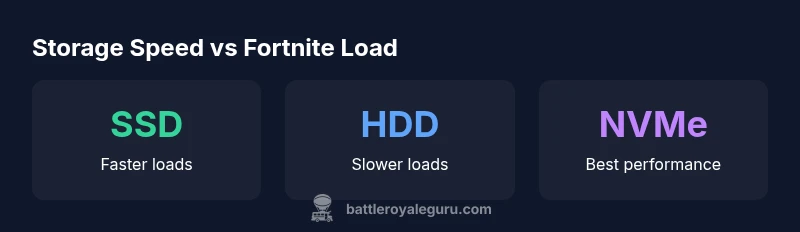
According to Battle Royale Guru, storage speed influences more than just startup times. It shapes texture streaming, map loading, and the continuity of a match. In 2026, many players ask does fortnite need ssd, especially when upgrading aging machines or deciding between budget drives and premium options. The short answer is: an SSD can help with load times and streaming, but it rarely makes a dramatic difference to raw frames per second. The Fortnite engine tends to be GPU- and CPU-bound in many scenes, so the benefit from storage speed exists mainly in the early game, during map loads, and when assets stream in quickly. For console players, the system storage also matters, but the scale of impact depends on the console model and game patch optimizations. In practice, if you’re upgrading from a mechanical hard drive, you’ll notice shorter boot times, faster level loading, and smoother texture pop-in. If you’re already using an SSD, the gains are more incremental and most noticeable in longer sessions or on large maps.
How SSDs Fit into Fortnite's Loading Pipeline
Fortnite’s loading pipeline involves several stages: initial boot, level loading, and texture streaming as you traverse the map. An SSD primarily accelerates I/O-bound stages, so the engine spends less time waiting for data reads. This translates to quicker splash screens, faster asset loading when you sprint into a new area, and less time waiting for textures to fully render as you approach distant buildings. The practical takeaway is that SSDs shine when you move rapidly across the map or join matches with large, high-resolution asset packs. For players who tend to pause between fights or frequently switch between lobbies, the perceived improvements can be meaningful.
FPS, Stutter, and When SSDs Actually Help
Raw FPS is largely governed by GPU and CPU limits in Fortnite. An SSD does not magically add frames per second; instead, it reduces disk-induced stalls that can look like stutter during long texture streams or heavy scene changes. In real-world tests, most players report smoother transitions and fewer hitch moments after upgrading from HDDs or older SATA SSDs. The degree of improvement depends on how often your system waits on the drive during gameplay. If you’re already on a fast NVMe SSD with ample RAM, the marginal gains decline significantly, especially in CPU-bound scenes.
Console vs PC: Where SSD Matters Most
Console players benefit from faster in-game assets loading when using the system’s storage upgrade path, but the impact is bounded by the console’s architecture. The PS5 and newer Xbox models rely on their integrated SSDs, which already provide strong load-time performance. Upgrading external storage or enabling console-specific performance features can help, but the biggest gains come from avoiding hard drives that slow read/write operations. On PC, a modern NVMe drive paired with adequate RAM yields the clearest, most noticeable improvements in load times and streaming.
Budgeting Your Upgrade: SSDs, RAM, and GPU Trade-offs
If your goal is overall Fortnite performance, invest in a balanced upgrade strategy. A fast SSD will help with load times and streaming, but if you’re GPU-bound, a new graphics card or more RAM often delivers a bigger FPS boost. Start by replacing a HDD with an SSD to eliminate startup delays, then assess whether your frame rate improves after other bottlenecks are addressed. Remember that price-to-performance varies by drive type (SATA vs NVMe) and capacity, so choose a model that aligns with your budget and the rest of your system.
Practical Steps to Test SSD Impact in Fortnite
To quantify the benefit, perform controlled tests. Boot Fortnite from a cold start, load into a standard map, and time the initial load. Then compare with a HDD, SATA SSD, and NVMe SSD if available. Repeat across several scenes (central hub, city area, and distant skyline) to capture texture streaming differences. Use in-game performance overlays or external tools to track load times, stutter frequency, and frame pacing. Document your results to decide whether a storage upgrade is worth keeping as part of your ongoing optimization plan.
Fortnite storage upgrade impact across common components
| Aspect | Fortnite Impact | Notes |
|---|---|---|
| Load Times | Reduced with faster I/O | Depends on drive type and system |
| Texture Streaming | Quicker asset swaps | Important during large maps |
| FPS/Gameplay | Minimal direct FPS gain | GPU/CPU bound scenarios dominate |
Questions & Answers
Will an SSD improve Fortnite performance on PC?
Yes, an SSD mainly reduces load times and texture streaming stutter. FPS gains are usually modest unless the system was heavily bottlenecked by disk I/O or you were on a slow HDD.
An SSD helps with load times and streaming, not dramatically boosting FPS on PC unless your setup was disk-bound.
Is an SSD worth it for console Fortnite?
Consoles typically rely on their built-in storage, which already offers fast access. Upgrading can shave some load time, but gains are generally smaller than on a PC with HDDs.
Consoles have fast storage, so an upgrade helps mainly with load times rather than FPS.
What other upgrades matter more than SSD?
CPU, GPU, and RAM can have a larger impact on FPS and stability. Network quality and drivers also influence gameplay smoothness.
GPU, CPU, and RAM upgrades usually give bigger FPS boosts than storage alone.
Are there downsides to using an SSD for Fortnite?
Mainly cost and endurance considerations. Compatibility and proper interface (SATA vs NVMe) affect the realized gains.
The main downside is cost; otherwise, SSDs are reliable and beneficial for load times.
How can I measure SSD impact in Fortnite?
Run controlled tests: compare load times and texture streaming with HDD vs SSD across several maps and scenes, using overlays or timed checks.
Perform side-by-side tests to see the exact improvements in load times and streaming.
“SSD upgrades deliver real benefits for load times and texture streaming, but the gains are usually modest unless you’re transitioning from a traditional HDD or dealing with long play sessions. The Battle Royale Guru Team recommends pairing storage speed with GPU/CPU optimizations for the best results.”
Key Points
- Assess load-time improvements first, not FPS gains alone.
- Pair storage upgrades with a broader performance plan.
- Choose an NVMe SSD if your motherboard supports it.
- On consoles, verify system storage improvements before upgrading.
- Test Fortnite performance after changes to quantify impact.