Difference Between Fortnite and Minecraft: An Analytical Comparison
An analytical comparison of Fortnite and Minecraft, focusing on gameplay loops, creativity, progression, and communities to help players decide where to invest time.


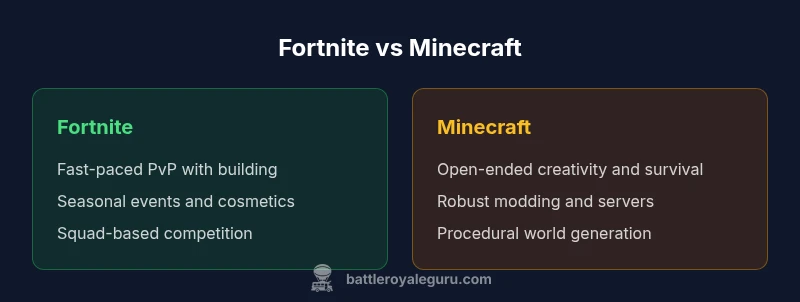
According to Battle Royale Guru, the difference between fortnite and minecraft comes down to core design and player goals. Fortnite delivers fast-paced PvP battles with building mechanics and seasonal events, while minecraft centers on sandbox creativity and exploration. If you’re deciding where to invest time, this comparison clarifies purpose, playstyle, and progression for practical, real-world gaming decisions. the difference between fortnite and minecraft
Core Design Philosophies
To understand the difference between fortnite and minecraft, we begin with core design philosophies. Fortnite is designed around competitive, time-limited play with a polished, fast-paced feel that rewards quick decision-making under pressure. Building is a dynamic layer that adds both offense and defense, changing how fights unfold. Minecraft, by contrast, centers on sandbox freedom: a world you shape, creatures you encounter, and goals you learn by experimentation. The difference between fortnite and minecraft is not just mechanics; it’s philosophy—one game aims to funnel players into structured, repeatable bouts, the other invites open-ended exploration and long-term projects. Player communities form around different pleasures: spectacle and fast curves for Fortnite, or creation and discovery for Minecraft. In this article, we’ll unpack these ideas and translate them into practical tips for how you spend your game time.
Gameplay Loop and Progression
Fortnite's gameplay loop cycles from landing, looting, building, and engaging in battles, with seasons re-framing objectives and unlocking cosmetic rewards. Progression is often tied to XP earned through matches and through a Battle Pass system that rotates content regularly. Minecraft's loop is more open-ended: gather resources, craft items, explore procedurally generated worlds, and survive threats. Progression arrives through gear, enchantments, and achievements, rather than a fixed season cadence. This difference shapes how players invest time: Fortnite rewards high-tempo decision-making and short-term goals, while Minecraft rewards curiosity, experimentation, and sustained projects. Understanding these rhythms helps you plan your gaming sessions and set expectations for what counts as progress in each game.
Creativity and Construction Tools
Fortnite provides a succinct set of construction tools tightly integrated into combat: walls, ramps, and platforms that adapt in real-time to fight dynamics. The creative aspect is present but bounded to official modes and maps. Minecraft offers near-unlimited construction possibilities, from simple shelters to sprawling redstone-powered machines. The contrast is stark: Fortnite’s creativity serves combat outcomes; Minecraft’s creativity serves long-term world-building. For players who love building as a pastime, Minecraft is unparalleled; for those who prefer tactical space control within matches, Fortnite’s built-in tools are more efficient and immediately rewarding.
World and Visual Style
Fortnite is known for its glossy, cinematic visuals, punchy color palette, and rapid pacing. The world is crafted to feel alive in a handful of minutes, with polished animations and a consistent, high-energy mood. Minecraft adopts a voxel-based, blocky aesthetic that invites imagination and retro charm. The art style influences how players perceive risk, exploration, and creativity: Fortnite foregrounds spectacle and speed, while Minecraft emphasizes exploration, customization, and patience. Performance tuning in both games affects accessibility: Fortnite often benefits from solid GPUs for smooth higher frame rates; Minecraft can run on lower-end hardware thanks to its simpler asset pipeline, especially in the Java edition with optimizations.
Monetization and Access
Monetization and access differ markedly. Fortnite is free-to-play with in-game cosmetic purchases and battle passes; there is no pay-to-win mechanic, but content cadence is driven by seasonal events and cosmetics. Minecraft is typically purchased upfront with two primary editions (Java and Bedrock), with additional costs for skin packs or Realms hosting. Cross-buy and cross-play affect players who switch platforms; In Fortnite, some cross-play features tie to Epic accounts; In Minecraft, Bedrock Edition supports broad cross-platform play across many devices. These models influence how players budget time and money across both ecosystems.
Community and Social Play
Fortnite emphasizes short, social, squad-based sessions with a strong emphasis on multiplayer competition, live events, and a vibrant cosmetics market that keeps players returning for new looks. Minecraft cultivates vast community ecosystems through creative servers, mod packs, survival communities, and Realms. The social experience in Minecraft leans toward long-term collaboration and shared projects, whereas Fortnite centers on dynamic, time-sensitive team play. Both games foster communities that produce user-generated content, tutorials, and competitive events, but they do so in fundamentally different ways that align with their design goals.
Learning Curve and Skill Progression
The learning curve in fortnite is shaped by fast, reactive decision-making, building speed, and map awareness under pressure. The progression is episodic—each season redefines challenges and rewards. Minecraft has a steeper but more organic learning curve: players learn resource gathering, crafting recipes, and sometimes complex mechanics like redstone circuits. However, the payoff is a sense of mastery over a world that expands as you learn. Beginners can start in Creative or Peaceful modes to reduce friction, while seasoned players gradually tackle survival challenges and complex builds.
Endgame and Longevity
Fortnite sustains long-term engagement through rotating seasons, new battle passes, limited-time modes, and cross-promotions with popular media. This cadence creates a predictable cycle that keeps experienced players returning while attracting newcomers during major events. Minecraft endures through continuous vanilla updates from Mojang, a deluge of community-made mods, and expansive creative servers. The longevity of Minecraft often comes from player-created content and ongoing world-building projects, which can span months or years. Both titles offer meaningful, if different, long-term experiences depending on what you value in a game.
Platform and Cross-Play Considerations
Platform availability shapes accessibility and social reach. Fortnite supports cross-play across most major consoles and PC via Epic accounts, enabling quick matchmaking and shared progression in many modes. Minecraft’s Bedrock edition emphasizes broad cross-platform play across devices, while the Java edition remains a robust, moddable platform with its own ecosystem. If cross-play and unified progress matter most, Fortnite provides a more integrated experience across its own ecosystem; if modding, servers, and a wider array of hardware options appeal, Minecraft is the standout choice.
Performance and System Requirements
Performance considerations influence where you play. Fortnite tends to push higher-end hardware for consistent high frame rates in demanding combat scenarios, while also offering acceptable performance on mid-range systems through optimizations. Minecraft, particularly the Java edition, can run on less powerful hardware, provided you don’t max out fancy shaders. The Bedrock edition is optimized for a broad range of devices, including lower-spec machines, mobile devices, and consoles. If you’re on a budget but want a smooth experience, Minecraft’s lighter footprint is advantageous; if you chase buttery-smooth frames and competitive play, ensure your system meets modern GPU standards.
Real-World Scenarios: When Each Game Shines
If you want a quick, social, competitive session with tight team coordination and live events, Fortnite shines. It’s designed for short bursts of action with a strong emphasis on multiplayer dynamics. If your focus is endless exploration, creative freedom, and a world that you can continuously shape with friends, Minecraft outshines Fortnite. Many players rotate between both games to satisfy different moods: Fortnite to scratch the competitive itch and Minecraft to satisfy the creative itch. Both titles offer substantial value for different reasons, and your choice can evolve with your gaming goals.
How to Decide in Practice
Start by defining your primary goal: do you want fast, competitive matches or expansive, creative freedom? If the answer leans toward competition and social play, begin with Fortnite and explore its seasonal content. If creativity and long-term progression appeal more, start with Minecraft, then experiment with mods or server communities to expand your horizons. Consider edition and platform availability, cost models, and the type of community you want to engage with. Finally, give yourself a two-week test: a handful of Fortnite sessions and a Minecraft build project to compare your enjoyment and motivation over time.
AUTHORITY SOURCES
- https://www.britannica.com/topic/Fortnite
- https://www.britannica.com/topic/Minecraft
- https://www.nytimes.com/topic/technology/video-games
Comparison
| Feature | Fortnite | Minecraft |
|---|---|---|
| Core Gameplay Loop | Fast-paced PvP with building; season-driven cadence | Open-ended survival, crafting, and exploration; world is player-driven |
| Creative/Construction Tools | Integrated combat-focused building in matches | Extensive crafting, redstone systems, and mod/server construction |
| Progression & Rewards | Seasonal XP and cosmetic Battle Pass progression | Gear and enchantments; achievements; no season resets |
| Art Style & Theme | Cinematic, bright, stylized battle-arena feel | Voxel-based, blocky, customizable aesthetics |
| Monetization Model | Free-to-play with cosmetic microtransactions and passes | Paid upfront (Java/Bedrock editions) with optional add-ons |
| Cross-Platform & Accessibility | Broad cross-play across platforms via Epic accounts | Wide cross-platform support via Bedrock; Java remains PC-centric |
| Community & Modding | Official modes and community events; limited modding | Robust modding scene; extensive servers and community content |
Upsides
- Clear differences help players choose based on goals
- Fortnite delivers quick, social, competitive sessions
- Minecraft unlocks limitless creativity and community projects
- Both games have active communities and ongoing updates
- Cross-platform options widen access across devices
Weaknesses
- Direct skill transfer is limited between the two games
- Monetization strategies may not suit all players (Fortnite more cosmetics-driven)
- Minecraft's learning curve can be steep for new builders/modders
Fortnite excels in fast, competitive play; Minecraft shines in open-ended creativity.
Fortnite is ideal for quick, squad-based matches and rotating events. Minecraft is preferable for creative control, long-term progression, and community-driven experiences.
Questions & Answers
What is the key difference between Fortnite and Minecraft?
Fortnite centers on fast, competitive PvP with built-in building, while Minecraft emphasizes sandbox creativity, exploration, and survival. The two games serve different playstyles and goals.
Fortnite is a competitive shooter with building; Minecraft is a creative sandbox with survival elements.
Can you play Fortnite and Minecraft on the same platform?
Yes, both games are available on multiple platforms. Cross-play richness varies by edition and platform for each title.
Both games run on many platforms, but cross-play rules differ by edition.
Is there a learning curve to Minecraft for new players?
Yes. Minecraft has a learning curve around crafting, survival mechanics, and world exploration. Creative mode can reduce friction for newcomers.
Minecraft has a learning curve, especially for crafting and survival, but Creative mode helps.
Do both games require ongoing purchases?
Fortnite is free-to-play with cosmetic purchases; Minecraft is a paid game with optional skins or Realms. Ongoing costs depend on how you play.
Fortnite is free with cosmetics; Minecraft is a one-time purchase with optional extras.
Which game has more modding or community content?
Minecraft has a vast modding and server ecosystem that supports extensive customization. Fortnite has official modes and events but more limited user-made content.
Minecraft is the go-to for mods and custom servers; Fortnite offers official modes and events.
Is either game better for learning teamwork?
Both support teamwork. Fortnite emphasizes squad coordination in short rounds; Minecraft emphasizes collaborative builds and shared projects.
Both can teach teamwork: Fortnite with squads, Minecraft with builds.
Key Points
- Define your primary goal before choosing a game
- Fortnite excels in short, competitive sessions with building mechanics
- Minecraft shines in creativity, exploration, and mod-friendly ecosystems
- Consider price model, platform options, and community networks
- Both games offer rich learning curves and robust communities