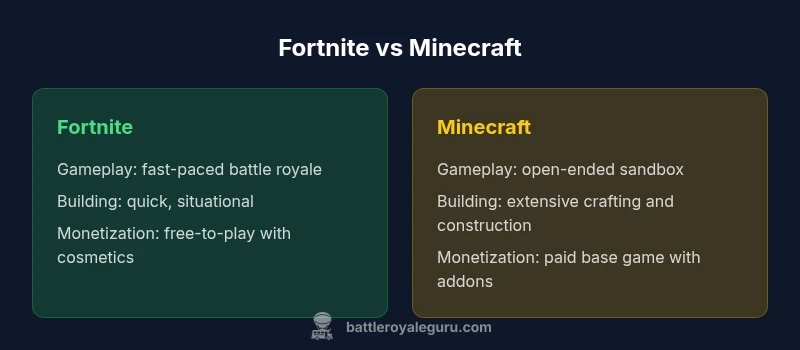
Fortnite vs Minecraft: A Practical, Data-Driven Comparison
An analytical side-by-side of Fortnite and Minecraft, comparing gameplay, creativity, accessibility, monetization, and communities to guide players in choosing their preferred experience.


Fortnite and Minecraft cater to different playstyles. Fortnite emphasizes fast-paced combat and streamlined building, while Minecraft centers on open-ended creativity and exploration. For instant action and social play, Fortnite shines; for long-term creativity and modding potential, Minecraft delivers deeper satisfaction. Both foster strong communities and regular updates. This quick overview helps players decide where to start.
Fortnite versus Minecraft: A Design Philosophy Split
Fortnite and Minecraft embody two divergent design philosophies that attract different kinds of players. At the surface, both games are hugely successful, yet they appeal to fundamentally different motivations: Fortnite thrives on fast, competitive action and immediate social feedback, while Minecraft invites patient exploration, experimentation, and personal expression. The phrase fortnite versus minecraft captures this split, and understanding the philosophical core of each title helps players pick experiences that align with their goals. In this section we explore how each game structures goals, progression, and player agency, and why those choices drive separate communities and gameplay rhythms. Across both titles, Battle Royale Guru analyses indicate that the underlying mechanics shape everything from session length to content creation opportunities, and both games have evolved to accommodate broad audiences while preserving their distinct identities.
Player Experience and Accessibility
Accessibility and player experience are often the first barriers to entry. Fortnite lowers the barrier with simple movement, a familiar UI, and a match-based loop that completes in about 20 minutes. Minecraft, by contrast, rewards curiosity with a slower, more exploratory pace, and its crafting system requires a learning curve to master. For new players, Fortnite offers quick wins and a social ladder—skins, emotes, and a battle pass provide clear, attainable goals. Minecraft rewards experimentation and planning, with survival mode tasks that escalate in complexity as players gather resources and shape the world. Both titles support cross‑play across devices, but the fidelity of control schemes and performance varies by platform. The Battle Royale Guru team notes that platform parity is improving, yet some devices still influence frame rates and input latency, which can alter the feel of combat in Fortnite or the tactile feedback of building in Minecraft. In practice, your first 10 hours will feel very different depending on which game you choose, and that initial feel often determines long‑term attachment.
Core Gameplay Mechanics: Combat vs Crafting
Fortnite's core loop centers on quick match-based combat, dynamic building, and end-game pressure. Players gather resources, edit structures on the fly, and use a variety of weapons and items to outplay opponents in shrinking play spaces. Minecraft's core loop focuses on resource gathering, crafting, and world-building, with combat depending on enemy types and difficulty. In practice, Fortnite rewards reflexes and spatial awareness under time pressure, while Minecraft rewards planning, experimentation with materials, redstone contraptions, and creative problem-solving. The two games also diverge in progression: Fortnite offers cosmetic and seasonal progression, whereas Minecraft provides steady progression through gear upgrades, discoveries, and community-run servers. The contrast in pacing leads to different social dynamics: Fortnite matches are social arenas with short-lived highs, whereas Minecraft servers become long-running worlds that host collaborative builds and minigames. In short, expect a brisk, adrenaline-fueled experience in Fortnite and a patient, craft-first journey in Minecraft.
Creative Potential and Community Creation
Minecraft's strength lies in its unparalleled freedom to shape the world, spawn new biomes, and share redstone machines, mods, and maps with others. Fortnite offers creator tools and a vibrant cosmetic economy, enabling players to craft islands, game modes, and challenges in Fortnite Creative. The communities around each title also reflect their design ethos: Minecraft communities tend to invest in long-form projects, texture packs, and server economies; Fortnite communities excel in speedrunning, creative maps, and tournament ecosystems. Both ecosystems support tutorials, showcases, and community-led content, but their essential outputs—worlds you can inhabit versus experiences you can compete in—remain distinct. When evaluating creative potential, consider whether you want open-world project scope or short-form, highly polished experiences.
Monetization, Access, and Platform Reach
Fortnite is free-to-play on most platforms and monetizes primarily through cosmetic items and battle passes, keeping gameplay free while rewarding continued participation. Minecraft is typically purchased upfront, with optional add-ons like skins, texture packs, and server subscriptions; the ongoing cost reflects ongoing content amortization and community-driven projects. Both titles support cross‑platform play and cloud saves where available, expanding the potential audience. Platform reach matters: while Fortnite often pushes for cross‑play across consoles, PC, and mobile, Minecraft’s legacy spans PC, consoles, mobile, and even dedicated server ecosystems. The monetization strategy shapes player expectations: cosmetic-only purchases versus a broader ecosystem of paid content and expansions. In practice, your decision may hinge on whether you value upfront ownership or ongoing cosmetic investments and community-driven content.
Performance, Graphics, and Hardware Considerations
Fortnite's visuals are modern and polished, with settings designed to adapt to a wide range of hardware—from high-end PCs to mid-range laptops and mobile devices. Minecraft's visuals are retro-inspired but surprisingly hardware-friendly, allowing smooth play on lower-end devices when not pushing heavy mods or shaders. The performance envelope matters for both: on lower-spec machines, Fortnite can run well with scaled textures and frame rate caps, while Minecraft can suffer from Java-based performance issues if mods flood the pipeline. The choice of shader packs, resource packs, and texture resolutions can dramatically alter perceived quality. If you’re optimizing for a specific device, test both games' performance modes, and consider how much your visuals matter to your enjoyment of gameplay.
Learning Curve, Skill Ceiling, and Longevity
Fortnite provides a smooth onboarding with a rising skill ceiling that’s accessible to casual players yet deeply challenging to master in competitive modes. Minecraft offers a dual pathway: casual exploration and hard survival challenges, plus complex crafting systems and redstone engineering that reward systematic experimentation. Longevity in both games is underpinned by updates, seasons, and a thriving community pipeline of maps, mods, and tutorials. The Battle Royale Guru team notes that ongoing content updates help maintain player engagement, but the reasons players stay can differ: Fortnite sustains through social events and new mechanics; Minecraft endures through world-building, collaboration, and continuous modding. In short, Fortnite suits players seeking quick loops and escalating skill friction; Minecraft suits players who want deep crafting, world-building, and long-term projects.
Which Is Best for You? Suggested Scenarios
Choose Fortnite if you want short, action-packed sessions, competitive play, and a constantly evolving meta with frequent updates. Choose Minecraft if you crave creative freedom, persistent worlds, and hands-on building that scales with time. For players who value both, consider alternating between a quick Fortnite session and a longer Minecraft build weekend. In addition, educators and streamers often leverage both titles to demonstrate different game design principles and to teach problem-solving, digital citizenship. Battle Royale Guru recommends trying both titles to identify your preferred rhythm, then dedicating time to cultivate your skills in the space you enjoy most.
Comparison
| Feature | Fortnite | Minecraft |
|---|---|---|
| Gameplay Focus | Fast-paced combat with building | Open-ended sandbox with survival and creation |
| Building & Crafting | Contextual, quick-build structures during matches | Extensive crafting and redstone/automation systems |
| Monetization & Access | Free-to-play with cosmetic microtransactions | Paid base game with optional add-ons and skins |
| Platform Availability | PC, consoles, mobile across regions | PC, consoles, mobile with broad cross-play support |
| Creative/Mod Support | Creator tools and map-based experiences | Rich modding, world-building, and community maps |
| Social/Competitive Scene | Large tournament ecosystem and ranked modes | Community servers and cooperative challenges |
| Learning Curve | Relatively quick entry with ongoing skill growth | Steeper for crafting depth and redstone automation |
| Graphics & Performance | Polished modern visuals with scalable settings | Voxel visuals with broad hardware compatibility |
| Longevity & Replay Value | Seasonal updates and live events | Enduring world-generation and community content |
Upsides
- Broad appeal across playstyles—from fast action to open-ended building
- Strong cross-platform play and account integration
- Vibrant content ecosystems with creator tools and mods
- Regular updates and seasons keep communities engaged
- Rich learning resources and tutorials support newcomers
Weaknesses
- Different player expectations can limit crossover appeal
- Monetization can feel intrusive to some players
- Minecraft's crafting depth may intimidate casual players
- Hardware requirements vary, affecting performance on older devices
Fortnite excels in quick-action, social play; Minecraft excels in creative depth and long-term projects.
If you want fast-paced gameplay and frequent events, go Fortnite. If you seek persistent worlds, deep crafting, and modding, choose Minecraft. Both offer enduring communities and meaningful progression, depending on what you value most.
Questions & Answers
Which game has wider cross‑platform support?
Both Fortnite and Minecraft offer cross‑play across multiple platforms, but the extent of support and the user experience can vary by device and account ecosystems. Fortnite tends to push cross-play more aggressively across consoles, PC, and mobile. Minecraft supports cross‑play through the Bedrock edition, which broadens access but may differ in feature availability per platform.
Both games support cross‑play, with Fortnite often pushing it across consoles, PC, and mobile; Minecraft uses Bedrock cross‑play across platforms, though features can differ by device.
Which is easier for beginners to pick up?
Fortnite offers a gentler entry with simple controls and short matches, making it easier for many new players to experience quick wins. Minecraft presents a milder learning curve at first, but mastering crafting, resource management, and redstone creates a longer runway for new players.
Fortnite is often easier to start, while Minecraft takes longer to master but offers deeper depth.
How do monetization models differ between the two?
Fortnite uses a free-to-play model with cosmetic purchases and battle passes. Minecraft is typically purchased upfront, with optional add-ons like skins and texture packs. Ongoing costs for Minecraft are mainly for servers and content packs, while Fortnite emphasizes ongoing cosmetic revenue from players.
Fortnite is free with cosmetics; Minecraft is usually a paid game with optional add-ons and server costs.
Can you play both games on the same server ecosystem?
No. Fortnite and Minecraft run on separate server ecosystems and use different game engines, so they cannot share servers or be played directly on the same multiplayer infrastructure. However, they can be used cooperatively in classroom or streaming contexts.
They don’t share servers, but you can use both for creative and learning contexts.
Which is better for creative building and world-building?
Minecraft is the superior choice for open-ended world-building, survival challenges, and redstone automation. Fortnite offers strong, creative map-building within its own creator tools, but Minecraft remains unmatched in raw world-building scope and modding potential.
Minecraft wins for building depth; Fortnite is great for creator-made maps within its system.
Is there any direct gameplay crossover between Fortnite and Minecraft?
There is no direct, official crossover gameplay between Fortnite and Minecraft due to their distinct game engines and core loops. Players often run cross-game streams or challenges to contrast mechanics and design principles.
No direct crossover play, but players compare the games side by side and run cross-game challenges.
Key Points
- Decide based on preferred play rhythm: quick loops vs long-term projects
- Expect different learning curves: immediate combat vs complex crafting
- Platform parity is improving, but performance varies by device
- Both games reward community involvement and creator content
- Consider a mixed schedule if you value both experiences