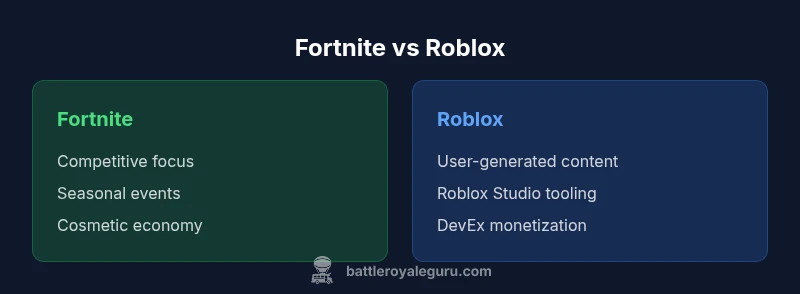
Fortnite vs Roblox: A Side-by-Side Comparison for Players
An analytical, side-by-side comparison of Fortnite and Roblox, covering gameplay, creation tools, monetization, safety, and community to help players decide which platform matches their goals.


Fortnite shines in competitive, fast-paced battle royale, while Roblox excels in user-generated games and creative building. This comparison weighs gameplay, creation tools, community dynamics, and accessibility to help you pick which platform aligns with your goals.
Why fortnite or roblox matters for players
According to Battle Royale Guru, choosing between fortnite or roblox hinges on your playstyle, goals, and time commitment. The Battle Royale Guru team found that Fortnite tends to attract players who crave tight PvP mechanics, seasonal events, and quick, high-intensity matches. Roblox, by contrast, appeals to builders, creators, and players who enjoy exploring a vast library of user-made games. This section lays the groundwork for a nuanced decision by examining core differences, audience expectations, and how each platform rewards effort over time. Whether you want a competitive arena experience or a playground of experimental games, understanding these dynamics helps you pick the right path and invest your time wisely.
Core differences at a glance
- Audience and goals: Fortnite targets competitive players seeking polished, fast sessions; Roblox serves a broader, younger audience with varied genres and creative freedom.
- Content cadence: Fortnite releases major seasonal updates and live events on a predictable cadence; Roblox relies on community-created experiences that continually expand in variety.
- Creation and tooling: Fortnite offers limited built-in creation modes and events; Roblox provides Roblox Studio for full-blown game development with monetization through virtual items and game passes.
- Monetization: Fortnite centers on cosmetics and battle passes with occasional collaborations; Roblox emphasizes user-generated content monetization via developer exchanges and in-game purchases.
- Accessibility: Fortnite supports multiple platforms with cross-play in many regions; Roblox emphasizes low entry barriers and cross-platform access across a wider device set.
- Safety and learning curve: Roblox’s safety controls and content moderation vary by creator; Fortnite presents fewer content worries but a higher skill floor for newcomers.
This quick digest helps frame the longer comparison and sets expectations for where each platform shines.
Gameplay and core mechanics: Fortnite vs Roblox
Fortnite is built around a fast, action-driven battle royale experience with building elements that add a strategic layer to gunplay and positioning. Matches are typically 20 minutes or less, and the pace is guided by a shrinking play area, late-game clutch moments, and high-production events. Roblox, in contrast, hosts a spectrum of experiences ranging from obstacle courses and simulators to role-playing worlds and experiments in game design. The core mechanic isn’t a single game loop but a platform for countless user-created experiences, each with its own objectives and control schemes. This section details how the two ecosystems translate player skill, learning curves, and long-term engagement into distinct play patterns.
Player audience and community dynamics
Fortnite’s audience skews toward teens and young adults who enjoy esports, streaming, and competitive play. The community often gravitates toward ranked modes, tournaments, and showpiece live events that generate shared moments and memes across networks. Roblox draws a broader age range, with a noticeable presence among younger players and parents seeking approachable content and educational themes. Community dynamics on Roblox emphasize creator recognition, collaboration, and a vast catalog of experiences, while Fortnite communities focus on skill progression, strategy, and high-skill gameplay. Battle Royale Guru’s analysis notes that community health on each platform hinges on moderation quality, creator support, and the perceived fairness of in-game economies.
Monetization, creation tools, and accessibility
Fortnite monetizes mainly through cosmetics, battle passes, and collaborations, which keeps gameplay free-to-play while driving revenue through cosmetic desirables. Roblox centers its economy on user-generated content, with developers earning revenue via the Developer Exchange (DevEx) program and game passes. Roblox Studio enables creators to build entire games, requiring some learning but opening endless possibilities. Accessibility varies: Fortnite supports major consoles and PCs with cloud options, while Roblox emphasizes cross-device accessibility, including mobile platforms, which broadens its reach but can raise moderation concerns. Both ecosystems reward persistent effort, but the paths to success look very different: polish and visibility in Fortnite versus scale and creativity in Roblox.
Cross-platform play and ecosystem compatibility
Cross-platform play is a major selling point for Fortnite, enabling friends on PC, consoles, and mobile to squad up, compete, and share experiences. Roblox also supports broad cross-platform play, but the ecosystem benefits from a diverse set of devices and a huge creator network. In Fortnite, cross-play is tightly integrated with matchmaking and progression. In Roblox, cross-device progress exists but can be more creator-centric, with game-specific progress and items. Battle Royale Guru notes that players should consider network stability, device performance, and content maturity when evaluating cross-platform experiences.
Safety, moderation, and learning curves
Roblox’s safety tools, parental controls, and community moderation are strong but depend on individual creators and game embeddings. The platform’s openness invites a wide range of experiences, which can include user-generated content that varies in quality. Fortnite maintains stricter content boundaries and a more contained world with consistent visual design and ongoing balance changes. The learning curve in Fortnite leans toward mastering mechanics, building, and map awareness, while Roblox demands curiosity about game design, scripting basics, and the ability to evaluate user-created content before diving in. Both communities reward careful reading of in-game rules and thoughtful engagement with moderation policies.
Real-world use cases: recommended scenarios
If you crave competition and a consistent competitive ladder, Fortnite is often the better choice, especially for players who enjoy esports, streaming, and seasonal events. If your goal is creativity, rapid prototype development, and a vast catalog of diverse games, Roblox offers a fertile sandbox where player-made worlds can become full-fledged projects. For younger players or families prioritizing creativity and learning by doing, Roblox is frequently a strong fit. For mixed households, alternating between Fortnite’s competitive sessions and Roblox’s creative library can provide a balanced gaming diet.
What players should consider before choosing
Start by outlining your priorities: Do you want a competitive, polished battle royale with frequent events, or a broad, user-generated playground where you can create and customize experiences? Consider the time you want to invest in learning tools (Roblox Studio) or building skills in tactical combat (Fortnite). Also weigh platform preferences, cross-play expectations, and how important in-game purchases feel to you. Battle Royale Guru suggests mapping these factors to your personal goals and testing both ecosystems briefly before committing to one long-term path.
The long-term prospects and updates
Both Fortnite and Roblox demonstrate strong update cadences, yet they cultivate different kinds of longevity. Fortnite maintains a visible and evolving competitive scene, with collaborations and new mechanics designed to attract returning players. Roblox continually expands through user-generated content, attracting developers who reuse and remix ideas at scale. For long-term engagement, players should monitor how each platform handles balance, moderation, and new feature introductions, as these will influence perception of value and ongoing interest.
Quick recap for decision-makers
In short, Fortnite is best for competitive players who want polish, fast matches, and live events. Roblox is best for creators who want to design, publish, and monetize varied experiences with minimal barriers to entry. Your choice should reflect whether you prioritize skill-based play and spectacle or creativity-based exploration and development. The Battle Royale Guru recommendation is to experiment with both to understand which ecosystem aligns with your gaming goals.
Comparison
| Feature | Fortnite | Roblox |
|---|---|---|
| Gameplay focus | Polished battle royale with building mechanics | Open-ended user-generated experiences and genres |
| Content creation/tools | Limited in-game creation modes, event-driven content | Roblox Studio enables full game development and publishing |
| Monetization | Cosmetics, battle passes, occasional collaborations | Developer monetization via DevEx and in-game purchases |
| Audience | Competitive players, esports enthusiasts | Creators, players seeking variety and learning |
| Cross-platform support | Strong cross-play across PC/console/mobile | Broad cross-device support across many platforms |
| Community health | Esports ecosystem, live events, structured moderation | Diverse creator base; moderation varies by game |
| Learning curve | Moderate to high skill ceiling, quick matches | Learning curve dependent on creator tools; extensive tutorials |
Upsides
- Fortnite offers a polished, competitive PvP experience with modern production values
- Roblox provides unparalleled creative freedom and a massive library of user-made games
- Both platforms offer active communities, frequent updates, and monetization paths
- Cross-platform play is available, enabling friends to play together across devices
Weaknesses
- Fortnite can feel repetitive for players seeking content variety beyond battle royale
- Roblox content quality varies widely; moderation and safety depend on creators
- Monetization in Roblox may require time to earn meaningful revenue for developers
- Learning Roblox Studio is required for deeper game development and can be time-intensive
Fortnite is the better fit for competitive play and polish; Roblox excels in creativity and a vast library of user-made games.
Choose Fortnite if you prioritize skill-based play, fast matches, and spectacular live events. Choose Roblox if you want to build, publish, and monetize your own games across a wide range of genres. The best choice depends on whether your primary interest is competition or creation.
Questions & Answers
Which is easier for beginners, Fortnite or Roblox?
Both platforms have low entry points, but Roblox often feels more welcoming for absolute beginners through its simpler, creator-oriented experiences. Fortnite has a steeper initial learning curve due to shooting mechanics and building in fast matches. Start with guided tutorials and choose a mode that matches your comfort level.
Roblox is typically easier at first for absolute beginners because of its wide variety of simple experiences; Fortnite takes longer to learn due to its combat and building systems.
Can you create games in Fortnite like Roblox?
Fortnite offers limited in-game creation and event tooling, but it does not rival Roblox Studio for full game development. If your focus is creative game development, Roblox provides a more comprehensive toolset and monetization path for developers.
Fortnite has some creation features, but Roblox Studio is the go-to for building full games.
Do both games support cross-play across platforms?
Yes, both Fortnite and Roblox support cross-platform play, though the user experience and progression systems differ. Fortnite emphasizes synchronized matchmaking and progression; Roblox emphasizes cross-device access to a large catalog of games.
Both support cross-play, but check your device and account progress for seamless syncing.
What age groups do Fortnite and Roblox appeal to?
Fortnite generally appeals to teens and young adults due to its competitive gameplay and live events, while Roblox attracts a broader range, including younger players attracted to creativity and family-friendly content.
Fortnite skews older teens; Roblox ranges from kids to teens and beyond depending on the game.
How do monetization models differ between Fortnite and Roblox?
Fortnite monetizes primarily through cosmetics and battle passes, while Roblox emphasizes developer earnings via DevEx and in-game purchases tied to user-created games. This creates different incentives for players who want to monetize content.
Fortnite focuses on cosmetics for revenue; Roblox emphasizes creator monetization via DevEx.
Which has more frequent updates?
Fortnite maintains a predictable seasonal cadence with live events, while Roblox experiences ongoing, creator-driven updates across many games. Both platforms encourage regular engagement, but the structure differs.
Fortnite has scheduled seasons; Roblox updates depend on individual creators and games.
Key Points
- Assess your preferred playstyle before deciding
- Fortnite = competitive action; Roblox = creativity and variety
- If you value user-generated content, Roblox shines; if you want a polished PvP pipeline, Fortnite wins
- Consider learning curves, monetization paths, and platform availability
- Test both ecosystems to confirm which aligns with your goals