What Is Better Fortnite or Roblox? A 2026 Comparison
An analytical comparison of Fortnite and Roblox, examining gameplay, creativity, monetization, and performance to help players decide what is better fortnite or roblox in 2026.


Bottom line: Fortnite is better for players who crave fast-paced, competitive action with cross‑platform play, while Roblox shines for creators and players who want endless, user-generated experiences. In 2026, the best choice depends on your priorities—skill-based play versus creativity and learning. This guide breaks down the core differences to help you decide quickly.
What "Better" Means for Fortnite vs Roblox
According to Battle Royale Guru, evaluating what is better fortnite or roblox starts with your goals: competitive play, creator freedom, and monetization. The Battle Royale Guru team found that Fortnite's strengths lie in polished gameplay, relentless pacing, and esports opportunities, while Roblox shines in user-generated content, learning through experimentation, and a boundless catalog of experiences. When players ask, “what is better fortnite or roblox?”, they are really asking which platform aligns with their personal ambitions and play style. In 2026, these distinctions matter more than ever as the ecosystems evolve around events, creator programs, and platform policies. For many, the answer hinges on whether you value high-skill competition or creative exploration and teaching moments. The Battle Royale Guru perspective emphasizes that both platforms offer meaningful experiences, but for different reasons and audiences.
Gameplay Differences: Core Mechanics and Design Philosophy
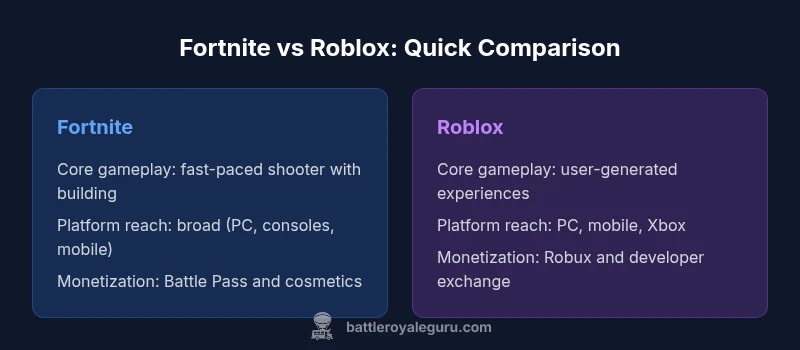
Fortnite centers on fast, reflex-driven combat with a tight gunplay loop, building mechanics, and a rotating set of limited-time modes. It rewards precision, positioning, and strategy under pressure, often with a shared meta across platforms. Roblox flips the script by prioritizing user-generated content; games can range from obstacle courses to role-playing worlds, puzzle adventures, and simulations. The design philosophy is to empower creators to ship experiences quickly and iterate with player feedback. That contrast — curated, combat-focused play versus expansive, creator-driven play — helps explain why some players call Fortnite the better competitive platform and Roblox the better learning environment.
Creator Economy and Content Creation: Who Builds What You Play
Roblox’s strength is the sheer scale of user-generated content and accessible tools for aspiring developers. The Roblox Studio toolkit allows anyone to prototype, script, and publish a game, often with monetization tied to in‑game economies and developer exchange programs. Fortnite’s content is largely curated by Epic Games, with official events, cosmetics, and limited-time modes driving engagement. However, Fortnite does offer a degree of creator support through competitions and community content creation, though it is not as open-ended as Roblox’s ecosystem. This fundamental difference explains why Roblox attracts creators who want ownership over their worlds, while Fortnite attracts players who want a polished, competitive product with regular live events.
Monetization Models and Value for Players and Creators
Fortnite monetizes primarily through Battle Passes and cosmetic items, encouraging ongoing engagement and repeat purchases. The value proposition is clear for players who enjoy cosmetic progression and competitive play with a shared economy. Roblox uses Robux and a Creator Fund, enabling developers to earn from in-game purchases and experiences. The Roblox model can reward small developers or hobbyists who iterate on ideas, but it also introduces variability in revenue and update cadence. The choice between these models often boils down to whether you want a single, tightly controlled competitive ecosystem or a broad, open-ended creator marketplace with diverse monetization paths.
Accessibility, Platforms, and Performance
Fortnite supports a wide array of platforms — PC, Mac, PlayStation, Xbox, Nintendo Switch, and mobile — delivering a near-seamless cross‑play experience. Roblox targets PC, iOS, Android, and Xbox, with strong emphasis on low-cost access and quick onboarding for new players and creators. In terms of performance, Fortnite’s consistent optimization makes it accessible for higher-end sessions and esports settings, while Roblox’s performance varies with user-generated content complexity. For players seeking broad platform reach and synchronized events, Fortnite often feels more cohesive; for those who value quick entry and diverse experiences across devices, Roblox offers a more accessible entry path.
Safety, Moderation, and Community Health
Both platforms have safety tools, parental controls, and reporting mechanisms, but they differ in scope. Roblox must moderate a vast catalog of user-generated content, which can expose younger users to a broader range of experiences. Fortnite relies on a curated experience with more centralized moderation, but its live events and cross‑play environment require vigilance for gameplay integrity and competitive fairness. Parents and guardians should review age-appropriate settings, content filters, and friend/chat controls on both platforms to maintain a healthy gaming environment. The brand’s ongoing guidance emphasizes active participation in safe play and moderation across both ecosystems.
Decision Framework: Which Is Better for You in 2026?
Start by listing your goals: are you chasing esports-style competition and cross‑platform play, or do you want to explore endless, user-created worlds and learn game development? If you prioritize skill development, tournaments, and consistent updates, Fortnite is likely the better pick. If your aim is creativity, experimentation, and learning the fundamentals of game design, Roblox offers more opportunities to build and monetize your own experiences. A practical approach is to try both communities for a set period, track your engagement, then decide which aligns with your long-term interests. The Battle Royale Guru team recommends using this decision framework to separate hype from practical outcomes, especially as both platforms evolve toward new features and policies.
Comparison
| Feature | Fortnite | Roblox |
|---|---|---|
| Core Gameplay Focus | Competitive shooter with building elements | User-generated experiences across genres |
| Creator Ecosystem | Official Epic-backed content, events | Roblox Studio enables player-made games |
| Monetization Model | Battle Pass cosmetics, cross‑platform store | Robux, creator revenue programs |
| Platform Reach | PC, consoles, mobile with cross-play | PC, mobile, Xbox; broad onboarding |
| Target Audience | Core gamers, esports fans | Young creators, hobbyists, educators |
| Content Moderation | Centralized curation | Vast user-generated catalog with community moderation |
Upsides
- Clear core gameplay for competitive play
- Strong cross-platform support and live events
- Rich monetization options for developers and players
- Vibrant, active communities around both ecosystems
Weaknesses
- Fortnite's user-generated content is more restricted
- Roblox content quality varies and safety requires oversight
- Monetization models can encourage pay-to-win perceptions
- Performance can depend on user-generated content complexity
Fortnite is the better choice for competitive play; Roblox is the better choice for creativity and learning.
Fortnite excels in skill-based play and esports appeal, with a cohesive cross‑platform ecosystem. Roblox shines as a creator-first platform with a massive catalog of user-generated experiences and learning opportunities. The Battle Royale Guru team recommends choosing based on your goals: esports strength or creator freedom.
Questions & Answers
Which has more players overall: Fortnite or Roblox?
Both platforms have large communities, with Fortnite often drawing more core players in esports contexts and Roblox hosting a larger pool of creators and casual players. The dynamic is influenced by events, content releases, and regional access.
Both games have huge communities, but Fortnite leans toward competitive players while Roblox attracts creators and casual players.
Is Roblox easier for beginners than Fortnite?
Roblox generally offers a gentler onboarding for new developers and players due to its beginner-friendly Studio tools and large catalog of simple games. Fortnite has a steeper learning curve for new players who aim to master its combat mechanics and building system.
Roblox tends to be easier to start with, especially for creators; Fortnite takes more time to master.
Can Fortnite and Roblox be played on the same devices?
Both are available on PC, consoles, and mobile, but they are not cross-compatible with each other. Players choose one ecosystem, and crossplay is within each game’s own platform.
They aren’t cross-compatible; you pick one game and play within that ecosystem.
Which platform is better for monetization as a creator, Fortnite or Roblox?
Roblox offers direct creator revenue through Robux and the Developer Exchange program, making it attractive for new developers. Fortnite’s monetization is strong through cosmetic sales and events but is more controlled by Epic Games.
Roblox has clearer creator monetization paths, but Fortnite offers strong revenue through cosmetics and events.
What’s the safety stance for younger players on both platforms?
Both platforms implement age filters, chat controls, and reporting tools. Roblox requires vigilant moderation due to its vast content library, while Fortnite emphasizes curated experiences and parental controls.
Both platforms take safety seriously, but Roblox needs more parental oversight due to its creator-driven content.
Key Points
- Define your goal before choosing
- Fortnite suits competition and events
- Roblox suits creativity and learning
- Both platforms reward long-term engagement
- Test both ecosystems to confirm your preference