Is Fortnite or Roblox Better for Kids? A Practical Guide
Battle Royale Guru analyzes is Fortnite or Roblox better for kids, comparing safety, content, monetization, and learning potential to help parents decide.


Both Fortnite and Roblox have distinct strengths for kids. Roblox offers a broad range of non-violent experiences with built-in safety tools, parental controls, and a vast creator ecosystem. Fortnite features high-quality visuals, structured events, and social features that appeal to older children. The best choice depends on age, content preferences, and how you manage playtime and purchases.
Is Fortnite or Roblox Better for Kids? Framing the Decision
According to Battle Royale Guru, the question of which platform is better for kids is not a single-figure answer. Both Fortnite and Roblox serve different needs and ages, and the safest choice depends on age, maturity, and how families implement controls. When parents ask is fortnite or roblox better for kids, they often consider content suitability, safety tools, and how the game fits into daily routines. In this framework, we focus on safety safeguards, content access controls, and the play style that aligns with your child’s interests.
The reality is that Roblox offers a much wider range of experiences, many of which are non-violent, creative, and educational, which can be beneficial for younger children and early learners. Fortnite, by contrast, emphasizes competitive gameplay, team-based events, and high-fidelity visuals that may engage older children and pre-teens who enjoy structured challenges. The key is to balance safety with agency: choose settings that limit chat, control monetization, and curate experiences that match your child's age and temperament. The short answer is not a universal “best”—it's about aligning the climate of play with family rules and your child’s goals.
Gameplay Models and Content Variety
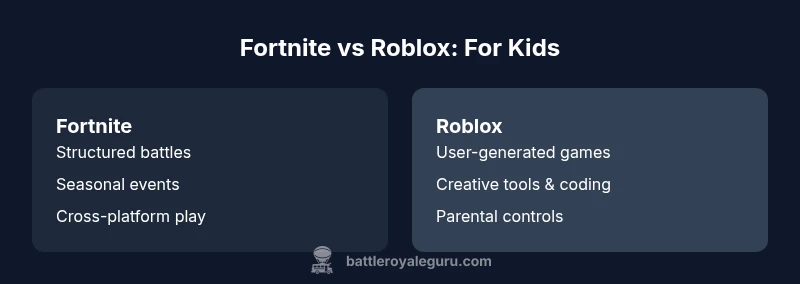
Fortnite centers on packaged battle royale matches, creative mode, and seasonal events that provide structured challenges and social competition. Roblox operates as a platform hosting millions of user-created experiences spanning genres from obstacle courses to role-playing simulations, puzzle adventures, and educational games. This sheer breadth means kids can switch between competitive play in Fortnite and creative exploration in Roblox. The trade-off is that Roblox content varies in focus and quality, which necessitates supervision and curated recommendations. For families evaluating long-term engagement, Roblox can feel more expansive while Fortnite offers more defined progression and social event calendars. Consider your child’s tolerance for multiplayer competition, speed of progression, and interest in building or storytelling when answering the question: is fortnite or roblox better for kids? The bottom line is that both platforms provide meaningful play, but the best fit depends on age, personality, and how you structure access and content.
Safety, Moderation, and Parental Controls
Safety is not a one-size-fits-all feature—it’s a combination of platform design and active parental involvement. Both Fortnite and Roblox offer parental controls, friend and chat settings, and spending limits, yet the effectiveness hinges on how families configure them. Roblox enables parents to adjust who can chat, what experiences are accessible, and how in-game purchases work. Fortnite provides a suite of controls for voice chat, party privacy, and a more predictable content flow through official events and curated modes. For parents, the key is to start with default protections, verify that chat is restricted to friends or turned off, and enable spending caps. Regular check-ins about who their child plays with and what experiences they access are essential to minimize exposure to inappropriate content. By setting rules early and revisiting them, you’re better prepared for a safe and enjoyable gaming routine.
Monetization, Spending, and Value
Monetization is a central consideration for families weighing is fortnite or roblox better for kids. Roblox uses Robux to purchase avatar cosmetics, game passes, and access to certain experiences, while Fortnite uses V-Bucks for cosmetic items, Battle Passes, and event-specific content. The risk of overspending increases with both platforms if there are no caps or time limits. Practical steps include enabling parental payment controls, setting weekly or monthly spending caps, and discussing with kids which purchases are truly optional. Evaluate value by looking at how much time a kid spends in each ecosystem, the educational or creative payoff of Roblox experiences (for example, coding or game design exposure), and the social rewards that come with Fortnite events or Roblox collaborations. If your goal is budget-conscious yet engaging play, Roblox can offer a wide palette of free-to-start experiences, while Fortnite can provide high-quality, event-driven content that motivates continued participation with mindful spending.
Social Play, Chats, and Community Safety
Social features are a core part of both Fortnite and Roblox, yet they operate differently. Fortnite emphasizes team battles, live events, and party systems that encourage coordinated play with known friends or approved teammates. Roblox emphasizes community-created experiences, chat options, and collaborative projects that can be highly social but require stronger safety scaffolding to protect younger players. For families, a practical approach is to implement strict friend lists, limit or disable voice chat, and keep conversations in-game moderated or offline until trust in the community is established. Also, teach kids to report inappropriate behavior and to avoid sharing personal information. The social energy on Roblox can foster creativity and teamwork when managed carefully, while Fortnite offers dynamic social hubs around events that are easy to supervise with set time windows and clear boundaries.
Education, Creativity, and Skill Development
Roblox can be a powerful gateway to creativity and basic coding through Roblox Studio, where kids design games, test ideas, and iterate with feedback. This creative pipeline can build problem-solving skills, math reasoning, and basic programming concepts in a highly engaging context. Fortnite Creative Mode introduces design thinking and rapid iteration through user-generated islands and game modes, which can inspire strategic planning and collaboration, though the scope leans more toward gameplay experimentation than formal coding. If your objective is hands-on learning, Roblox offers broader opportunities to explore game design concepts, while Fortnite provides immediate, structured challenges that teach tactics, teamwork, and adaptability in high-energy environments.
Accessibility, Devices, and Cross-Platform Play
Both platforms strive for broad accessibility, but device availability and cross-platform dynamics differ. Fortnite runs on PC, consoles, and mobile devices with cross-play across many systems, which can help siblings play together regardless of device. Roblox is largely PC and mobile-first, with console support depending on regional availability and title approvals; cross-play tends to be more limited by game and platform. When choosing between is fortnite or roblox better for kids, consider your household’s device mix, internet reliability, and how comfortable your child is moving between screen sizes. Consolidating play on fewer devices can simplify safety settings and monitorability, while multi-device access may expand play opportunities if you can maintain consistent parental controls across platforms.
Practical Guidelines for Parents: Getting Started
If you’re unsure where to begin, start small and scale responsibly. Create a family gaming plan with clear expectations about screen time, chat use, and spending limits. Turn on age-appropriate safety features in both games, such as restricting chat to friends or turning it off, enabling spending limits, and requiring password-protected purchases. Visit the official safety centers for Fortnite and Roblox to review recommended settings and regional guidance. Build a routine that includes shared play times, post-play debriefs, and a feedback loop where kids can discuss what they enjoyed and what challenged them. Finally, curate a list of preferred experiences in Roblox and outline a calendar of Fortnite events to keep expectations aligned with family rules.
Conclusion: Customizing the Experience for Your Family
The question is not simply which platform is better for kids; it’s how you tailor the experience to your family’s values and your child’s maturity. By combining Roblox’s creative potential with Fortnite’s event-driven play, families can offer a balanced mix of creativity, social interaction, and strategic challenges. The best approach is a phased plan: start with safer, creator-led Roblox experiences for younger children, gradually adding more structured Fortnite play as comfort with safety features grows. The key is ongoing dialogue, consistent safety practices, and a clear understanding of the expectations around in-game purchases and social interactions. The Battle Royale Guru team believes that a thoughtful, controlled approach yields the most positive outcomes from both platforms.
Final Note on Choice and Progression
Remember that the landscape of kid-friendly games evolves, and platforms update safety features and content pipelines. Revisit settings every few months to reflect your child’s changing interests and age. The choice between Fortnite and Roblox should be dynamic, not a one-time decision. With careful oversight, both platforms can offer motivating, age-appropriate experiences that support creativity, competition, and digital literacy.
Comparison
| Feature | Fortnite | Roblox |
|---|---|---|
| Gameplay style | Structured battles, competitive play, seasonal events | Massively diverse user-generated experiences across genres |
| Content variety | Predominantly battle royale + creative mode with official events | Millions of user-created games; broad spectrum from non-violent to fantasy |
| Safety and moderation | Controls for voice chat, party privacy, and parental settings; event moderation | Moderation varies by title; strong parental controls but high content variability |
| Monetization | V-Bucks for cosmetics and passes; time-limited events | Robux for items, passes, and access to experiences; wide price range |
| Cross-platform | PC, Xbox, PlayStation, Nintendo, mobile; strong cross-play | PC and mobile primary; console support depending on game and region |
| Education/creativity | Limited creator tooling beyond build/edit modes | Roblox Studio enables game design and coding concepts |
| Best for | Older kids seeking structured competition and events | Younger to pre-teen kids seeking creative, safe exploration |
Upsides
- Large, active communities on both platforms
- Strong parental controls and safety features
- Roblox encourages creativity and coding through Studio
- Fortnite provides dynamic events and social hubs for older kids
- Wide device compatibility and cross-platform play
Weaknesses
- In-game purchases can escalate quickly without caps
- Content on Roblox is user-generated and not always curated for kids
- Chat and voice features may expose kids to strangers without safeguards
- Differences in moderation quality across experiences can be unpredictable
Roblox is generally safer for younger children, while Fortnite suits older kids seeking competition and events
Choose Roblox for younger kids who benefit from broad creative experiences and strong safety tools. Choose Fortnite for pre-teens who enjoy structured challenges and social events; tailor safety settings and spending limits to your family's rules.
Questions & Answers
Is Roblox safe for younger kids with parental controls?
Roblox can be safe for younger kids when parents enable strict chat restrictions, limit what experiences are accessible, and set spending caps. Regular check-ins about what games are being played help maintain a positive experience.
Roblox can be safe with strong parental controls; start with restricted chat and curated experiences, then review together periodically.
Is Fortnite appropriate for kids under 10?
Fortnite’s content is generally aimed at older kids due to competitive gameplay and visual intensity. If a younger child participates, use strict safety settings, limit chat, and select kid-friendly modes and events.
Fortnite is usually better for older kids; with strict settings, it can be moderated for younger players.
How do parental controls differ between Fortnite and Roblox?
Both offer controls for chats, spending, and visibility, but Roblox emphasizes curating experiences and friend lists, while Fortnite focuses on party settings and event access. Tailor both to your family rules and review regularly.
Roblox focuses on experience access and chat controls; Fortnite centers on party and event controls.
Can kids learn coding or digital literacy from Roblox?
Yes. Roblox Studio exposes kids to game design concepts, scripting, and problem-solving in a hands-on way, making it a practical path toward basic coding literacy.
Roblox can teach kids basic coding and game design through Roblox Studio.
Is cross-play safe for younger kids?
Cross-play can expand social opportunities but requires diligent safety settings and supervision. Use limited friend lists and enable reporting features to manage interactions.
Cross-play broadens social play but requires proactive safety settings.
Which platform offers better value for money?
Value depends on play style: Roblox provides many free-to-start experiences with optional expenses, while Fortnite offers rich live events and cosmetics that may appeal to kids who engage with the ecosystem long-term.
Roblox often feels like more free-to-start value; Fortnite offers premium events and cosmetics for ongoing engagement.
Key Points
- Assess your child’s age and maturity before choosing.
- Activate and tailor safety controls on both platforms.
- Roblox favors creativity; Fortnite emphasizes competition and events.
- Set clear budgets and time limits to prevent overspending.
- Monitor interactions and adjust settings as needed.