Fortnite to CS2 Sens: A Practical Conversion Guide
Learn how to map your Fortnite sensitivity to CS2 for consistent aim. Step-by-step methods, testing tips, and practical drills to improve cross-game aiming and muscle memory.


Your goal is to translate your Fortnite sensitivity into CS2 so your aim feels familiar across both games. This quick guide shows how to map DPI, pick a baseline, and validate it with focused testing. You’ll learn a reliable, repeatable method to align fortnite to cs2 sens without guesswork, plus practical drills to lock in the new setting.
Understanding cross-game aim: Fortnite to CS2 sens
Translating your Fortnite sensitivity into CS2 affects how quickly your aim responds to mouse movement. Because Fortnite uses a different engine, field of view (FOV) handling, and sensitivity scaling than CS2, a direct one-to-one setting rarely feels identical. The ultimate aim is to create a reliable mapping that preserves your muscle memory while accounting for engine differences. According to Battle Royale Guru, the most successful players treat this as a calibration exercise, not a guess. Start from a stable DPI baseline and validate with controlled tests before moving to real matches. This approach reduces frustration and accelerates mastery across both titles.
When you navigate fortnite to cs2 sens, you’re not just swapping numbers—you’re reconciling how each game translates mouse motion into on-screen rotation. Expect subtle differences in acceleration, input latency, and how the engine interprets vertical versus horizontal movement. A solid conversion plan keeps your consistency intact, lowers the time you spend chasing aim drift, and makes cross-play sessions more predictable for practice and scrims.
Core concepts: sensitivity, DPI, and engine differences
Sensitivity is the direct multiplier that converts your mouse movement into on-screen rotation. DPI (dots per inch) determines how far the mouse travels for a given number of inches moved. Engine differences between Fortnite (Unreal Engine) and CS2 (Source 2) alter how sensitivity feels at the same numeric setting. Add in FOV differences and input smoothing, and you’ve got a non-linear mapping problem rather than a simple one-to-one transfer. The practical takeaway is to treat sensitivity as a movable dial rather than a fixed value. Keep your DPI constant while you tune the in-game sensitivity in CS2, then verify with targeted drills to ensure the change is translating correctly on-screen. Ongoing practice with consistent equipment and surfaces is crucial for true cross-game stability.
When you set up a cross-game sens plan, also account for the fact that your physical mouse posture, grip, and stride of movements can subtly alter perceived sensitivity. A well-configured system minimizes fatigue and helps you sustain focus during long practice sessions. The Battle Royale Guru team emphasizes measurement-based calibration: test, record, adjust, and re-test. This disciplined approach builds reliable muscle memory that transfers between Fortnite and CS2.
A practical mapping approach (no one-size-fits-all numbers)
There isn’t a single universal formula that perfectly matches fortnite to cs2 sens for every player. A practical approach begins with a stable DPI baseline you’re comfortable using in both games. From there, you establish an initial CS2 sensitivity that feels roughly proportional to your Fortnite feel, then verify with controlled tests. Document your baseline values and use small, incremental changes to avoid overshooting the target feel. Rely on objective tests—aim trainers, 360-degree drills, and map-specific practice—to determine whether the translation is comfortable across scenarios.
Keep in mind that some players prefer to preserve consistent 360-degree speed across games. If your CS2 turns feel too fast or too slow at first, adjust by small increments and retest. The goal is to reach a stable point where your crosshair returns to center with similar speed, precision, and consistency when moving from Fortnite to CS2. If you notice fatigue or inconsistency on long sessions, re-check your DPI and surface quality, then re-run a short calibration block.
Testing and validation routines
The best way to validate a fortnite to cs2 sens conversion is to combine structured tests with real play. Start with a focused aims trainer session: perform a series of controlled 360-degree turns, track the time or distance required to complete each turn, and compare results across games. Then move to live scrims or deathmatch maps to see how the new settings hold up under pressure, adjusting as needed. Use a consistent test environment—same mouse, same DPI, same surface, and the same CS2 sensitivity—so you can attribute changes to the settings rather than the environment.
A practical test plan looks like this:
- Calibrate using a stable DPI and CS2 sensitivity for 15-20 minutes of repeatable drills.
- Do 20-30 360-degree turns in a trainer, noting consistency and fatigue.
- Play 5-10 minutes on a practice map to evaluate drift at different ranges.
- Repeat on a second map to confirm cross-map reliability. Document every change and the resulting feel to enable precise backtracking if needed.
Common pitfalls and how to avoid them
Cross-game sens conversions are easy to misjudge if you rely on guesswork. Common pitfalls include changing DPI too often, chasing a “perfect” number that doesn’t translate well in practice, or ignoring surface quality and hardware limitations that affect input precision. To avoid these issues, keep DPI fixed during the CS2 tuning phase, test with a simple map or aim trainer, and only adjust the in-game sensitivity. Also, avoid large jumps in sensitivity between tests; tiny steps provide clearer feedback and reduce the risk of overshooting the target feel.
Another frequent issue is neglecting cross-device consistency. If you play on a laptop, desktop, and laptop again, differences in DPI scaling, display refresh rate, and input latency can skew your results. The best practice is to finalize your CS2 sensitivity on the primary device and then adjust only when switching devices, re-checking your aim with the exact same test protocol.
Maintenance: When to revisit your settings
Sensitivity preferences can shift over time due to hardware wear, driver updates, or changes in your playstyle or map preference. Plan to recheck your fortnite to cs2 sens every few weeks, especially after a new season, a hardware change, or a significant training push. Create a short reset protocol: revalidate with a 10-minute aim trainer block, compare to your previous measurements, and decide whether to tweak again.
Documented changes help you identify patterns: if a certain device consistently drifts, it may indicate a surface or sensor issue rather than a pure setting problem. Prioritize consistency, reduce the number of variables, and maintain a dedicated calibration session every time you adjust equipment or playstyle.
Step-by-Step transition plan
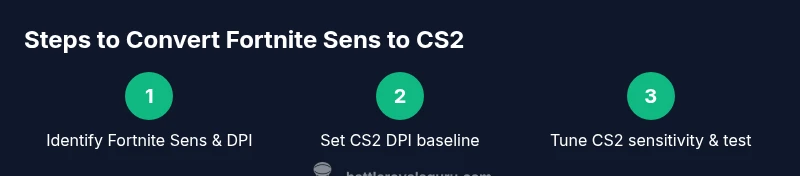
The goal of this article is to give you a practical framework for converting fortnite to cs2 sens through a structured calibration process. Follow the steps in the step-by-step block to implement the insights from these sections, then validate with the recommended tests. This flow keeps your muscle memory intact while allowing you to adapt to the differences between Fortnite and CS2. If you stick to the plan, you’ll see a smoother, more reliable cross-game aiming experience.
Tools & Materials
- Gaming mouse with adjustable DPI(DPI range 400-1600; on-device DPI button preferred)
- CS2 installed(Official Valve release, latest patch)
- Fortnite installed(Reference game for baseline sensitivity)
- Calibration mat or smooth desk surface(Promotes consistent sensor readings)
- High-refresh monitor (144 Hz+)(Better feedback during testing)
Steps
Estimated time: 60-90 minutes
- 1
Identify Fortnite sensitivity and DPI
Open Fortnite settings and locate your in-game sensitivity. Record your mouse DPI from the hardware software or on-mouse display. Keeping these baseline figures documented helps later when you map to CS2.
Tip: Document values in a dedicated notebook or spreadsheet. - 2
Choose a CS2 DPI baseline
Decide on a stable DPI you will use for CS2 (common choices fall in the 800–1600 range). Consistency here is essential to ensure the sensitivity mapping is meaningful.
Tip: Stick to one DPI baseline during the tuning phase. - 3
Set an initial CS2 sensitivity
With your CS2 DPI baseline set, choose a middle-range in-game sensitivity to start. Do not aim for perfect parity yet—focus on establishing a starting feel that resembles your Fortnite motion.
Tip: Start with a mid-range value and move in small steps. - 4
Test with aim drills and 360s
Use a training map or aim trainer to perform 20–30 smooth 360-degree turns. Note how quickly you complete a full rotation and how stable your crosshair is during the motion.
Tip: Keep test sessions short and repeatable to track progress. - 5
Fine-tune CS2 sensitivity
Adjust CS2 sensitivity in small increments and re-check with the same 360-degree drill. Compare results to your Fortnite baseline and aim for similar rotation feel across both games.
Tip: Document every change and its impact. - 6
Validate on maps and practice sessions
Move from drills to a practice map or deathmatch to verify the setting under realistic conditions. Pay attention to target acquisition at various ranges and while strafing.
Tip: Test across at least two different maps or drills. - 7
Save presets and plan rechecks
Save your CS2 profile with the final sensitivity and DPI. Schedule a follow-up validation after any future hardware or driver changes.
Tip: Create a quick revert point if you need to reset.
Questions & Answers
Is it possible to perfectly match Fortnite sensitivity in CS2?
No single value will exactly replicate the feel due to engine differences. Focus on a comfortable, proportional sensitivity and good aim consistency.
You can't match perfectly, but you can aim for a comfortable, proportional sensitivity and consistent aim.
Should I use the same DPI in CS2 as in Fortnite?
Keeping DPI consistent helps your muscle memory. Adjust only the in-game sensitivity to find the right balance.
Keep the same DPI to preserve your muscle memory, then tune CS2 sensitivity.
How long should I test before finalizing?
Spend focused testing sessions totaling 15-20 minutes of aim practice, then refine using real matches.
Test in focused 15-20 minute blocks, then refine in actual play.
What if my aim feels off on certain maps?
Some maps demand different micro-adjustments. Re-test across diverse maps and targets to ensure consistency.
If it feels off on some maps, re-test and adjust for overall consistency.
Can I revert if I dislike the new sensitivity?
Yes. Save your previous profile and revert if needed, then retry with small tweaks.
Yes, you can revert to your previous settings and try small tweaks.
Watch Video
Key Points
- Test with a fixed DPI baseline
- Aim for a smooth 360 test across games
- Document settings to track progress
- Use short practice sessions for frequent adjustments
- Re-test across maps and devices