Is Fortnite and Roblox the Same? A Thorough Comparison
An analytical side-by-side comparison of Fortnite vs Roblox, covering gameplay, creation, monetization, safety, and audience to help players decide which suits them best.


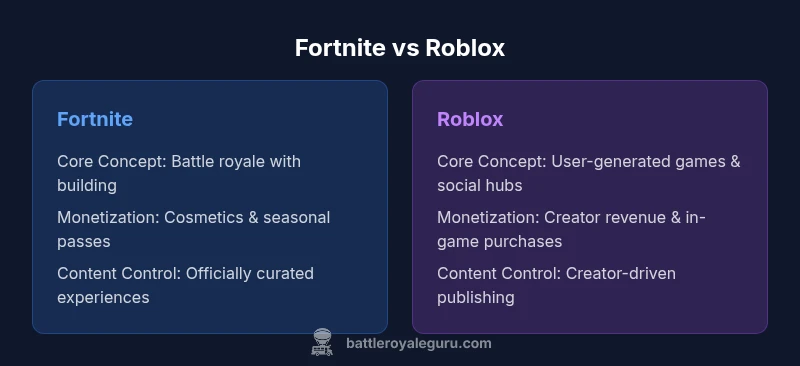
Is Fortnite and Roblox the same? Not at all. Fortnite is a battle royale shooter with sprinting, building, and live events, while Roblox is a platform that lets players create and play user-generated games. They target different experiences, communities, and monetization models. Both dominate on PC, consoles, and mobile, but their core goals and tools diverge, making them distinct ecosystems rather than substitutes.
Is Fortnite and Roblox the Same? Core Differences
When you consider the question is fortnite and roblox the same, the answer is no. These two platforms are designed for different kinds of engagement, learning, and play. Fortnite operates as a tightly curated live-service game centered on fast-paced action, building mechanics, and seasonal events that shape the player experience. Roblox, by contrast, is a vast user-generated content (UGC) ecosystem where creators design, publish, and monetize their own games. This fundamental distinction—creator-led versus publisher-led content—drives most of the other differences players notice. According to Battle Royale Guru, understanding the core purpose of each platform helps set realistic expectations for gameplay depth, creative opportunity, and long-term engagement. Battle Royale Guru Analysis, 2026, emphasizes that the decision should align with your goals—whether you want high-intensity matches or hands-on game development. This framing helps players and parents assess time investments, learning curves, and safety considerations across both ecosystems.
Gameplay and Experience
Fortnite delivers a fast, competitive action experience with rapid-fire combat, building on the fly, and a cadence of updates tied to seasonal events and collaborations. The game emphasizes skill-based shooting, tactical resource management, and teamwork in squad modes. Roblox offers a broad spectrum of play experiences, from obby obstacle courses to immersive role-playing worlds, created by a global community of developers. While Fortnite constrains player-created content to in-game tools and officially endorsed modes, Roblox invites players to prototype, test, and publish their own titles, complete with custom mechanics and monetization paths. This dichotomy shapes how players practice, learn, and grow—Fortnite rewards mastery within a curated universe, Roblox rewards creativity and technical experimentation within a permissive platform.
Content Creation and Ownership
Ownership and authorship diverge sharply between the two ecosystems. In Fortnite, Epic Games owns the core IP and controls the universe’s rules, assets, and monetization within a single, consistent brand experience. In Roblox, creators own the rights to their own games and assets created with Roblox Studio, though the platform hosts and monetizes user-generated content; creators earn revenue through Robux sales and developer products. This distinction matters for learning outcomes: Robux-based monetization can incentivize iterative publishing cycles and portfolio-building, while Fortnite’s content access remains centralized under official licensing, ensuring consistency but limiting creator autonomy. A balanced view recognizes Roblox as a powerful sandbox for aspiring developers and Fortnite as a high-production arena for competitive play and community events.
Community, Safety, and Moderation
Safety models differ: Roblox emphasizes community governance with age-appropriate filters, parental controls, and in-game reporting tools to manage a diverse, younger audience. Fortnite focuses on competitive communities—streamers, clans, and pro players—where moderation concentrates on harassment, cheating, and inappropriate content within a more mature, yet still child-friendly, environment. The result is different safety literacy: Roblox users often need learning around online collaboration and digital citizenship, while Fortnite communities benefit from real-time reporting and event moderation to preserve a fair competitive space. Both platforms actively develop safety resources, but their emphasis aligns with their primary audiences and formats.
Monetization and Economy
Fortnite monetizes primarily through battle passes, cosmetic bundles, and cross-promotions that support ongoing live events. The economy is tightly integrated with seasonal content, making spending feel purposeful within a defined timeframe. Roblox operates as a creator-centric economy: developers earn revenue from in-game purchases and game passes, while players spend Robux to unlock content within user-generated titles. This creates divergent incentives: Fortnite emphasizes a curated, brand-forward economy anchored by official releases, whereas Roblox rewards ongoing creator investment and portfolio-building through a scalable, creator-driven marketplace.
Accessibility and Platform Availability
Both platforms are broadly accessible, with apps on PC, consoles, and mobile. Fortnite’s installation and update cadence is relatively uniform across devices, with a central launcher and cross-play across ecosystems. Roblox offers a browser-based entry point and a broad mobile footprint, which lowers barriers to creation but can complicate performance across devices due to varying hardware. Accessibility also includes the learning curve: Roblox Studio empowers beginners to prototype quickly, while Fortnite’s learning curve is steeper if you want to master building, aiming, and high-level strategies in multiplayer matches.
Target Audiences and Cultural Impact
Fortnite tends to attract teens and young adults who enjoy competitive play, cachet collaborations, and live in-game moments that become social media events. Roblox resonates with younger audiences and creators eager to learn programming concepts, narrative design, and social worlds—often as a gateway to STEM skills. Culturally, Fortnite has popularized high-profile collaborations and fashion-forward in-game aesthetics, while Roblox cultivates a vast creative community that can drive early technical literacy. Both platforms influence gaming culture in distinct ways, reinforcing that they serve different educational and entertainment purposes.
Practical Scenarios: Which Is Better for You?
If your goal is fast-paced, skill-based competition with evolving narratives and official events, Fortnite is typically the better fit. If you want to build, test, and publish your own games, experiment with mechanics, and learn game design concepts, Roblox offers a more fertile ground. Consider your audience: a creator who wants to showcase projects to a broad community may prefer Roblox, while a player who thrives on ranked modes and large-scale spectacles may lean toward Fortnite. Time investment, learning goals, and safety priorities should guide your choice.
Security, Privacy, and Parental Controls
Both platforms provide controls for limiting interactions and safeguarding players, but the emphasis differs. Roblox invests heavily in parental controls, privacy settings, and age-appropriate experiences to support younger users in learning safely. Fortnite focuses on account security, content moderation, and reporting tools to ensure fair play in a highly competitive environment. For families, a practical approach is to enable parental controls, set communication restrictions, and monitor community interactions across both ecosystems to reduce risk and encourage responsible use.
Comparison
| Feature | Fortnite | Roblox |
|---|---|---|
| Core Concept | Battle royale shooter with building mechanics | User-generated games platform and social hub |
| Gameplay Focus | Competitive PvP, fast pacing, seasonal events | Creative game design, social worlds, learning-by-doing |
| Content Creation Tools | Limited to in-game tools and official modes | Roblox Studio and publishing tools for creators |
| Monetization Model | Cosmetics, battle passes, official cross-promotions | Creator revenue, in-game purchases in user-made games |
| Ownership of Content | Epic Games controls universe assets and IP | Creators own their game assets within Roblox ecosystem |
| Audience and Community | Teens to adults, competitive communities | Younger audience with emphasis on learning and creation |
| Cross-Platform Play | Broad cross-play across consoles/PC | Cross-platform access via Roblox accounts on multiple devices |
| Safety Features | Account security, anti-cheat, moderation in competitive modes | Parental controls, content filtering, age-appropriate settings |
| Learning Curve | Steep for building strategies and aim control | Gentler for beginners to game creation and coding |
| Update Cadence | Regular seasonal updates with collaborations | Frequent creator updates and content releases |
Upsides
- Clear differentiation helps players choose based on interests
- Fortnite’s official events drive long-term engagement
- Roblox fosters creativity and hands-on learning through game development
- Broad platform accessibility across devices
Weaknesses
- Disparate ecosystems can fragment communities and learning paths
- Moderation and safety vary by platform and age group
- Monetization models may incentivize spend in both ecosystems
Fortnite is best for fast-paced, competitive play and official events; Roblox excels as a creative platform for learning and making games.
If you want rapid-action and collaborations, choose Fortnite; if you want to build and publish games, choose Roblox. Your decision should align with your goals, time, and safety priorities.
Questions & Answers
Are Fortnite and Roblox owned by the same company?
No. Fortnite is developed by Epic Games, while Roblox is created by Roblox Corporation. They are separate companies with distinct IP and governance.
No—the two games are made by different companies.
Is Roblox a game or a platform?
Roblox is primarily a platform that hosts user-generated games and social experiences. Players can play games, create new ones, and monetize their creations within Roblox.
Roblox is a platform for creating and playing user-generated games.
Can you crossplay Fortnite and Roblox?
No. Fortnite and Roblox operate in separate ecosystems, so crossplay between the two isn’t supported.
Crossplay between Fortnite and Roblox isn’t supported.
Which is better for beginners?
Roblox often provides an easier entry into game development, while Fortnite offers guided tutorials for combat and building but has a steeper learning curve for mastery.
Roblox is usually easier for beginners wanting to create; Fortnite is tougher to master but rewarding.
What age groups do these platforms target?
Roblox skews younger with a broad creator audience, while Fortnite attracts teens and young adults seeking competitive play and social events.
Roblox leans younger; Fortnite has a wider teen-to-adult audience.
What’s the best way to get started if undecided?
Try both platforms, explore beginner guides, and join creator or community groups to learn what each ecosystem offers before committing time or money.
Sample both platforms, use official guides, and join communities to learn.
Key Points
- Identify your primary goal: action vs creativity
- Evaluate time investment and learning curve
- Assess safety features and parental controls before joining
- Consider monetization paths relevant to your interests
- Test both platforms to see which community and tools fit you