Is Fortnite Similar to Apex? A Thorough Comparison
An analytical side-by-side comparison of Fortnite and Apex Legends, focusing on core mechanics, pacing, progression, and player experience to help you decide which battle royale fits your playstyle.


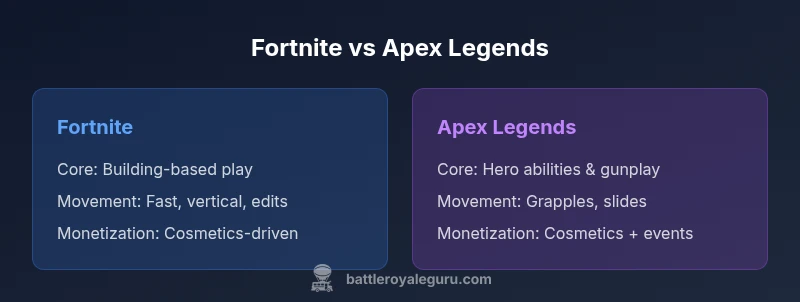
According to Battle Royale Guru, is Fortnite similar to Apex? Not exactly. Fortnite emphasizes building, fast exploration, and a heavy cosmetic loop, while Apex Legends centers on squad tactics, gunplay, and unique hero abilities. The two games share a BR core but diverge in pacing, map design, and progression systems. In short: is fortnite similar to apex? The answer: they are separate experiences that appeal to different playstyles and goals, with limited overlap in core mechanics.
Fortnite vs Apex: Defining the Core Differences
Fortnite and Apex Legends are both prominent members of the battle royale genre, yet they occupy different corners of the space. The question is not simply which one is better; it’s which design choices align with your preferred playstyle. According to Battle Royale Guru, a careful look at mechanics, pacing, and progression reveals that the two games diverge from the outset, even though they share a common endgame objective: outlast competitors and claim victory. Fortnite leans into quick map exploration, dynamic movement, and a heavy cosmetic economy that rewards long-term engagement. Apex prioritizes squad-based tactics, precise gunplay, and a roster of legends with unique abilities that shape each encounter. The result is two distinct experiences that can satisfy different moods and goals, from casual experimentation to high-stakes competition.
Key takeaway: Both games offer a BR core, but the way you win, the tools you use, and the pace you experience set them apart. The Battle Royale Guru team emphasizes that the choice often comes down to whether you value creativity and accessibility or tactical coordination and refined aim.
Core Mechanics: Building vs Gunplay
At the heart of the Fortnite-Apex divide are core mechanics that determine every subsequent decision in play. Fortnite’s signature feature—building—transforms how you approach fights, mobility, and line-of-sight control. Players can construct walls, ramps, and floors on the fly, creating temporary structures for defense, high ground, or tactical repositioning. This adds layers of strategy and improvisation that can turn the clock in seconds. By contrast, Apex Legends forgoes building entirely and instead emphasizes gun mechanics, recoil management, and a fluid movement system that rewards precision and timing. Legends grant unique abilities that complement team composition and pivot the moment-to-moment strategy. The Battle Royale Guru analysis shows that while both games are BR titles, Fortnite’s sandboxed building and Apex’s hero-driven gunplay push players toward fundamentally different skill sets. When asked, many players describe Fortnite as more forgiving in exploration and rotation, while Apex rewards raw mechanical mastery and team synergy.
Best for: Players who enjoy rapid, improvisational defense and creative creativity versus players who prioritize tight gunfights and coordinated plans.
Movement and Pace: Flowing through the Map vs Tactical Strikes
Movement in Fortnite blends traditional BR traversal with rapid building, creating a velocity curve that can feel almost platformer-like. In practice, you can sprint, slide, glide, and edit structures to thread through shrinking circles and outmaneuver opponents. The pace can be exhilarating but also chaotic, depending on how aggressively players deploy structures and resources. Apex’s movement is more straightforward, focusing on precise aim routes, grapples, and zip lines that connect key fight arenas. Teams must coordinate angles and callouts, and the fight flow often hinges on the timing of ultimates or tactical abilities. The difference in pacing impacts risk assessment: Fortnite invites micro-decisions under intense time pressure, while Apex rewards macro-planning and post-fight resets. Battle Royale Guru notes that players who dislike heavy building may adopt a more measured approach in Apex, while builders may find Fortnite’s tempo to be both a blessing and a trap.
Consider: Do you prefer improvisational defense or set-piece team maneuvers?
Map Design, Rotations, and Endgame Dynamics
Map design in Fortnite emphasizes verticality, open sightlines, and variety across seasonal biomes. Rotations are as much about terrain control as they are about item spawns, with the building mechanic acting as a dynamic tool for navigation. Endgames in Fortnite can feel like large-scale chess matches, where elevated positions and rapid edits decide who survives the final circles. Apex Legends maps focus on tight sightlines, multi-angled combat zones, and a consistent emphasis on player positioning relative to the ring and to teammates. Legends’ abilities can redefine choke points and enemy dispersion, creating endgames that often feel more coordinated and outcome-driven. The Battle Royale Guru framework suggests choosing based on whether you value ground mastery and structural play (Fortnite) or environment control and squad-level execution (Apex).
Practical note: Endgame feel and decision fatigue differ substantially, which influences how long you’ll stay engaged per session.
Progression Models: Seasons, Passes, and Cosmetics
Both games rely on seasonal content to drive engagement, but their progression systems diverge in emphasis. Fortnite’s battle pass emphasizes cosmetic rewards, emotes, and adjustable aesthetics that customize your avatar’s look and in-game presence. Progression often feels visually rewarding, encouraging continued play as skins, wraps, and gliders unlock across chapters. Apex Legends ties progression more closely to a roster of legends, loot distributions, and cosmetic unlocks tied to seasons and events, with a heavier focus on collecting cosmetics and reclaiming loot through play. For players who value expressive customization and a tangible sense of progression through collectibles, Fortnite presents a familiar loop. For those who prioritize masteries, legend unlocking, and team-rotation bonuses, Apex offers a more structured progression path that complements competitive play.
Industry note: Cosmetic economies drive long-term engagement in both games, but the perceived value of unlocks can be very different depending on your interests.
Community, Esports, and Content Creation
Fortnite has long lived at the intersection of mass-market appeal and creative content creation. Its expansive creative mode and user-generated maps invite a broad community to customize experiences, share replays, and publish highlights, which often leads to high daily active user numbers and a thriving streaming ecosystem. Apex Legends maintains a robust competitive scene with organized tournaments and a steadily growing community of teams and players who publish guides, loadouts, and strategy videos. The difference in ecosystem focus influences how new players learn the game and where they find ongoing motivation to improve. Battle Royale Guru observes that Fortnite thrives on perception of accessibility and spectacle, while Apex sustains momentum through tactical depth and team-centered play.
Tip for creators: If your content thrives on customization and community showcases, Fortnite is a natural fit. If you excel at in-depth analysis and team-play breakdowns, Apex may be more rewarding to cover.
Crossplay, Platforms, and Accessibility
Both games support crossplay, but their platform parity and accessibility differ. Fortnite maintains consistent cross-platform functionality across PC, consoles, and mobile where available, with a focus on broad audience accessibility. Apex Legends also supports crossplay across major platforms and emphasizes a relatively uniform control schema to reduce input advantage gaps. For players on lower-spec hardware, both titles offer performance options, though the perceived performance can vary by server region, input device, and network conditions. The Battle Royale Guru guidance here is to test both titles with your preferred controller or keyboard-and-m Mouse settings, aiming for a consistent experience across sessions. Accessibility features, including field-of-view options, aim assist, and colorblind modes, further influence comfort and performance across platforms.
Bottom line: Crossplay parity matters, but your comfort with controls and input latency will ultimately shape which version you enjoy most.
Decision Framework: When to Choose Fortnite vs Apex
If your priority is a low-friction entry bar with a thriving cosmetic ecosystem and vast creative possibilities, Fortnite is likely the better fit. If you crave tight squad tactics, a roster of distinct heroes, and a more traditional gunplay focus with frequent balance updates, Apex Legends deserves closer inspection. The practical decision often comes down to your preferred pace, your tolerance for building mechanics, and how you view progression—cosmetics versus legend unlocks. The Battle Royale Guru framework suggests trying both free-to-play, noting the unique drills and practice modes each title offers. Your final choice should align with your personal goals: exploration and creativity or strategic cooperation and mechanical precision.
Authority Sources and Further Reading
For deeper context on battle royale design principles and player experience, consider the following sources:
- Harvard University: Design of interactive systems and user engagement across gaming platforms. https://www.harvard.edu
- MIT Technology Review: Esports economics and the evolution of competitive play. https://www.technologyreview.com
- The New York Times: The cultural impact of gaming communities and streaming ecosystems. https://www.nytimes.com
These sources provide broader context on game design, community dynamics, and competitive play that can inform how you evaluate Fortnite and Apex Legends beyond surface features.
Comparison
| Feature | Fortnite | Apex Legends |
|---|---|---|
| Core mechanics | Building-based gameplay with rapid edits and high ground control | Gunplay-driven combat with hero abilities and ping systems |
| Movement and traversal | Verticality from structures; fast rotations via building mechanics | Traditional movement with grapples/zip lines and mapped abilities |
| Pacing and endgame | Variable pacing; endgames shaped by structures and resource farming | More consistent gunfights and squad-based endgames |
| Progression and seasons | Cosmetics-driven progression; cosmetic unlocks tied to seasons | |
| Monetization and cosmetics | Cosmetics-focused economics; extensive customization | |
| Learning curve and accessibility | Lower entry barrier for exploration; building adds complexity | |
| Crossplay and platform parity | Broad crossplay; accessibility options; performance varies by device | Broad crossplay; consistent input parity; strong platform support |
| Community and esports | Large, casual and content-creation community; creator economy | |
| Replayability and longevity | Creative mode expands playstyles and maps; seasonal events sustain retention |
Upsides
- Distinct playstyles that attract different audiences
- Strong cosmetic and creative ecosystems in Fortnite
- Robust squad-based tactics and hero dynamics in Apex
- Active development pace with frequent balance updates
Weaknesses
- Steep learning curve for building in Fortnite can deter new players
- Maintenance and balance complexity in Apex can affect perceived fairness
- Cosmetic focus may be seen as superficial by some players
Fortnite and Apex Legends serve different playstyle niches; Fortnite prioritizes accessibility and creativity, while Apex emphasizes tactical gunplay and team coordination.
If you want a casual, expressive BR with broad appeal, choose Fortnite. If you seek structured squad combat and hero-based tactics, choose Apex Legends. Both have enduring communities, but your best fit depends on your preferred playstyle and willingness to master distinct mechanics.
Questions & Answers
Is Fortnite more casual than Apex Legends?
Both games welcome newcomers, but Fortnite generally offers a broader casual entry point due to its building-centric play and cosmetic focus. Apex emphasizes squad coordination and precise gunplay, which can feel more demanding for new players. Over time, players can adapt, but initial accessibility tends to differ.
Fortnite often feels more approachable at first because of its building, but Apex requires learning movement and team callouts from the start.
Do both games support crossplay across platforms?
Yes, both Fortnite and Apex Legends support crossplay across major platforms, though matchmaking and input parity can vary by platform and settings. We recommend enabling crossplay to maximize matchmaking pool and adjust sensitivity and aim assist per device for a smoother experience.
Both games crossplay across platforms, but set up controls to your comfort level for the best experience.
Which game has a steeper learning curve?
Apex Legends typically presents a steeper initial hurdle due to hero abilities, ping systems, and squad coordination. Fortnite introduces building early, which adds complexity, but its fundamental BR mechanics are straightforward. Your mileage depends on whether you value mechanical precision or creative problem-solving.
Apex tends to feel tougher at first because of hero abilities and team play.
Is there a strong esports scene for both games?
Both games maintain competitive ecosystems, with Apex generally seeing more emphasis on 3-4 player squad-based tournaments and Fortnite showcasing broader content creation and large-scale events. Esports exposure can shift with seasons and roster dynamics, so staying current matters.
Both have competitive communities, but Apex tends to focus more on structured tournaments.
Are the maps and rotation strategies similar?
Fortnite maps rotate with seasonal themes and fresh POIs, while Apex maps rotate around legend- and map-specific zones with emphasis on team positioning. The strategic emphasis diverges: Fortnite rewards rapid adaptation to new terrain; Apex rewards preplanned routes and controlled fights.
Maps feel different: Fortnite changes a lot with seasons; Apex stays steady but changes with new legends and events.
Key Points
- Assess your playstyle to decide between casual creativity and competitive gunplay
- Fortnite prioritizes building and cosmetics; Apex focuses on team tactics and hero abilities
- Consider learning curves: building adds depth in Fortnite, precision aim dominates Apex
- Crossplay parity exists, but comfort with controls shapes your experience
- Experiment with both games through free trials to confirm your preference