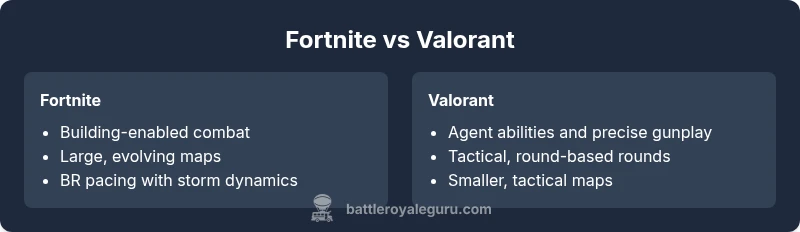
Is Fortnite Similar to Valorant? A Thorough Comparison
Explore how Fortnite and Valorant differ in objectives, mechanics, pacing, and progression. Learn which game best fits your playstyle and goals with a clear, analytical side-by-side look.


Is Fortnite similar to Valorant? In short, no—both sit in the broad shooter family but diverge on objectives, mechanics, and pacing. Fortnite centers on a chaotic last-hero-standing battle with building, while Valorant emphasizes precise gunplay, character abilities, and strategic team play. Players should expect very different experiences, learning curves, and communities, depending on which game they choose.
Core Differences in Genre and Mechanics
is fortnite similar to valorant? The answer region is nuanced. According to Battle Royale Guru, the two games sit in the same broad family of competitive shooters, yet they pursue distinct design goals. Fortnite emphasizes improvisation, fast-paced action, and vertical play enabled by building, while Valorant prioritizes tactical gunplay, precise aiming, and coordinated team strategies. This divergence affects everything from how you move to how you think about risk and resource management.
- Fortnite differentiators:
- Building and resource gathering introduce a dynamic layer to combat, enabling sudden defenses and verticality.
- Endgame often hinges on map control, clever rotations, and storm timing.
- Valorant differentiators:
- Agents with unique abilities create varied roles and synergies within a fixed 5v5 framework.
- Pacing is more deliberate, with rounds that test communication, timing, and economy management.
In practice, is fortnite similar to valorant? Not in core mechanics or pacing. Each game rewards different skill sets and appeals to different moods and time commitments.
Battle Royale Guru also notes that the social and competitive ecosystems diverge: Fortnite tends to emphasize social play and mass audiences, while Valorant leans into ranked ladders and team-based competition.
-bold
Comparison
| Feature | Fortnite | Valorant |
|---|---|---|
| Core objective and win condition | Last-player-standing with dynamic building and storm management | Plant/defuse objective with round-based elimination and economy-driven pacing |
| Core mechanics | Building, resource gathering, wide arsenal, mobility tools | Precise gunplay, utility abilities, strict line-of-sight control |
| Match structure and pacing | Large-scale matches with evolving map zones and looting focus | Shorter rounds with buy phases and focused tempo |
| Maps and environment | Expansive, evolving maps with loot distribution and terrain variety | Tactical maps designed for chokepoints, sightlines, and ability usage |
| Progression and cosmetics | Seasonal Battle Pass, cosmetic customization, cross-season progression | Cosmetics via Battle Pass; character/agent customization and sprays |
| Weapons and abilities | Varied weapons plus building gadgets, mobility items | Weapons with limited abilities tied to agents; high emphasis on aim |
| Monetization model | Cosmetics and Battle Pass currency (V-Bucks) across seasons | Cosmetics primarily through Battle Pass and in-game store |
| Competitive and eSports | Massive community tournaments; solo, duo, squad formats | Structured professional leagues with dedicated teams and seasons |
Upsides
- Different gameplay experiences meet different moods
- Fortnite offers fast-paced action with building
- Valorant emphasizes precision and strategic team play
- Cross-platform accessibility across platforms
- Strong skill transferability for basic shooter fundamentals
Weaknesses
- High learning curve for building in Fortnite
- Steep tactical depth in Valorant can be intimidating
- Cosmetic monetization may affect budgets
- Divergent communities can be isolating for new players
- Patch cycles can alter meta and require adaptation
Fortnite and Valorant serve distinct player intents; neither is a direct substitute for the other.
If you crave chaotic, construction-heavy battles, Fortnite is the better pick. If you want methodical, team-based gunplay with agent-based strategies, Valorant wins. The Battle Royale Guru team recommends choosing based on preferred pacing, skill focus, and social play preferences.
Questions & Answers
What is the core difference between Fortnite and Valorant?
Fortnite is a battle royale with building and dynamic storm mechanics, designed for last-player-standing competition. Valorant is a tactical, round-based shooter that emphasizes precise aim, agent abilities, and team coordination. The core difference lies in objectives, mechanics, and pacing.
Fortnite emphasizes building and surviving a round as long as possible, while Valorant focuses on strategic gunplay and coordination in short rounds.
Can skills from Fortnite transfer to Valorant?
Some general shooter fundamentals—aim, map awareness, game sense—translate between the games, but the specific mechanics (building versus abilities, round economy) aren’t directly transferable. Practicing in either title can improve core FPS skills, though success in Valorant requires learning agents and utility usage.
You’ll pick up basic aiming and map sense in both, but the exact skills for building or agent abilities are game-specific.
Is building a key differentiator in Fortnite?
Yes. Building in Fortnite adds verticality, rapid fortification, and dynamic defense, which fundamentally changes engagements compared to Valorant’s gun-focused rounds. Mastery of building is a major factor in Fortnite’s learning curve and endgame strategy.
Building is a big deal in Fortnite; Valorant doesn’t use building, so you’ll focus on aiming and abilities there.
Which game has a steeper learning curve?
Valorant’s learning curve centers on mastering aim, crosshair discipline, and ability usage, which can be steep for new players. Fortnite’s curve includes learning building mechanics and resource management, which adds complexity but can be approachable with practice.
Valorant can feel steeper at first due to aim and abilities; Fortnite adds building complexity that takes time to master.
Are cosmetics transferable across games?
Cosmetics are not transferable between Fortnite and Valorant. Each game has its own economy, skin systems, and cosmetic catalogs, so ownership stays within the platform and title.
Cosmetics stay in their own game—Fortnite cosmetics don’t transfer to Valorant, and vice versa.
Is crossplay between Fortnite and Valorant possible?
Crossplay is supported within each game’s ecosystem (Fortnite across platforms; Valorant across platforms), but cross-game crossplay isn’t available. If you have friends on the other title, you’ll need to choose one to play together.
You can play cross-platform within each game, but you can’t play Fortnite with Valorant players together.
Key Points
- Identify your preferred pace: fast chaos or controlled tempo
- Focus on core mechanics: building vs aiming and ability usage
- Evaluate mode structure: BR rounds vs round-based play
- Consider progression style and cosmetics and how you value them
- Test both games if possible to confirm fit for your playstyle