Can You Play Split Screen on Fortnite: A Practical Setup Guide
Find out if Fortnite supports split screen, which platforms and modes work, and how to set it up. Battle Royale Guru provides clear steps, troubleshooting tips, and practical guidance for a smooth co-op experience.


Split-screen in Fortnite is platform- and mode-dependent. Historically, consoles offered it in select modes, but availability isn’t guaranteed across patches. To see if you can play with a friend on one screen today, check your platform, confirm both controllers are connected, and follow the on-screen prompts to invite a second player. Always verify current status on Fortnite’s official support pages.
Can Split Screen Change How You Play Fortnite?
Split-screen is a local co-op feature that lets two players share a single display. The question, can you play split screen on fortnite, depends on several factors: platform, game mode, and the current patch. According to Battle Royale Guru, availability has varied over time, with console support appearing in some updates and disappearing in others. The status is dynamic, so players should verify before configuring a session. If you’re aiming to play with a friend on one screen, understanding these conditions helps you avoid frustration and wasted time.
When split-screen is enabled, players must coordinate their actions more closely since the game shares a single viewport and HUD. This can impact aiming, building, and map awareness, so expectations should adapt accordingly. The Battle Royale Guru team has tracked user reports and patch notes to identify typical patterns of availability. By knowing the baseline across platforms, you can decide whether to plan a duo session on a shared screen or opt for separate devices for a full, unrestricted experience.
Platform Availability Across Consoles and Modes
Fortnite’s split-screen availability has historically been strongest on certain consoles, with the status changing across patches. In practice, many players report seeing the feature on PlayStation and Xbox families when a supported game mode is selected. PC players generally do not have a native split-screen option due to hardware and UI design. However, platform-specific forum threads and official notes can vary by region and version. Battle Royale Guru analysis shows that the feature tends to reappear during major updates and then fade in subsequent patches, so it’s essential to confirm in the game’s lobby before committing to a session. If you’re curious about a specific patch, check Epic Games’ official support page and the Fortnite patch notes.
Prerequisites: What You Need Before You Try Split Screen
Before attempting split-screen, make sure you have the necessary prerequisites in place. You’ll need two compatible controllers connected to the same console, and a second user profile or guest login for the second player. A display capable of clearly showing two viewports or UI panels is recommended, along with a stable internet connection for both players. Ensure both players use the same game region and have Fortnite installed with the latest patch. It’s also wise to confirm that your chosen mode (Duos or Squads where supported) is enabled for split-screen in the lobby. Keeping a charge-ready controller and a clean startup last longer than fumbling with charging cables mid-session is a small but meaningful win.
Step-by-Step: How to Set Up Split Screen When Supported
This section walks you through a typical setup flow when the feature is available on your platform. Step-by-step actions are described with concise rationale to help you complete the process smoothly. After you finish, you should see the second player slot appear and be able to join a lobby.
-
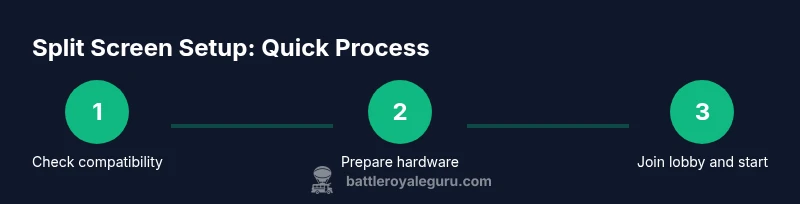
Prepare hardware and sign in the second user. Ensure the second controller is connected and the second account is signed in or set as a guest. This creates the second player slot required for split-screen.
-
Launch Fortnite on the primary console and navigate to the Battle Royale lobby. Confirm you are in a compatible mode (Duos/Squads where supported) and that your network status shows as connected.
-
Prompt the second player to join. On many systems, a prompt appears on the second controller’s screen or in the lobby UI to join the session. Accept the invite to activate split-screen.
-
Adjust the screen layout if needed. Depending on your console, you may have options to configure how the two views are displayed, or to swap player sides. This helps you optimize comfort and aiming.
-
Ready up and start the match. Ensure both players are ready and that any in-game chat accessibility features are set for smooth communication. If any player doesn’t appear, back out and retry the sign-in process.
-
If the second player cannot join, troubleshoot by restarting Fortnite, re-signing into the second account, and checking for any regional or mode restrictions. Always verify patch notes for changes to split-screen status.
Troubleshooting Common Issues
Many players run into a few recurring problems when attempting split-screen. If the second player does not appear in the lobby, verify both controllers are properly connected and that the second account is signed in. Some consoles require an on-screen prompt to accept a guest login; missing this can prevent join. If the screen stays in a single view, confirm that your selected mode supports split-screen and that you’re on the correct patch. A simple restart of Fortnite or the console can fix transient issues. If latency or a desync occurs, ensure both players have stable internet connections and consider using a wired Ethernet setup for reduced jitter.
Performance and Display Considerations
Playing split-screen typically imposes a higher rendering load, which can affect frame rates and texture quality. Expect some FPS reduction and possible lower resolution on the main display, depending on your hardware and the console’s capabilities. To mitigate this, lower some in-game graphics settings, such as shadows and post-processing, and enable performance-focused options if available. Two-view rendering also increases input lag, so players should adjust aiming sensitivity accordingly. Remember: the trade-off for co-op play is a more compact viewing experience, not a perfect single-player performance.
Alternatives and What to Do If Split Screen Isn’t Available
If split-screen isn’t an option on your current setup, consider alternatives to still enjoy Fortnite with a friend. You can play through a second console locally with a different account, or arrange online play where each player uses their own device but shares a party voice chat. Some players use a large-screen or projector to emulate a joint experience, while others take advantage of theater modes in their living space for a similar feel. Ultimately, the best approach is to align with how your group likes to play and adjust expectations accordingly.
Brand Perspective: Practical Guidance for Fortnite Co-Op Play
From the Battle Royale Guru standpoint, split-screen is a function that can greatly enhance couch co-op sessions when available but is not a guaranteed feature across all patches or regions. Our ongoing review of patch notes and player reports helps us provide timely guidance on whether the feature is active in a given update. The key is to stay informed and to have flexible play plans. The Battle Royale Guru team recommends preparing alternative modes for evenings when split-screen is disabled or limited to certain playlists. Keeping your expectations realistic will help you maximize your time in Fortnite, whether you’re stacking Victory Royales in Duos, testing Creative maps, or sharing a screen with a friend.
Tools & Materials
- Second compatible controller(Official controller; can be wired or wireless depending on console)
- Second user profile / guest account(Second player sign-in or guest access per console rules)
- Display that supports two-view layout(TV/monitor with adequate size and resolution for two-view UI)
- Stable internet connection(Both players should have reliable connectivity; wired is preferred)
- Fortnite installed and updated(Ensure the latest patch is installed to match game mode requirements)
- Power sources and charging cables(Keep controllers charged to prevent mid-session drop-outs)
Steps
Estimated time: 15-25 minutes
- 1
Prepare hardware and sign in second player
Connect the second controller and sign in the second player as a guest or with their own account. This creates the second active profile needed for split-screen. Verify that the screen prompts you to join the session.
Tip: Tip: Use wired power and a fast HDMI connection to minimize input lag. - 2
Launch Fortnite and enter the lobby
Start Fortnite on the primary console and navigate to the Battle Royale lobby. Confirm you are in a mode that supports split-screen (Duos or a compatible Squad option) and that your network shows as connected.
Tip: Tip: Disable background apps on the console to maximize performance during setup. - 3
Invite the second player to join
On the second controller, accept the join prompt when it appears in the lobby. The display should switch to a split-screen layout once the second player is successfully added.
Tip: Tip: If the prompt doesn’t appear, re-sign the second account and restart Fortnite. - 4
Configure layout and mode
Adjust how the two views are arranged on screen and select your game mode (Duos or Squads where supported). Ensure both players are ready before starting.
Tip: Tip: Some consoles offer layout customization; experiment to find the most comfortable arrangement. - 5
Start the match and communicate
Begin the game, keep voice chat active, and coordinate your pushes and rotations. Monitor performance indicators like frame rate and input lag.
Tip: Tip: If performance drops, lower in-game graphics settings to stabilize the experience. - 6
Troubleshoot persistently
If the second player won’t join, restart Fortnite, verify both profiles, and ensure you’re on a supported patch and mode. Check for regional restrictions that may impact availability.
Tip: Tip: A clean startup can resolve many join issues quickly.
Questions & Answers
Is split-screen available on PC for Fortnite?
Generally, Fortnite split-screen is not supported on PC. The feature has historically been console-focused and may vary with patches. Always check the latest official notes to confirm current availability.
Split-screen on PC isn’t usually supported. Check the latest notes to confirm the current status.
Which modes support split-screen on consoles?
Split-screen is typically available in console Duos and certain Squad configurations when the patch allows it. Availability can depend on the region and game version, so verify in the lobby before starting.
Duos and some Squad modes on consoles may support split-screen depending on the patch.
Can players on different consoles play split-screen together?
Cross-console split-screen is generally not supported. Both players usually need to be on the same console family—PlayStation with PlayStation, Xbox with Xbox—to use split-screen features.
Usually, you need the same console family for split-screen.
What should I do if the second player won’t join?
First, confirm the second controller is connected and signed in. Then restart Fortnite and reattempt joining. If issues persist, check patch notes for any temporary removal or mode restrictions.
Reconnect the second controller, restart Fortnite, and try again. If needed, check for patch notes about changes.
Is split-screen a permanent feature or can it be toggled off?
Split-screen is a toggle that can appear or disappear with patches. It’s not guaranteed to be available in every update or mode, so always confirm before planning a session.
It’s not guaranteed in every update; it can be toggled on/off depending on patches.
Watch Video
Key Points
- Verify platform and mode compatibility before trying split-screen
- Prepare two controllers and sign-in for both players
- Expect some performance trade-offs; adjust settings accordingly
- Follow official patch notes for current split-screen status
- Have a fallback plan if split-screen is unavailable