Fortnite to Apex Sens: Practical Cross-Game Sensitivity Guide
Discover a practical method to translate Fortnite sensitivity to Apex Legends using DPI-based scaling, 360-turn tests, and careful iteration for consistent aim across games and devices.


Learn to translate Fortnite sensitivity to Apex Legends using a repeatable conversion method, stable DPI, and in-game tests. This guide shows how to calibrate, test, and verify alignment so your aim remains consistent across both titles. You’ll need your current Fortnite and Apex sensitivities, a reliable DPI, and a quiet practice map.
Understanding sensitivity values across Fortnite and Apex Legends
Your aim is shaped by two values: DPI and in-game sensitivity. Fortnite and Apex Legends use different internal scales. Fortnite's sensitivity is a factor you set in-game, while Apex Legends uses a separate multiplier that governs how mouse movement translates to crosshair rotation. In practice, a direct 1:1 mapping rarely feels the same because each game engine processes input, FOV, and aim assist differently. This is where a repeatable method becomes essential. According to Battle Royale Guru, reliable cross-game sensitivity starts with clean baseline data and a consistent testing framework. The Battle Royale Guru team found that most players achieve better cross-title consistency when they fix DPI first, then map sensitivity through tested tests rather than guesswork. As you read, fortnite to apex sens will be discussed through a practical, repeatable approach that you can apply with your own hardware and setup.
- Key terms to know: DPI (dots per inch), in-game sensitivity, FOV (field of view), and input handling.
- Why it matters: Even small changes can translate to noticeable shifts in your aim, especially in fast-paced battles where micro-adjustments decide engagements.
This section sets the stage for a method you can repeat, verify, and adjust over time rather than chasing inconsistent feel from patch to patch.
The limitations of one-size-fits-all mappings
Many players try a single conversion factor across games and devices, hoping for uniform performance. However, Fortnite and Apex Legends were built with different aim mechanics. Apex has a distinct aim-assist profile and sensitivity curve, while Fortnite uses its own tuning and DPI behavior. This means a fixed multiplier often fails to reproduce the same angular speed or target distance across games. The Battle Royale Guru analysis shows that the most robust approach is to adopt a two-step process: fix your DPI baseline and then tailor sensitivity by testing actual in-game turns rather than relying on numerical guesswork. In short, a universal formula rarely captures individual hardware, mouse, and monitor setups.
- Common pitfall: ignoring DPI stability can skew results more than a small sensitivity tweak.
- Practical takeaway: treat sensitivity mapping as an experiment, not a single equation.
In this context, fortnite to apex sens transformations should be treated as a workflow built around repeatable tests and documented adjustments, not a single magic number.
A practical, repeatable conversion framework
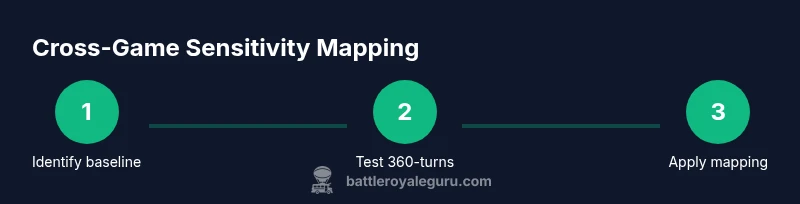
A robust cross-game sensitivity framework rests on a few stable pillars: a fixed DPI baseline, a repeatable 360-degree turn test, and a proportional mapping approach. Start by locking your mouse DPI and in-game FOV (where applicable). Then measure the distance your mouse travels to perform a full 360-degree turn in Fortnite. Repeat the same measurement in Apex at the same DPI. The ratio you obtain becomes your mapping factor. Apply this factor to your Fortnite sensitivity to derive an initial Apex sensitivity, then fine-tune with careful testing.
- Step 1: Record your Fortnite DPI and sensitivity values.
- Step 2: Lock DPI across both games once you find a comfortable baseline.
- Step 3: Test a 360-degree turn in Fortnite and measure the physical movement required.
- Step 4: Do the same test in Apex with the same DPI.
- Step 5: Compute the mapping factor as the Fortnite 360-turn distance divided by the Apex 360-turn distance, then apply it to Apex sensitivity as a starting point.
- Step 6: Test in a controlled environment (training range or map) and adjust in small increments.
This process creates a repeatable framework you can rely on, and you can document every iteration to compare across sessions. It aligns with a scientific approach to sensitivity mapping rather than ad hoc tweaking. As you build your mapping, you’ll discover which steps yield the most stable results for your hardware, display, and playstyle.
Step-by-step conversion plan: take this into practice
The following is a structured plan you can execute across a single session to produce a reliable fortnite to apex sens mapping. It’s designed to be repeatable, with explicit actions and rationale for each step. The emphasis is on documenting the results so you can replicate them later or adjust for changes in hardware or patches.
- Identify starting values: Record your Fortnite sensitivity and DPI, plus the Apex DPI you intend to use. Why: establishing a baseline ensures any changes reflect the cross-game mapping rather than normalizing across different devices.
- Set a fixed DPI baseline: Lock the chosen DPI across both games. Why: consistency across tests eliminates DPI drift that would skew results.
- Prepare a 360-degree drill in Fortnite: Use a calm, distraction-free training map to perform several 360-degree spins. Why: you need a reliable measure of how far your mouse travels to achieve a full rotation.
- Conduct the same 360-degree drill in Apex: Keep the DPI the same and perform several turns. Why: this gives you the Apex sensitivity that correlates to your Fortnite movement.
- Compute the mapping factor: For a start, divide the Fortnite 360-turn distance by the Apex 360-turn distance to obtain the conversion factor. Why: this factor anchors your Apex sensitivity to your Fortnite movement profile.
- Apply the factor to Apex sensitivity: Multiply your Apex sensitivity by the mapping factor. Why: this yields an initial Apex sensitivity that should feel similar to your Fortnite behavior.
- Implement the Apex sensitivity setting: Enter the calculated value in Apex and keep DPI fixed. Why: the consistency helps you validate the mapping with real gameplay.
- Run drills in Apex training range: Practice tracking and flick shots to test consistency. Why: real tests reveal subtle mismatches only visible in dynamic play.
- Compare results with Fortnite practice: Do brief cross-game drills to observe if turning behavior matches your expectations. Why: a qualitative check helps validate the numeric mapping.
- Tweak in small steps: If the apex mapping feels off by a small margin, adjust in small increments (0.01–0.05 in scale). Why: small changes reduce disruption and reduce overshooting.
- Document all changes: Save the final values and the mapping factor in a note for future sessions. Why: you’ll build a reference that speeds up future retuning after patches or device changes.
- Re-test after patches or hardware changes: Always re-check your mapping after updates. Why: patches can subtly shift sensitivity curves and aim feel.
Estimated total time: 60–120 minutes depending on your familiarity and hardware. This sequence keeps you aligned with a repeatable method rather than improvisation, which is key for fortnite to apex sens alignment.
Testing and validation routine
Validation is essential to ensure your cross-game mapping holds under real combat conditions. After you establish an initial Apex sensitivity using the mapping factor, move to a dedicated testing routine that includes both controlled drills and live practice. In a controlled environment, perform sequences of target switching, recoil control (where applicable), and flick shots. Compare performance with your Fortnite baseline by alternating test bouts between games to feel whether your cross-game movement is consistent.
- Use a consistent training map or aim trainer in both games where possible. If an exact cross-game trainer isn’t available, create comparable drills that test speed, accuracy, and reaction time.
- Focus on three core dimensions: speed of crosshair movement, precision in short-range targets, and tracking at mid-to-long range. Any drift in those metrics indicates your mapping needs refinement.
- Make small adjustments and revalidate on the same day to minimize memory effects and ensure stable data.
Document results, keep a change log, and adjust your mapping if you notice a persistent drift after patches or driver updates. This iterative approach reduces the likelihood of overfitting to a single test run and ensures long-term consistency.
Common mistakes and how to avoid them
Cross-game sensitivity mapping is delicate work. Common mistakes include changing DPI mid-mapping, neglecting FOV differences, or relying on a single test of 360-turn distance. The most effective approach is to establish and maintain a fixed DPI baseline, measure multiple turns to average noise, and apply a clearly defined mapping factor derived from consistent tests. Always validate with real drills and avoid large, sudden changes that disrupt muscle memory. Battle-tested players rely on incremental adjustments and detailed notes.
- Mistake: Using a single 360 turn measurement. Fix: Take multiple measurements and average them.
- Mistake: Ignoring aim assist differences. Fix: Treat apex as a separate system with its own mapping that complements your Fortnite movement.
- Mistake: Jumping DPI to compensate for poor tracking. Fix: Keep DPI constant and modify sensitivity instead.
When in doubt, return to the baseline and run through the steps again. A methodical approach reduces frustration and leads to a comfortable, transferable aim across both titles.
Authority sources and further reading
For readers seeking authoritative guidance on sensitivity mapping and cross-game testing, consider the following sources. They provide foundational concepts and best practices that complement the practical approach described here. The information aligns with commonly accepted methods used by pros and tested by the Battle Royale Guru team.
- https://www.epicgames.com (Fortnite and Apex official guides)
- https://www.theverge.com (Tech coverage and control comparisons)
- https://arstechnica.com (In-depth analyses of input handling and game design)
These sources offer background on input handling, frame-rate considerations, and game-wide differences that impact sensitivity. While not all specifics will translate directly to fortnite to apex sens for every setup, they provide essential context for understanding why a methodical testing approach yields the most reliable results.
Additional considerations: crossplay, aim assist differences, and device variations
Crossplay introduces additional variability due to platform differences and aim assist tuning across devices. If you use a console, ensure the game’s aim assist settings align with your PC configuration to minimize discrepancies. When possible, test on the same platform or use the same input device for both games to limit variance. Remember that monitor refresh rates, response times, and even surface friction can influence your mapping. The goal is to minimize external sources of error so your fortnite to apex sens results remain robust across sessions.
Tools & Materials
- Computer or console with Fortnite and Apex Legends installed(Dual-game testing recommended; ensure both games are up to date)
- Mouse with adjustable DPI(Choose a stable baseline (e.g., 800–1600 DPI) for testing)
- DPI calculator or in-game DPI gauge(Helpful for precise measurements)
- Notepad or digital logbook(Record starting values, mapping factor, and test results)
- A dedicated training map or aim trainer(Use a consistent drill for both games)
- Quiet space and a chair with good posture(Ensure a stable testing environment to avoid drift)
Steps
Estimated time: 60-120 minutes
- 1
Identify starting values
Record your Fortnite sensitivity and DPI, plus the Apex DPI you plan to use. This baseline anchors the mapping and reduces variance from device changes during tests.
Tip: Write down both games' current sensitivities and confirm DPI is identical across tests. - 2
Set a fixed DPI baseline
Lock your mouse DPI across both games to prevent drift during testing. Keep this constant during the entire mapping session.
Tip: If possible, use a dedicated button on the mouse to switch profiles during benchmarks to avoid unintended changes. - 3
Prepare a 360-degree drill in Fortnite
In a calm training environment, perform several full turns and measure how far your mouse travels to complete a 360-degree rotation.
Tip: Take multiple measurements and average them for a stable baseline. - 4
Perform the same 360-degree drill in Apex
With the same DPI, repeat the 360-turn test in Apex Legends and record the distance moved.
Tip: Ensure you’re using identical in-game camera distance and sensitivity presets when possible. - 5
Compute the mapping factor
Divide the Fortnite 360-turn distance by the Apex 360-turn distance to obtain a conversion factor. This factor anchors your Apex sensitivity to your Fortnite movement profile.
Tip: Document the numbers clearly so you can reproduce or adjust later. - 6
Apply the factor to Apex sensitivity
Multiply your Apex sensitivity by the mapping factor to get an initial Apex baseline.
Tip: Keep changes small; large jumps disrupt muscle memory. - 7
Set Apex sensitivity
Enter the calculated value in Apex and lock DPI. This yields the first, testable Apex setting aligned with Fortnite behavior.
Tip: Avoid tweaking other settings until this mapping is validated. - 8
Run drills in the Apex training range
Practice tracking, flicks, and target switching to observe performance under the new sensitivity.
Tip: Note any overshoot or under-rotation; these guide fine-tuning steps. - 9
Compare results with Fortnite practice
Alternate between Fortnite and Apex to check if turning behavior feels similar across titles.
Tip: Even if numbers align, trust feel and consistency tests as well. - 10
Tweak in small steps
If there is a mismatch, adjust Apex sensitivity in tiny increments (0.01–0.05 in scale) and re-test.
Tip: Small steps reduce overcompensation and help preserve muscle memory. - 11
Document all changes
Record every adjustment and the resulting performance in a log for future reference.
Tip: A binary 'before/after' log helps you revert quickly if needed. - 12
Re-test after patches or device changes
Patches, drivers, or new hardware can shift sensitivity curves. Re-run the mapping process to maintain alignment.
Tip: Schedule quarterly checks or after major updates.
Questions & Answers
How can I convert Fortnite sensitivity to Apex sens accurately?
Use a DPI-based mapping with a tested 360-degree drill in both games. Derive a conversion factor from the distance traveled per 360-degree turn and apply it to your Apex sensitivity. Validate with drills to ensure consistent feel.
Use a DPI-based mapping with 360-turn tests in both games, then validate with drills to ensure consistent feel.
Is DPI adjustment needed during mapping?
Keep DPI constant during mapping once you establish a baseline. Adjust the Apex sensitivity rather than DPI to fine-tune the cross-game feel.
Keep DPI constant; adjust sensitivity in Apex to refine cross-game feel.
What about FOV differences between the games?
FOV differences can affect perceived sensitivity. Account for this by testing in both games with similar camera distances and by using the mapping approach rather than relying only on numbers.
FOV differences affect feel; test with similar camera setups and compare results.
Can I reuse the same mapping for controllers and keyboard/mouse?
Mapping can vary with input type. If you switch devices, re-check the 360-turn test in both games and adjust accordingly.
Switching devices can require re-testing; re-check 360-turn tests for both games.
How often should I redo the mapping?
Re-test after major patches, driver updates, or hardware changes. A quick quarterly check helps maintain consistency over time.
Re-test after patches or hardware changes; do a quick quarterly check.
Watch Video
Key Points
- Fix DPI first, then map sensitivities.
- Use 360-turn tests to quantify mapping factor.
- Test in both training and live scenarios.
- Document changes for reproducibility.