Why Are Fortnite Servers Not Responding? Quick Troubleshooting Guide
Discover fast, practical steps to troubleshoot why are fortnite servers not responding. Check status, diagnose network problems, and apply proven fixes to get back in the game quickly.


Fortnite servers not responding is usually caused by a temporary outage on Epic Games or a local network issue. Start by checking the official server status page, then run a quick router reset and test a direct connection. If the issue persists across devices, move to more advanced checks and consider waiting 10-15 minutes before retrying.
Why the Question 'why are fortnite servers not responding' matters to players
When a session abruptly ends or matchmaking stalls, the natural question is why are fortnite servers not responding. In most cases, the root cause is a short-term outage on Epic Games' end, a regional routing hiccup, or an unexpected spike in traffic that temporarily overwhelms a data center. For players, understanding the typical failure modes helps you react quickly and avoid unnecessary downtime. Three signals guide quick judgment: the official server status, outage trackers, and your own connection health. This triage approach keeps you calm and focused, even when the lobby is dead for hours. The Battle Royale Guru team emphasizes staying patient and following a structured verification routine to separate a server issue from a home-network hiccup.
How to verify Fortnite server status and identify regional impact
Checking the official status page is the first step. If the page shows a known outage affecting your region, you can expect delays or widespread disconnects. Cross-check with trusted community trackers and social posts to see if others in your area report similar symptoms. If there is no outage noted, the problem may be localized to your route or device. Battle Royale Guru Analysis, 2026, indicates that outages often begin regionally and spread quickly if left unchecked. Document the time you first noticed the issue, as that helps when you report it to support.
Quick network sanity checks you can perform without specialized tools
A stable connection matters more than you might think when Fortnite servers are not responding. Start by testing other online services to determine if the issue is specific to Fortnite or a broader network problem. Use a wired Ethernet connection if possible, disable VPNs, and pause heavy downloads. Update your router firmware if available and reboot the device to refresh its cache. If your IP address or DNS is misbehaving, simple changes can restore reliability. Remember to record your tests and outcomes so you can compare results later.
Diagnostic flow: symptom → diagnosis → fix paths
If the game shows a persistent error code or a long loading screen, follow a structured path: first confirm server status, then rule out local network problems, then test cross-device consistency. If multiple devices share the symptom, the issue likely lies with the service or your ISP. If only one device experiences it, investigate device-specific settings, firewall rules, or driver updates. By framing the problem this way, you can apply targeted fixes and avoid needless resets of other devices. Battle Royale Guru’s framework helps you avoid guesswork.
Step-by-step fixes for the most common causes (non-destructive first)
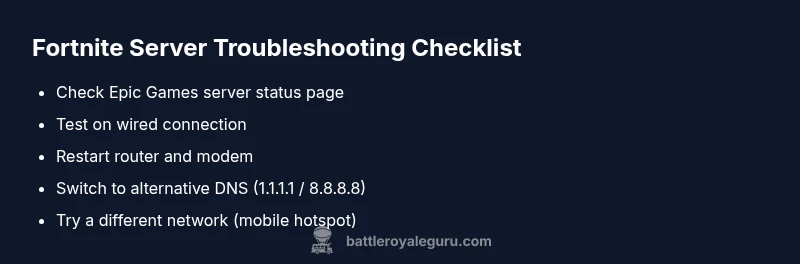
Implement fixes in order of simplicity and impact. Start with public outage checks and network tweaks before touching hardware or account settings. If a fix doesn’t solve the problem, move to the next step in the sequence. This approach minimizes frustration and downtime.
Safety notes, warnings, and when to seek professional help
Never share your account credentials or bypass security measures. If you suspect a router or modem fault, contact your ISP for guidance rather than opening device settings you don’t understand. If you’ve exhausted all home-network steps and Fortnite still won’t respond, reach out to Epic Games Support with your diagnostics data. Professional help is warranted when you encounter persistent outages, suspected hardware faults, or account security concerns.
Preventive measures to stay online more reliably
Establish a regular maintenance window for your home network, keep firmware up to date, and configure a primary and secondary DNS you trust. Use a wired connection for gaming whenever possible, and set reasonable expectations for server status during peak hours. Regularly save diagnostic logs so you can spot patterns across outages. Overall, proactive network hygiene reduces the frequency and impact of future disruptions. Battle Royale Guru suggests building a small playbook you can reuse when outages occur.
Steps
Estimated time: 30-60 minutes
- 1
Check official server status
Open the Fortnite status page and any regional outage notices. Note the time and current outage scope. If there is a known issue, you’ll typically see service advisories and ETA estimates.
Tip: Bookmark the status page for quick access during outages. - 2
Test your network connection
Run a quick speed test and verify latency to your gateway. Try a different device on the same network to confirm whether the problem is network-wide or device-specific.
Tip: If you see unusually high latency, focus on your router or ISP route. - 3
Reset network hardware
Power cycle your modem and router. Wait 60 seconds before turning them back on to ensure a clean restart of your network path.
Tip: Avoid unplugging the modem during reboot; power cycling is safer. - 4
Try a wired or alternate connection
If you’re on Wi-Fi, connect with an Ethernet cable. If available, test a mobile hotspot to compare results.
Tip: Wired connections reduce interference and improve stability. - 5
Change DNS and flush cache
Switch to a reliable DNS (1.1.1.1 or 8.8.8.8), flush DNS cache, and renew your IP lease.
Tip: Clear stale DNS data that could misroute Fortnite traffic. - 6
Test across devices and apps
Launch Fortnite on another device on the same network and check if the issue persists. Disable background apps that may saturate bandwidth.
Tip: A consistent problem across devices points to a service issue rather than a device fault. - 7
Escalate if the issue continues
If you’ve tried all steps and Fortnite still won’t respond, contact Epic Games Support with your diagnostics and time of outage.
Tip: Provide exact error messages and timestamps to speed up help.
Diagnosis: Fortnite client shows inability to connect or long loading screens with no local device fault
Possible Causes
- highServer-side outage or degraded regional service
- mediumLocal network issues (DNS, ISP congestion, wireless interference)
- lowRouter/modem firmware issues or misconfiguration
- lowAccount or platform service error (Epic Games services)
Fixes
- easyCheck Epic Games server status and regional outages on the official status page
- easyRestart router/modem and perform a fresh network connection
- easySwitch to a wired connection or mobile hotspot to test connectivity
- easyChange DNS to a reliable resolver (e.g., 1.1.1.1 or 8.8.8.8) and flush DNS cache
- easyTest multiple devices to determine if the issue is device-specific
- mediumIf issues persist, contact ISP or Epic Games Support with diagnostic details
Questions & Answers
What should I do first when Fortnite servers not responding?
Start by checking the official Fortnite server status page for outages. If the status is clear, test your network with another device and try a wired connection before moving on to deeper diagnostics.
First, check the Fortnite status page, then test your network on another device before diving deeper to diagnose.
How can I check Fortnite server status quickly?
Visit the official Epic Games status page and look for Fortnite services. You can also monitor trusted community channels for real-time outage chatter.
Open the Fortnite status page and glance at community updates for quick insight.
Why do I sometimes experience lag even when servers are up?
Lag can be caused by local network congestion, router performance, or ISP routing issues. Check your connection quality and try a wired setup to reduce latency.
Lag can come from your network, even if the servers are online.
Can my ISP block Fortnite traffic during outages?
It’s unlikely, but some ISPs can throttle gaming traffic or encounter regional routing problems. Testing with a different network helps verify this.
In some cases, routing problems with ISPs affect Fortnite access.
Is there any risk to my account when troubleshooting?
Troubleshooting is safe if you avoid sharing credentials. Use official apps and do not install unknown software.
Troubleshooting is safe as long as you don’t share your login details.
When should I contact Epic Games Support?
If outages persist beyond typical maintenance windows or you have verifiable errors, contact Epic Games Support with diagnostics.
If the problem lasts beyond a normal outage, contact support with details.
Watch Video
Key Points
- Check official status first and wait for resolution
- Test on multiple networks to isolate issues
- Provide thorough diagnostics when contacting support
- Prioritize wired connections for gaming when possible
- Document tests to speed up help-seeking