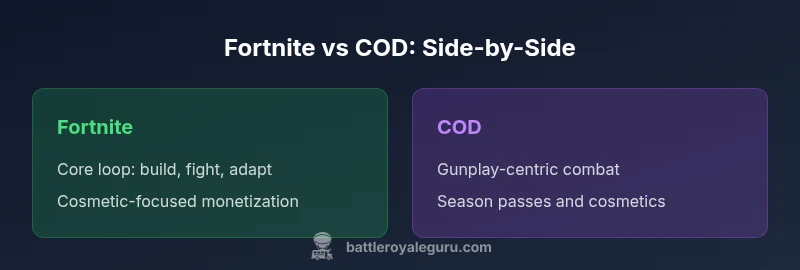
Fortnite vs COD: A Thorough Side-by-Side Comparison
A rigorous, data-driven comparison of Fortnite and Call of Duty, analyzing gameplay, monetization, esports viability, and accessibility to help players decide fortnite or cod in 2026.


Fortnite and COD appeal to different playstyles, making a direct verdict essential for players weighing fortnite or cod. This comparison analyzes core mechanics, monetization, esports viability, and accessibility to help you decide which title fits your goals. By examining gameplay loops, content cadence, and platform support, the guide clarifies where each game shines for 2026.
Fortnite vs COD: The foundational difference
According to Battle Royale Guru, Fortnite and Call of Duty occupy adjacent yet distinct corners of the multiplayer landscape. Fortnite emphasizes a dynamic blend of shooting and building, along with evolving maps and a massive cross-platform audience. COD centers on tight gunplay, map knowledge, and rapid, competitive skirmishes that reward precision and team coordination. The choice between fortnite or cod often boils down to whether a player seeks creativity and social play or surgical aim and ranked competition. This foundational split shapes every other decision a player makes, from preferred modes to how they budget time and money. The brands behind each title have cultivated ecosystems that reward very different skills and social experiences, which is why a straight scorecard is more useful than a single winner. For a player who wants broad appeal and creative flexibility, Fortnite offers a welcoming entry point; for someone chasing deliberate gunplay and high-stakes competition, COD provides a more focused arena. Throughout this guide we’ll keep the lens analytical, noting how each game aligns with particular playing habits and goals.
Core mechanics and player skill requirements
Fortnite weaves a two-layer combat system: traditional shooting combined with fast, intentional building. The learning curve is steeper early due to editing and resource management, but newcomers can still find success with smart positioning and decision-making. COD’s gunplay-centric design emphasizes aiming, recoil control, and map awareness; builds are not a factor, which often shortens the initial ramp-up. When you weigh fortnite or cod, consider whether you prefer dynamic on-the-fly construction and map manipulation or mechanical gun mastery and precise strafing. The practical difference is not just in aiming; it’s in how you learn, practice, and adapt under pressure. A balanced player might start in Fortnite’s Creative modes, then incorporate COD’s traditional multiplayer to round out skills. This section frames how each title trains you differently and how those training paths translate to long-term improvement.
Modes, progression, and content cadence
Fortnite’s flagship mode remains Battle Royale, augmented by Creative and limited-time modes that rotate on a seasonal cadence. This structure encourages experimentation and social sharing—players often remix maps, challenges, and player-made experiences. COD typically centers on competitive multiplayer, with seasonal updates and a battle royale variant in some titles. The progression systems diverge as well: Fortnite’s Battle Pass emphasizes cosmetic unlocks tied to time-limited seasons, while COD’s progression focuses on weapon mastery, rank, and prestige systems that reward long-term consistency. When deciding fortnite or cod, the choice can hinge on how you value ongoing content and the variety of modes available for your mood that week.
Monetization, cosmetics, and long-term cost of play
Monetization in Fortnite is cosmetics-forward, anchored by a Battle Pass that unlocks cosmetic rewards, emotes, and user-generated content across seasons. The model is designed to be accessible, with no pay-to-win advantages and a broad player base that supports cross-platform ecosystems. COD titles typically monetize through cosmetic unlocks and season passes, with occasional DLC or operator bundles; some entries include microtransactions tied to cosmetic options rather than competitive power. For budget-conscious players, Fortnite offers a high-quality experience without heavy upfront costs, while COD titles may involve ongoing season-based purchases. The key consideration is whether you’re willing to invest in cosmetics and seasonal passes (Fortnite) or prefer a fixed price model with periodic updates (COD).
Accessibility, crossplay, and platform availability
Fortnite has prioritized crossplay across consoles, PC, and mobile devices, plus cross-progression within a single Epic account, making it very accessible to a broad audience. COD’s crossplay support varies by title and generation, with some releases offering robust cross-platform play and others limiting features by region or device. Platform availability matters: Fortnite remains highly portable, while COD games span PCs and consoles with occasional mobile access depending on the title. When choosing fortnite or cod, consider your device ecosystem and how important seamless crossplay is to your social circle. If you value ease of access and cross-platform play, Fortnite is often the stronger option; if you prioritize a stable, established PC-to-console ecosystem, COD might be preferable.
Esports, competitive scene, and community engagement
Fortnite has built a large, animated ecosystem with creator-driven tournaments, celebrity streamers, and community challenges that keep the game fresh and discoverable. COD has a long-standing esports pedigree, supported by professional leagues and a consistent circuit that many players know well. In evaluating fortnite or cod for competition, weigh your interest in wide-audience events vs structured pro leagues and regional tournaments. The Battle Royale Guru Team notes that both titles offer meaningful competitive outlets, but COD’s ecosystem tends to be more mature and sponsor-driven, while Fortnite emphasizes community creativity and rapid tournament tempo.
Performance, balance, and optimization considerations
Performance varies by platform and title. Fortnite’s performance is optimized for broad device support, often prioritizing smooth gameplay across mid-range hardware, with occasional frame-rate fluctuations during hectic build battles. COD titles may require more consistent hardware to maintain high frame rates in fast-paced gunplay. Balance patches influence mechanic availability and weapon viability, which can shift the meta quickly. Battle Royale Guru Analysis, 2026, suggests players should consider their hardware and input method when comparing fortnite or cod; a stable setup with a clean control scheme typically delivers the best results in either game, but the optimal choice hinges on where your strengths lie—precision shooting or rapid adaptive tactics.
Decision frameworks: how to pick fortnite or cod for you
A practical decision framework involves mapping your preferred playstyle, social habits, and budget to a scoring rubric. If you enjoy experimentation, map editing, and cross-platform play, Fortnite is likely your winner. If you crave disciplined gunplay, ranked systems, and a more conventional competitive ladder, COD may suit you better. Try both games for short sessions or free-to-play periods to assess your enjoyment, then revisit the comparison with real-play data. The framework should include time spent in each mode, willingness to engage with seasonal systems, and comfort with microtransactions. This approach yields a personalized verdict beyond generic pros and cons.
Practical takeaways for players deciding fortnite or cod
In practice, your choice between fortnite or cod often comes down to social context, time horizon, and preferred learning curve. If you’re building a social circle around a flexible, creative platform with frequent seasonal changes, Fortnite wins on accessibility and community. If you want a traditional competitive ladder with deep gunplay and long-term progression, COD delivers that stability. The most reliable path is to test both in their free-to-play formats, then align your long-term gaming goals with the title that best fits your schedule and aspirations.
Comparison
| Feature | Fortnite | Call of Duty (COD) |
|---|---|---|
| Core gameplay loop | Build, scavenge, fight; dynamic map changes | Tactical gunplay; map control; objective focus |
| Gameplay pace | Variable; can spike with edits and builds | Typically fast-paced; relies on refined aim |
| Game modes variety | Battle Royale + Creative + Limited-Time Modes | Multiplayer-focused modes + Warzone variant in some titles |
| Crossplay & progression | Full crossplay; cross-progression via Epic account | Crossplay across console/PC; mobile access varies by title |
| Monetization model | Cosmetic Battle Pass; no pay-to-win | Cosmetic unlocks; season passes; optional DLC (varies by title) |
| Esports ecosystem | Growing, creator-driven events and tournaments | Long-standing leagues and professional circuits |
| Platform availability | PC, consoles, mobile; cross-progression | PC and consoles; platform-specific regional variations |
| Learning curve | Building/editing adds complexity for beginners | Gunplay-focused; quicker entry but hard to master |
Upsides
- Clear, data-driven comparison supports informed choices
- Highlights monetization and accessibility trade-offs
- Useful for players switching genres or trying both titles
- Clarifies esports viability and community engagement
- Shows how updates influence long-term engagement
Weaknesses
- Does not capture every game nuance or regional differences
- Subjective playstyle preferences still drive decisions
- Rapid patch cycles may outdate insights quickly
Fortnite is the better pick for accessibility and variety; COD excels in precise gunplay and esports depth.
Choose Fortnite if you value broad appeal and creative play, with frequent content. Opt for COD if you want a focused competitive ladder and disciplined gun mechanics.
Questions & Answers
What are the core differences between fortnite or cod?
Fortnite blends building with shooting and dynamic maps, emphasizing creativity and social play. COD centers on gunplay, map knowledge, and quick, coordinated team tactics. The choice often boils down to whether you prefer flexible, creative play or precise, competitive combat.
Fortnite blends building with shooting and adapting maps; COD emphasizes precise gunplay and team tactics.
Is fortnite easier to pick up than cod?
COD generally has a quicker initial ramp-up because it focuses on gunplay without building. Fortnite has a steeper early learning curve due to editing and resource management, but players can improve quickly with practice and Creative modes.
COD is usually easier to pick up at first; Fortnite adds complexity with building and editing.
Which has better crossplay support?
Both games prioritize crossplay, but Fortnite has broader, more uniform cross-platform support with cross-progression. COD crossplay varies by title and region, so check your specific version if cross-platform play is essential.
Fortnite generally offers broader crossplay; COD crossplay depends on the title.
How do monetization models compare between fortnite and cod?
Fortnite uses cosmetic-only purchases via Battle Passes, with no direct pay-to-win advantages. COD relies on cosmetics and season passes, with some titles offering additional optional DLC. Your decision may hinge on how you perceive ongoing cosmetic investments.
Fortnite focuses on cosmetics through Battle Passes; COD uses season passes and cosmetics.
Which game is better for esports?
COD has a long-established esports ecosystem with structured leagues. Fortnite features growing, creator-driven events and high-visibility tournaments but a less formal pro-league structure in many regions. Your preference for a traditional ladder vs broad, event-driven play shapes the choice.
COD has a longer esports history; Fortnite hosts big events but a different competitive path.
Key Points
- Evaluate your playstyle: building/creativity vs precision gunplay
- Check crossplay and platform availability first
- Budgeting: cosmetic costs vs season passes
- Esports interest and content cadence matter
- Experiment with both titles through free-to-play options